

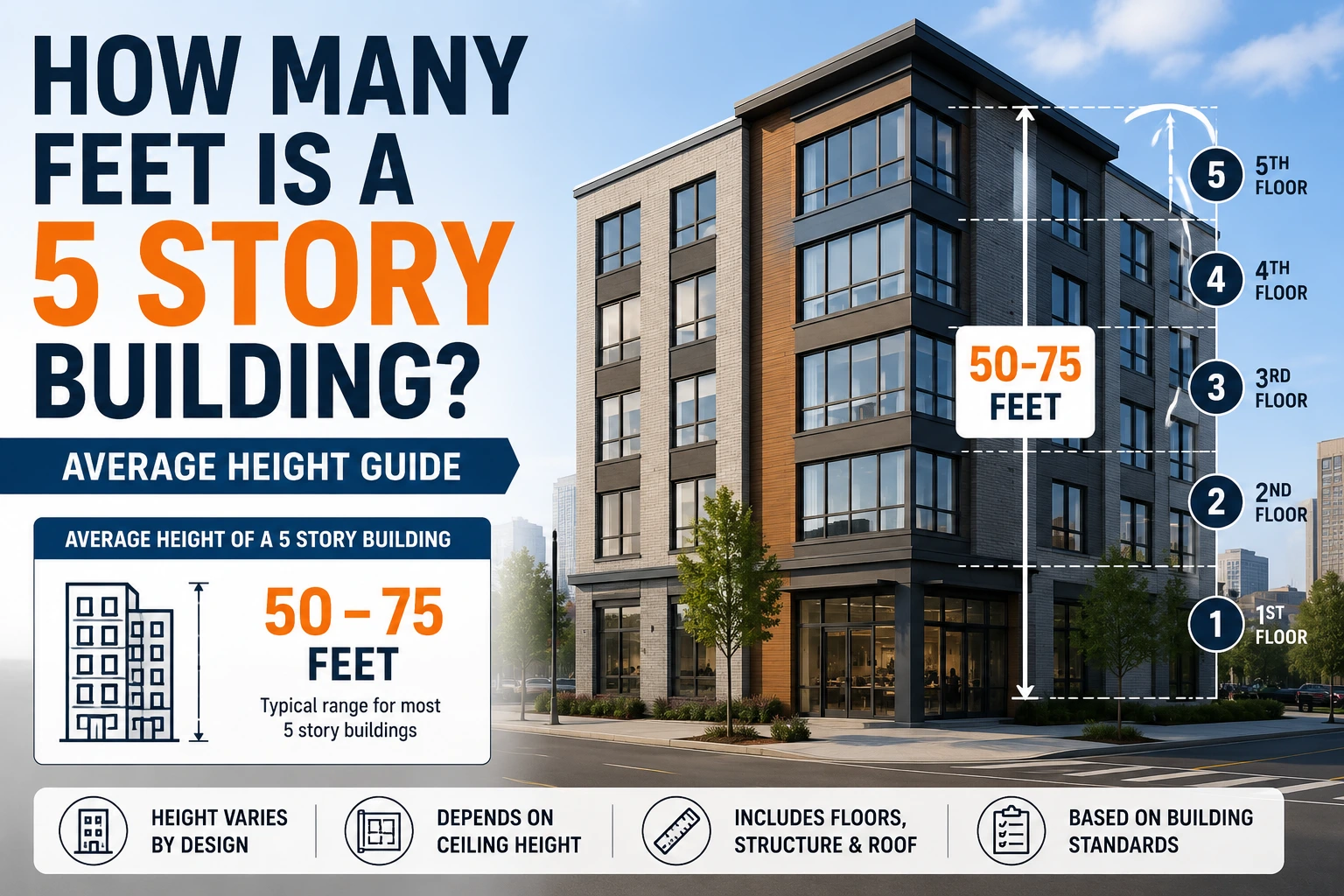
If you’ve ever looked at an apartment complex, hotel, office building, or condominium and wondered how many feet is a 5 story building, you’re not alone. This is a common question among homeowners, students, real estate professionals, and construction enthusiasts.
The short answer is that a typical 5-story building is usually between 50 and 75 feet tall. However, the exact height depends on the purpose of the building, ceiling heights, roof design, and local construction requirements.
In this guide, we’ll break down the average height of a 5-story building, explain why heights vary, provide practical examples, and show how professionals estimate building dimensions.
Understanding Building Stories and Height
Before calculating building height, it’s important to understand what a “story” means.
What Is a Story in Construction?
A story (or storey) is a level of a building that people can occupy.
For example:
- Single-story house = 1 floor
- Two-story house = 2 floors
- Apartment building = multiple stories
Each story includes:
- Floor structure
- Ceiling space
- Utilities
- Mechanical systems
The distance from one floor to the next is known as the floor-to-floor height.
Why Building Heights Vary
Not every story has the same height.
For example:
| Building Type | Typical Floor Height |
|---|---|
| Residential | 9–12 feet |
| Apartment Building | 10–12 feet |
| Office Building | 12–15 feet |
| Hotel | 10–12 feet |
| Retail Building | 14–20 feet |
This variation explains why two 5-story buildings can have very different overall heights.
How Many Feet Is a 5 Story Building?
Most construction professionals estimate that a 5-story building falls within the following range:
| Building Type | Average Height |
|---|---|
| Residential Apartment | 50–60 feet |
| Hotel | 55–65 feet |
| Office Building | 60–75 feet |
| Mixed-Use Building | 55–70 feet |
A common rule of thumb is:
One story = approximately 10 to 14 feet
For a typical residential structure:
5×10=50 feet
For a taller commercial structure:
5×14=70 feet
Therefore, most people can assume a 5-story building is approximately 50–70 feet tall.
Average Residential Building Height
Residential buildings generally have lower ceilings.
A typical 5-story apartment building may have:
- 9-foot ceilings
- Floor systems between levels
- Roof structure
Total height:
50–60 feet
Average Commercial Building Height
Commercial buildings often require:
- Higher ceilings
- HVAC equipment
- Larger utility spaces
Typical height:
60–75 feet
Standard Height of Each Story
The height of each floor greatly influences total building height.
Residential Floors
Residential buildings commonly use:
| Component | Height |
|---|---|
| Ceiling | 8–10 feet |
| Floor Structure | 1–2 feet |
| Utilities | 1 foot |
Total per story:
10–12 feet
Commercial Floors
Commercial buildings often include:
| Component | Height |
|---|---|
| Ceiling | 10–12 feet |
| Mechanical Space | 1–2 feet |
| Structural Systems | 1–2 feet |
Total per story:
12–15 feet
5 Story Building Height Chart
The following chart provides quick estimates.
| Height Per Story | Total Height |
|---|---|
| 10 feet | 50 feet |
| 11 feet | 55 feet |
| 12 feet | 60 feet |
| 13 feet | 65 feet |
| 14 feet | 70 feet |
| 15 feet | 75 feet |
This chart helps estimate building height without detailed blueprints.
Factors That Affect a 5 Story Building’s Height
Many factors influence how tall a building becomes.
Ceiling Heights
Luxury apartments often have higher ceilings.
Examples:
- Standard apartment: 8–9 feet
- Premium apartment: 10–12 feet
- Luxury penthouse: 12+ feet
Higher ceilings increase overall building height.
Roof Design
Flat roofs and pitched roofs create different total heights.
Roof features may include:
- Drainage systems
- Attic spaces
- Decorative architecture
- Mechanical equipment
Mechanical Systems
Modern buildings require space for:
- HVAC systems
- Electrical wiring
- Plumbing
- Fire suppression equipment
These systems add height between floors.
Building Codes
Local building regulations often influence:
- Minimum ceiling heights
- Fire safety requirements
- Accessibility standards
- Structural requirements
As a result, two similar buildings in different cities may have different heights.
Real-World Examples of 5 Story Buildings
Understanding real examples helps visualize the size of a 5-story structure.
Apartment Complex
A modern apartment building may measure:
- 11 feet per floor
- 5 floors
Total height:
55 feet
Office Building
An office building may measure:
- 13 feet per floor
- 5 floors
Total height:
65 feet
Hotel
A hotel often includes:
- Guest rooms
- Mechanical spaces
- Lobby with higher ceilings
Typical height:
60–70 feet
Comparing a 5 Story Building to Other Structures
Many people find height comparisons helpful.
| Structure | Approximate Height |
|---|---|
| One-story house | 10–15 feet |
| Two-story house | 20–30 feet |
| Three-story building | 30–45 feet |
| Five-story building | 50–75 feet |
| Ten-story building | 100–150 feet |
A 5-story building is typically about twice the height of a two-story house.
How to Estimate Building Height Quickly
If you don’t have access to building plans, use this simple method.
Step 1: Identify Building Type
Determine whether the building is:
- Residential
- Office
- Hotel
- Mixed-use
Step 2: Estimate Floor Height
Use:
- 10–12 feet for residential
- 12–15 feet for commercial
Step 3: Multiply by Number of Stories
For example:
5×12=60 feet
This provides a reasonable estimate.
Common Mistakes When Calculating Building Height
Many people underestimate building height because they focus only on ceiling measurements.
Ignoring Floor Thickness
Floor structures add significant height.
Forgetting Roof Structures
Roofs can add several feet to total height.
Assuming Every Story Is Identical
Ground floors often have taller ceilings than upper floors.
Confusing Ceiling Height With Story Height
A 9-foot ceiling does not mean the story is only 9 feet tall.
Structural components add additional height.
Practical Uses for Knowing Building Height
Knowing the height of a 5-story building can be useful in many situations.
Construction Planning
Builders use height calculations for:
- Structural design
- Material estimates
- Permit applications
Real Estate Evaluation
Investors often compare building sizes when assessing property value.
Safety Planning
Height affects:
- Fire safety systems
- Emergency access
- Evacuation planning
Educational Purposes
Students studying architecture or engineering frequently need height estimates.
Expert Tips for Height Estimation
Professionals use several techniques to improve accuracy.
Use Average Floor Heights
When exact data isn’t available, use:
- 10–12 feet for residential
- 12–15 feet for commercial
Consider Building Age
Older buildings may have different floor heights than modern structures.
Look for Mechanical Penthouses
Rooftop equipment often increases total building height.
Verify With Local Records
Property records and planning documents often list official building heights.
9. FAQs
How many feet tall is a typical 5 story building?
Most 5-story buildings are between 50 and 75 feet tall, depending on building type and floor heights.
Is a 5 story building always 50 feet tall?
No. While 50 feet is common for residential buildings, commercial structures can exceed 70 feet.
How tall is a 5 story apartment building?
Most apartment buildings with five stories are approximately 50–60 feet tall.
How many feet is each story in a building?
A typical story ranges from 10 to 15 feet, including floor structures and utilities.
How do architects calculate building height?
Architects calculate total height using floor-to-floor measurements, roof structures, and mechanical spaces rather than ceiling height alone.
10. Conclusion
If you’re wondering how many feet is a 5 story building, the answer typically falls between 50 and 75 feet, depending on the building’s design and purpose. Residential apartment buildings are usually closer to 50–60 feet, while office and commercial buildings often reach 60–75 feet due to taller floors and additional mechanical systems.
Understanding story height, ceiling dimensions, structural components, and building codes helps provide a more accurate estimate. Whether you’re involved in construction, real estate, architecture, or simply curious about building dimensions, knowing the average height of a 5-story building gives you a useful benchmark for comparing structures and estimating scale.
Discover more