

If you’ve ever ordered mulch, gravel, soil, or concrete, you’ve probably encountered the term cubic yard. A common question people ask is: how many feet is in a cubic yard?
The answer depends on whether you’re talking about length or volume. A cubic yard is a unit of volume, while a foot is usually a unit of length. Because they measure different things, you cannot directly convert a cubic yard into a single foot measurement.
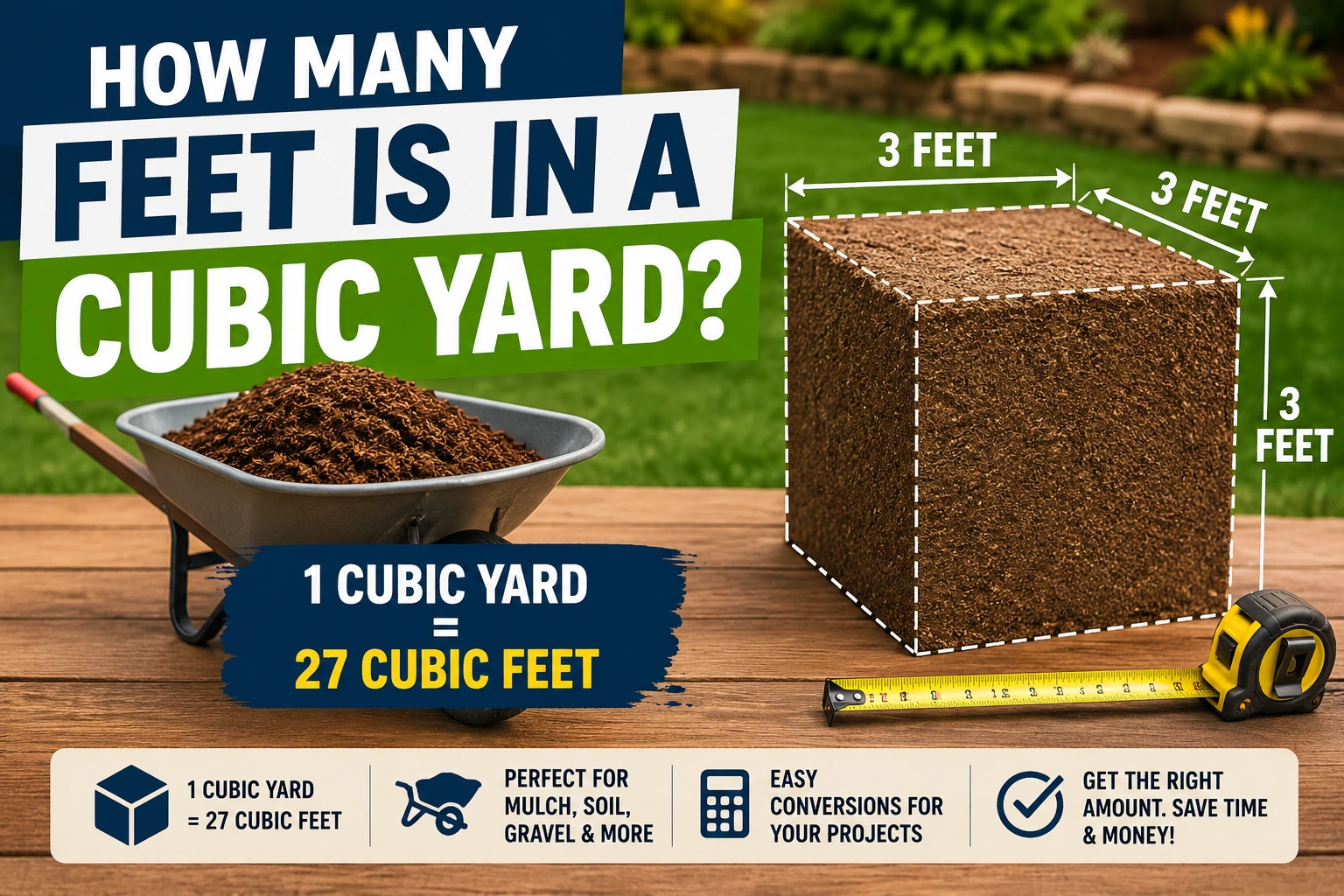
However, 1 cubic yard equals 27 cubic feet.
Understanding this conversion is important for landscaping projects, construction jobs, home improvements, and material estimates. In this guide, you’ll learn exactly how cubic yards and cubic feet relate, how to convert between them, and how to avoid common measurement mistakes.
Understanding the Difference Between Feet and Cubic Yards
Before converting measurements, it’s important to understand what each unit represents.
Foot (ft)
A foot is a unit of length.
Examples include:
- Height of a wall
- Length of a room
- Width of a driveway
One foot measures distance in a single direction.
Cubic Foot (ft³)
A cubic foot measures volume.
It represents a space that is:
- 1 foot long
- 1 foot wide
- 1 foot high
Volume measures the amount of three-dimensional space an object occupies.
Cubic Yard (yd³)
A cubic yard is also a unit of volume.
A cubic yard is a cube measuring:
- 3 feet long
- 3 feet wide
- 3 feet high
Because volume uses three dimensions, the conversion involves multiplying all three measurements together.
How Many Cubic Feet Are in a Cubic Yard?
The most accurate way to answer “how many feet is in a cubic yard” is to say:
There are 27 cubic feet in 1 cubic yard.
The Basic Formula
Since:
- 1 yard = 3 feet
A cubic yard equals:
3 ft × 3 ft × 3 ft
Step-by-Step Calculation
3 × 3 × 3 = 27
Therefore:
1 cubic yard = 27 cubic feet
This is the standard conversion used in construction, landscaping, and engineering projects.
Why a Cubic Yard Is Not the Same as a Foot
Many people mistakenly think a cubic yard can be converted directly into feet.
The confusion happens because:
- Feet measure length.
- Cubic yards measure volume.
Think of it this way:
If someone asks how much water fits inside a tank, you need a volume measurement.
If someone asks how long the tank is, you need a length measurement.
These measurements serve different purposes.
For example:
| Measurement | Type |
|---|---|
| Foot | Length |
| Square Foot | Area |
| Cubic Foot | Volume |
| Cubic Yard | Volume |
Because cubic yards measure volume, they convert to cubic feet rather than feet.
Cubic Yard to Cubic Feet Conversion Chart
The following table makes conversions quick and easy.
| Cubic Yards | Cubic Feet |
|---|---|
| 1 | 27 |
| 2 | 54 |
| 3 | 81 |
| 4 | 108 |
| 5 | 135 |
| 6 | 162 |
| 7 | 189 |
| 8 | 216 |
| 9 | 243 |
| 10 | 270 |
To convert cubic yards to cubic feet, simply multiply by 27.
Formula
Cubic Feet = Cubic Yards × 27
Common Examples of Cubic Yard Conversions
Let’s look at some practical examples.
1 Cubic Yard
1 × 27 = 27 cubic feet
Answer: 27 cubic feet
2 Cubic Yards
2 × 27 = 54 cubic feet
Answer: 54 cubic feet
5 Cubic Yards
5 × 27 = 135 cubic feet
Answer: 135 cubic feet
10 Cubic Yards
10 × 27 = 270 cubic feet
Answer: 270 cubic feet
These conversions are useful when estimating materials such as dirt, mulch, gravel, or concrete.
Real-World Uses of Cubic Yard Measurements
Cubic yards are commonly used whenever large amounts of material are involved.
Landscaping
Landscapers often purchase:
- Mulch
- Topsoil
- Compost
- Decorative stone
These materials are typically sold by the cubic yard.
For example:
A landscaping supplier may deliver 5 cubic yards of mulch to cover flower beds and garden areas.
Concrete Projects
Concrete companies usually sell ready-mix concrete by the cubic yard.
Examples include:
- Sidewalks
- Patios
- Foundations
- Driveways
Knowing the cubic yard requirement helps prevent ordering too much or too little concrete.
Soil and Mulch
Garden projects frequently require volume calculations.
A raised garden bed measuring:
- 9 feet long
- 3 feet wide
- 1 foot deep
Contains:
9 × 3 × 1 = 27 cubic feet
That’s exactly:
1 cubic yard of soil
Gravel and Stone
Driveways, pathways, and drainage projects often require gravel measured in cubic yards.
Converting between cubic feet and cubic yards helps determine:
- Material costs
- Delivery requirements
- Coverage area
How to Calculate Cubic Yards From Feet
Sometimes you know the dimensions in feet and need to calculate cubic yards.
Formula
First calculate cubic feet:
Length × Width × Height
Then divide by 27.
Formula
Cubic Yards = Cubic Feet ÷ 27
Example Calculation
Suppose a pile of soil measures:
- Length = 12 feet
- Width = 6 feet
- Depth = 3 feet
Step 1:
12 × 6 × 3 = 216 cubic feet
Step 2:
216 ÷ 27 = 8 cubic yards
Answer: 8 cubic yards
Visualizing a Cubic Yard
Many people struggle to imagine how large a cubic yard actually is.
Picture a box that is:
- 3 feet long
- 3 feet wide
- 3 feet tall
That’s one cubic yard.
Some everyday comparisons include:
- About the size of a standard washing machine
- Roughly the capacity of a large contractor’s wheelbarrow load repeated several times
- A common amount of mulch delivered for medium-sized landscaping projects
Visualizing the dimensions helps when planning deliveries and storage space.
Common Mistakes People Make
When converting cubic yards and feet, several errors occur frequently.
Confusing Feet With Cubic Feet
Feet measure length.
Cubic feet measure volume.
Always make sure you’re using the correct unit.
Forgetting the Cubic Conversion
Many people multiply by 3 instead of 27.
Remember:
A cubic yard involves three dimensions.
3 × 3 × 3 = 27
Mixing Area and Volume
Square feet and cubic feet are not interchangeable.
For example:
- Square feet measure surface area.
- Cubic feet measure volume.
Using the wrong measurement can result in inaccurate material estimates.
Ignoring Material Depth
Coverage calculations depend heavily on depth.
A cubic yard spread over a shallow area covers much more ground than a cubic yard spread deeply.
Always include depth when estimating materials.
Expert Tips for Accurate Material Estimates
Professionals use several techniques to avoid waste and extra costs.
Measure Twice
Verify all dimensions before placing an order.
Even small errors can affect volume significantly.
Order Slightly Extra
Many contractors add 5% to 10% extra material to account for:
- Compaction
- Spillage
- Uneven surfaces
Use Consistent Units
Convert all measurements to feet before calculating volume.
Mixing feet, inches, and yards often causes mistakes.
Understand Supplier Pricing
Most suppliers price materials by:
- Cubic yard
- Ton
- Truckload
Confirm which unit is being used before comparing quotes.
Check Material Density
Two materials can occupy the same volume but weigh very different amounts.
For example:
- Mulch
- Sand
- Gravel
- Topsoil
All have different densities.
Volume calculations remain the same, but transportation and costs may vary.
9. FAQs
1. How many cubic feet are in one cubic yard?
One cubic yard contains 27 cubic feet.
2. Can you convert a cubic yard directly to feet?
No. A cubic yard measures volume, while a foot measures length. The correct conversion is to cubic feet.
3. Why does a cubic yard equal 27 cubic feet?
Because one yard equals 3 feet, and volume requires three dimensions:
3 × 3 × 3 = 27 cubic feet.
4. How do I convert cubic feet to cubic yards?
Divide the number of cubic feet by 27.
Formula:
Cubic Yards = Cubic Feet ÷ 27
5. What materials are commonly sold by the cubic yard?
Common examples include:
- Mulch
- Topsoil
- Compost
- Gravel
- Sand
- Concrete
- Decorative stone
10. Conclusion
If you’re wondering how many feet is in a cubic yard, the key point is that a cubic yard is a unit of volume, not length. Therefore, the correct conversion is that 1 cubic yard equals 27 cubic feet.
This conversion is widely used in landscaping, construction, gardening, concrete work, and material estimation. Understanding the relationship between cubic yards and cubic feet helps you order the right amount of material, avoid costly mistakes, and complete projects more efficiently.
Whenever you need to convert between the two, remember the simple rule:
1 cubic yard = 27 cubic feet
And to convert cubic feet back to cubic yards, simply divide by 27. This straightforward calculation can save time, money, and frustration on virtually any project involving volume measurements.
Discover more