

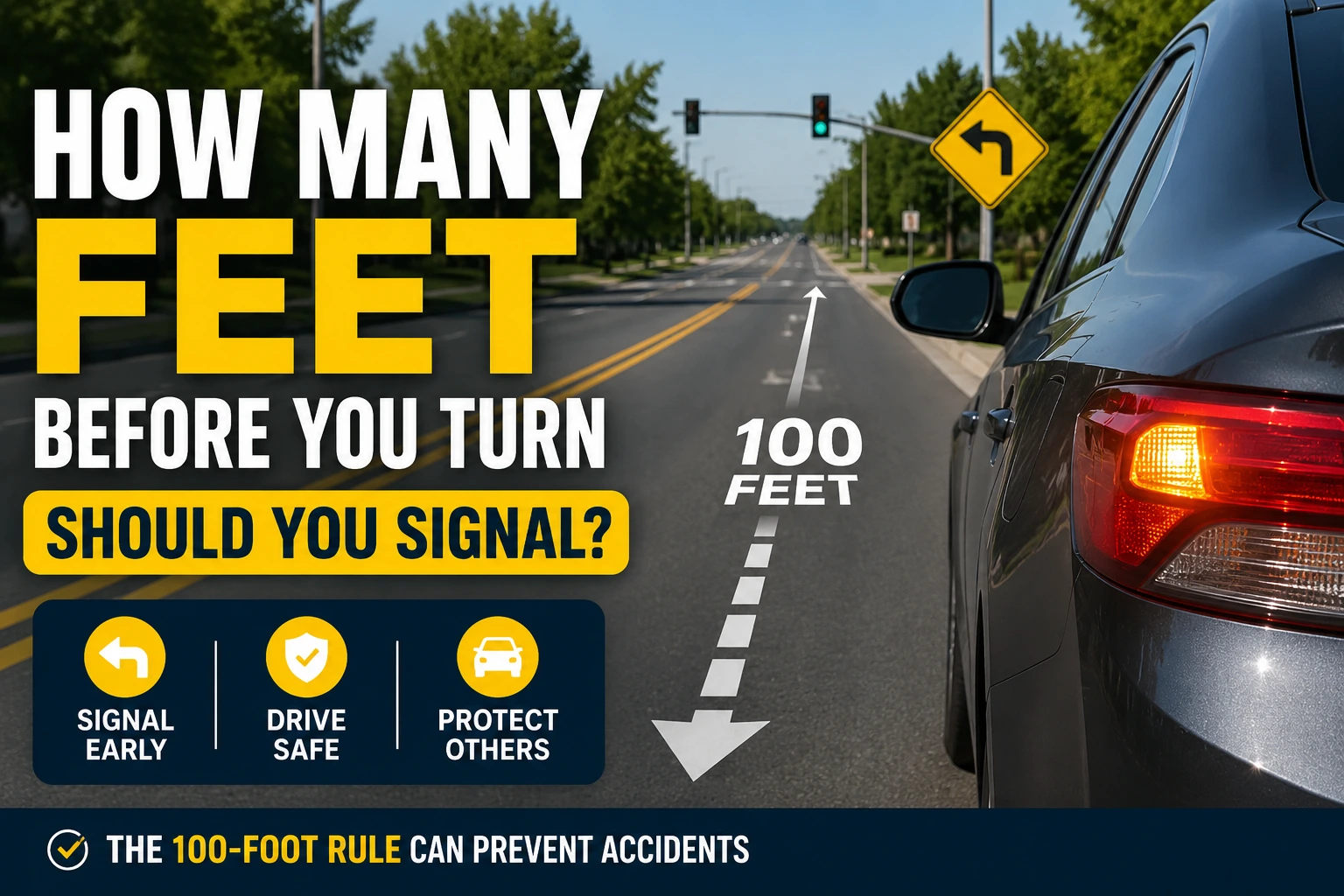
If you’ve ever studied for a driver’s license exam or wondered about proper road etiquette, you’ve probably asked yourself: how many feet before you turn should you signal?
The answer is simple in most situations: drivers should signal at least 100 feet before making a turn. This gives other drivers, cyclists, and pedestrians enough time to react to your intended movement.
Using turn signals is one of the most basic yet important driving habits. It reduces confusion, helps prevent collisions, and keeps traffic flowing smoothly. Whether you’re a new driver preparing for a road test or an experienced motorist reviewing safe driving practices, understanding signaling rules is essential.
In this guide, we’ll explain the 100-foot rule, discuss state law variations, explore common mistakes, and provide practical examples to help you become a safer driver.
Why Turn Signals Matter
Turn signals are one of the primary ways drivers communicate with others on the road.
Without signals, nearby drivers have to guess your intentions. This uncertainty can lead to sudden braking, unsafe lane changes, and accidents.
Benefits of Using Turn Signals
- Reduces crash risk
- Improves traffic flow
- Increases predictability
- Protects pedestrians and cyclists
- Helps drivers maintain safe following distances
- Demonstrates responsible driving behavior
A signal is essentially a warning that tells everyone around you what you plan to do next.
How Many Feet Before You Turn Should You Signal?
The generally accepted rule across most states is:
| Driving Action | Recommended Signal Distance |
|---|---|
| Turning left | At least 100 feet |
| Turning right | At least 100 feet |
| Entering a driveway | At least 100 feet |
| Leaving a parking area | Before entering traffic |
| Changing lanes | Several seconds before movement |
For most roads and intersections, 100 feet before the turn is considered the minimum safe and legal signaling distance.
This allows other road users enough time to:
- Notice your signal
- Understand your intention
- Adjust speed if necessary
- Change lanes safely
- Avoid unexpected movements
The 100-foot guideline is commonly taught in driver’s education courses and appears on many state driving exams.
Why Is the 100-Foot Rule Important?
The purpose of signaling early is reaction time.
Drivers need a few seconds to process information and respond appropriately.
Consider this example:
A vehicle traveling at 35 mph covers approximately 51 feet per second.
If you signal only 20 feet before turning, nearby drivers may have less than half a second to react. That’s often not enough time to safely adjust.
When you signal 100 feet before turning, others receive advance notice, reducing the likelihood of rear-end collisions or side-impact crashes.
Key Safety Advantages
- More reaction time
- Better visibility of intentions
- Reduced sudden braking
- Fewer intersection accidents
- Improved traffic coordination
State Laws and Variations
Although the 100-foot rule is widely used throughout the United States, traffic laws can vary by jurisdiction.
Many states specifically require drivers to signal continuously during the final 100 feet before turning.
Examples include:
- California
- Florida
- Texas
- Illinois
- Ohio
- New York
Some states may have slightly different wording in their vehicle codes, but the practical requirement remains similar.
Always Check Local Laws
Drivers should review their state’s driver’s handbook because:
- Requirements can change
- Certain roads may have unique regulations
- Commercial drivers may have additional rules
If you’re preparing for a driving test, study the rules specific to your location.
When Should You Signal for Different Driving Situations?
Different driving situations require slightly different signaling practices.
Turning at Intersections
When approaching an intersection:
- Check mirrors.
- Activate your turn signal at least 100 feet before the turn.
- Maintain the signal until the turn is completed.
- Cancel the signal if it does not automatically turn off.
This is the most common scenario covered on driving exams.
Turning Into a Driveway
Many drivers forget that driveways count as turns.
Whether entering:
- A home driveway
- A business parking lot
- A gas station
- A shopping center
You should still signal approximately 100 feet beforehand when practical.
Changing Lanes
Lane changes differ from turns.
Instead of measuring feet, safety experts recommend signaling several seconds before moving.
A good process is:
- Signal
- Check mirrors
- Check blind spots
- Move when safe
Never activate your signal and immediately change lanes.
Exiting Highways
Highway exits require early signaling due to higher speeds.
At highway speeds:
- Signal well before the exit ramp
- Move smoothly into the exit lane
- Avoid sudden lane changes
Because vehicles are moving faster, earlier signaling becomes even more important.
Understanding What 100 Feet Looks Like
Many drivers struggle to estimate distances while driving.
Fortunately, 100 feet isn’t difficult to visualize.
Common Comparisons
100 feet is approximately:
- One-third of a football field
- About 7–8 average car lengths
- Roughly the width of a large intersection
- Around 30 meters
Practical Example
Imagine you’re driving toward an intersection.
When you’re about 7 to 8 car lengths away from the corner, that’s usually a good time to activate your signal.
With practice, estimating this distance becomes automatic.
Common Turn Signal Mistakes Drivers Make
Even experienced drivers sometimes misuse turn signals.
Here are the most common errors.
Signaling Too Late
This is perhaps the most frequent mistake.
Last-second signals provide little warning and can surprise nearby drivers.
Forgetting to Signal
Some drivers become complacent, especially when roads seem empty.
However, signaling should be a habit regardless of traffic conditions.
Leaving the Signal On
An active signal that isn’t being used can confuse other motorists.
Always ensure your signal cancels after a turn.
Signaling Incorrectly
Activating the wrong signal can create dangerous misunderstandings.
Double-check before making your move.
Not Signaling in Parking Lots
Many people skip signals in parking areas.
Yet pedestrians and other vehicles still rely on visual communication.
How Turn Signals Improve Road Safety
Research consistently shows that communication is one of the most important aspects of defensive driving.
Turn signals help create predictable driving behavior.
Safety Benefits Include
Reduced Rear-End Collisions
Drivers behind you can slow down appropriately.
Fewer Side-Impact Crashes
Cross traffic can anticipate your actions.
Better Pedestrian Awareness
Pedestrians gain valuable information before crossing.
Improved Bicycle Safety
Cyclists can react sooner to turning vehicles.
Smoother Traffic Flow
Traffic moves more efficiently when intentions are clear.
In short, signaling early helps everyone share the road safely.
Tips for Remembering to Signal Correctly
Good signaling habits can become second nature.
Use the “Mirror, Signal, Move” Method
Always follow this sequence:
- Check mirrors
- Signal
- Make the maneuver
This process reduces rushed decisions.
Think Ahead
Anticipate turns before reaching them.
Planning early makes signaling easier.
Practice Consistency
Signal every time, even when:
- Roads are empty
- You’re entering a driveway
- You’re leaving a parking space
Consistency builds muscle memory.
Review Driving Test Standards
Many driving examiners closely watch signaling behavior.
Proper signaling can help avoid unnecessary point deductions.
Turn Signal Rules on Driving Tests
For many new drivers, the question “how many feet before you turn should you signal” comes up because of the driving exam.
Most examiners expect candidates to:
- Signal at least 100 feet before turns
- Signal before lane changes
- Maintain signals throughout turns
- Cancel signals afterward
- Use signals consistently
Failing to signal correctly may result in:
- Point deductions
- Driving errors
- Potential test failure if repeated
Because signaling is a basic safety skill, examiners take it seriously.
Driving Test Tip
Whenever you know a turn is approaching, signal early rather than late.
Examiners typically view early signaling more favorably than delayed signaling.
9. Frequently Asked Questions
1. How many feet before you turn should you signal?
In most states, drivers should signal at least 100 feet before making a turn.
2. Is signaling 50 feet before a turn enough?
In many jurisdictions, 50 feet is considered too late and may not meet legal requirements.
3. Do I need to signal when turning into my driveway?
Yes. A driveway entry is still a turn and should generally be signaled.
4. Should I signal before changing lanes?
Absolutely. Signal several seconds before moving into another lane and check your blind spots.
5. Can I fail a driving test for not signaling?
Yes. Repeated signaling errors can result in deductions or failure during a road test.
10. Conclusion
Understanding how many feet before you turn should you signal is a fundamental part of safe driving. In most situations, the correct answer is at least 100 feet before the turn. This distance gives other drivers, cyclists, and pedestrians enough time to react and adjust safely.
Using your turn signal consistently helps prevent accidents, improves traffic flow, and demonstrates responsible driving habits. Whether you’re preparing for a driver’s license exam or simply improving your driving skills, following the 100-foot signaling rule is one of the easiest ways to become a safer and more predictable driver on the road.
Make signaling a habit every time you drive, and you’ll contribute to a safer experience for everyone sharing the roadway.
Discover more