
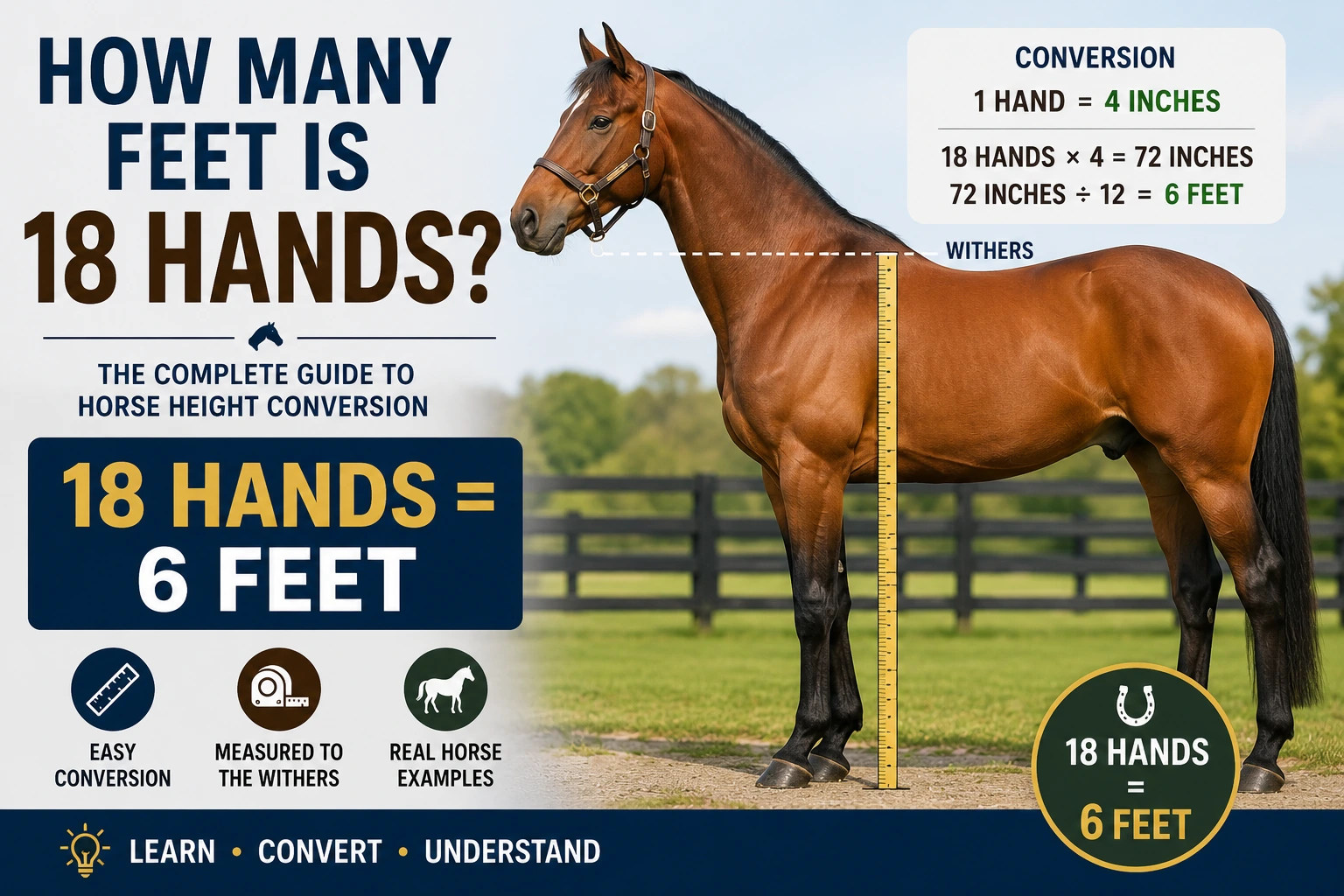
If you are wondering how many feet is 18 hands, the answer is 6 feet. In horse measurement, one hand equals 4 inches. Therefore, an 18 hand horse measures 72 inches from the ground to the top of its withers, which is exactly 6 feet.
Horse height is usually described in hands rather than feet. This can seem unusual if you are new to horses, but the system has been used for centuries and is still common in the equestrian world.
Understanding the conversion is useful when comparing horse sizes, researching breeds, buying a horse, choosing riding equipment, or simply trying to picture how tall an 18 hand horse really is.
The calculation is simple:
18 hands × 4 inches = 72 inches
Then:
72 inches ÷ 12 = 6 feet
So the direct answer is:
18 hands = 6 feet
How Many Feet Is 18 Hands?
An 18 hand horse is exactly 6 feet tall at the withers.
The word hands refers to a traditional unit used to describe the height of horses. One hand is equal to 4 inches.
Therefore:
1 hand = 4 inches
18 hands = 18 × 4 inches
18 hands = 72 inches
Since 12 inches make 1 foot:
72 ÷ 12 = 6 feet
Therefore, an 18 hand horse is:
6 feet tall
This measurement refers to the height from the ground to the highest point of the horse’s withers, not to the top of its head.
That distinction is important because a horse’s head and neck can extend much higher than its measured body height.
Understanding the Hand Measurement for Horses
The hand is a traditional unit of measurement that is especially associated with horses.
Instead of saying that a horse is 5 feet tall or 6 feet tall, equestrians commonly say that the horse is a certain number of hands high.
For example, a horse might be described as:
- 14 hands
- 15 hands
- 16 hands
- 17 hands
- 18 hands
The abbreviation is often written as hh, meaning hands high.
An 18 hand horse can therefore be described as an 18 hh horse.
Why Horse Height Is Measured in Hands
The hand has historical roots in measuring horses and other animals. Before modern measuring tools became common, the width of a human hand provided a convenient rough measurement.
Although modern tools are much more precise, the traditional system remained important in the horse world.
Today, using hands makes it easy for horse owners, breeders, riders, trainers, and buyers to communicate about horse height.
For example, saying that a horse is 16 hands immediately gives an experienced equestrian a useful idea of its size.
How a Hand Is Converted to Inches
The conversion is fixed:
1 hand = 4 inches
This makes the calculation very easy.
For example:
10 hands = 40 inches
12 hands = 48 inches
15 hands = 60 inches
16 hands = 64 inches
18 hands = 72 inches
Once the height is converted into inches, you can divide by 12 to get feet.
How to Convert 18 Hands to Feet
Converting 18 hands into feet takes two simple steps.
Step 1: Convert Hands to Inches
Since one hand equals 4 inches, multiply 18 by 4.
18 × 4 = 72 inches
So 18 hands equals 72 inches.
Step 2: Convert Inches to Feet
There are 12 inches in one foot.
Divide 72 inches by 12.
72 ÷ 12 = 6 feet
Therefore:
18 hands = 6 feet
This is an exact conversion rather than an estimate.
You can use the same method for any horse height measured in whole hands.
For example, a 16 hand horse is:
16 × 4 = 64 inches
64 ÷ 12 = 5.33 feet
That means a 16 hand horse is 5 feet 4 inches tall.
How Tall Is an 18 Hand Horse?
An 18 hand horse is 6 feet tall at the withers.
That makes it a very tall horse compared with many riding horses.
For perspective, a person who is 6 feet tall and an 18 hand horse have the same numerical height when measured from the ground to the horse’s withers. However, this does not mean their overall appearance or body structure is the same.
A horse’s head, neck, body, and legs create a much larger overall animal.
The horse’s withers are the point used for official height measurement because this part of the body is relatively stable compared with the position of the head.
18 Hands in Feet and Inches
Because 18 hands converts perfectly into 72 inches, there is no remaining fraction of a foot.
The conversion is:
18 hands = 72 inches
72 inches = 6 feet
Therefore:
18 hands = 6 feet 0 inches
This is different from measurements such as 17 hands.
For example, 17 hands equals:
17 × 4 = 68 inches
That equals:
5 feet 8 inches
So moving from 17 hands to 18 hands increases the horse’s measured height by 4 inches.
Horse Height Conversion Chart
The following chart shows common horse heights and their equivalent measurements.
| Horse height | Inches | Feet and inches |
|---|---|---|
| 12 hands | 48 inches | 4 feet |
| 13 hands | 52 inches | 4 feet 4 inches |
| 14 hands | 56 inches | 4 feet 8 inches |
| 15 hands | 60 inches | 5 feet |
| 16 hands | 64 inches | 5 feet 4 inches |
| 17 hands | 68 inches | 5 feet 8 inches |
| 18 hands | 72 inches | 6 feet |
| 19 hands | 76 inches | 6 feet 4 inches |
| 20 hands | 80 inches | 6 feet 8 inches |
This chart makes it easy to see how much height changes with each additional hand.
Every whole hand represents exactly 4 inches.
How Horse Height Is Measured
Horse height is measured from the ground to the highest point of the withers.
The horse should normally stand on a level surface with its legs positioned naturally.
A measuring stick designed for horses can be used to obtain a more accurate measurement.
The horse’s head position does not determine its official height.
Measuring From the Ground to the Withers
The measurement begins at ground level and ends at the highest point of the withers.
The withers are located at the base of the horse’s neck, above the shoulders.
This location is used because it provides a consistent reference point.
When measuring a horse, the animal should stand squarely rather than leaning forward or backward.
Why the Head Is Not Used for Horse Height
A horse can move its head and neck through a large range of positions.
If the top of the head were used for measurement, the recorded height could change every time the horse moved.
The withers provide a much more stable reference point.
This is why an 18 hand horse is not necessarily 6 feet from the ground to the top of its head. The 6 foot figure applies to the official height at the withers.
How Tall Is an 18 Hand Horse Compared With Other Horses?
An 18 hand horse is considerably taller than many horses commonly seen in riding activities.
For example, a 15 hand horse measures 5 feet at the withers.
A 16 hand horse measures 5 feet 4 inches.
A 17 hand horse measures 5 feet 8 inches.
An 18 hand horse reaches 6 feet.
The difference may seem small when expressed in hands, but each hand represents 4 inches. Therefore, a few hands can create a significant difference in overall horse size.
| Height | Feet and inches | Difference from 18 hands |
| 14 hands | 4 feet 8 inches | 16 inches |
| 15 hands | 5 feet | 12 inches |
| 16 hands | 5 feet 4 inches | 8 inches |
| 17 hands | 5 feet 8 inches | 4 inches |
| 18 hands | 6 feet | Same height |
| 19 hands | 6 feet 4 inches | 4 inches taller |
This comparison shows why an 18 hand horse is considered a large animal.
Is an 18 Hand Horse Considered Tall?
Yes. An 18 hand horse is generally considered very tall.
Many riding horses fall somewhere around the middle of the common horse height range, while an 18 hand horse is noticeably larger.
However, height alone does not determine whether a horse is suitable for a particular rider or activity.
Other factors include:
- Body build
- Weight
- Leg length
- Temperament
- Training
- Rider experience
- Saddle fit
- Intended activity
A taller horse may be impressive to look at, but the best horse for a rider depends on much more than height.
What Types of Horses Can Reach 18 Hands?
Several large horse breeds can reach or exceed 18 hands.
Large warmbloods, draft horses, and some sport horse types can grow to impressive heights.
Examples may include:
- Shire horses
- Clydesdales
- Belgian draft horses
- Percherons
- Large warmbloods
Not every horse within these groups will reach 18 hands. Individual genetics, nutrition, health, age, and breeding all influence final size.
Some horses may also be described as 18 hands even though they belong to a breed where smaller individuals are more common.
Why Horse Height Matters
Horse height can be useful for practical reasons.
When choosing a horse, height can help a rider understand the general scale of the animal.
It can also affect:
- Saddle and tack considerations
- Mounting height
- Rider position
- Trailer space
- Stable arrangements
- Feeding requirements
- Competition classifications
However, height should not be the only factor considered.
Two horses with the same measured height can have very different body proportions. One may have a longer back, another may have longer legs, and another may have a heavier build.
For this reason, experienced horse owners consider the complete structure of the horse rather than relying only on the number of hands.
Common Mistakes When Converting Hands to Feet
One common mistake is forgetting that a hand equals 4 inches rather than 12 inches.
Another mistake is treating hands as if they were already feet.
For example, 18 hands does not mean 18 feet.
Instead:
18 hands × 4 inches = 72 inches
Then:
72 inches ÷ 12 = 6 feet
Another common mistake is measuring the horse’s head rather than its withers. Horse height is normally recorded at the withers.
It is also easy to confuse a horse’s height with its total physical length. Height describes the vertical measurement from the ground to the withers. It does not describe the distance from the nose to the tail.
Practical Examples of 18 Hand Horse Height
Imagine standing beside an 18 hand horse.
The horse’s withers would be approximately 6 feet above the ground.
If you are familiar with a standard doorway, an 18 hand horse can give you a good visual sense of scale because its withers can be around the height of a tall adult person.
The horse’s head and neck extend above the withers, so the animal’s highest point will be considerably higher than 6 feet.
This is one reason photographs of very tall horses can sometimes make their size difficult to judge.
Another useful comparison is a 16 hand horse. At 5 feet 4 inches at the withers, it is 8 inches shorter than an 18 hand horse.
That difference is substantial when viewed in person.
Tips for Measuring a Horse Accurately
If you need to measure a horse, accuracy starts with the setup.
Place the horse on a firm and level surface.
Make sure the horse is standing naturally and evenly on all four feet.
Use a proper horse measuring stick if available.
Measure from the ground vertically to the highest point of the withers.
Avoid estimating the measurement by eye.
If the result falls between whole hands, record the measurement using the appropriate smaller unit rather than automatically rounding to the nearest whole hand.
It is also helpful to measure more than once if you need a reliable result.
For horses being registered, sold, or entered into activities where official height matters, follow the specific measurement rules required by the relevant organization.
Frequently Asked Questions
How many feet is 18 hands?
18 hands is exactly 6 feet at the horse’s withers. One hand equals 4 inches, so 18 hands equals 72 inches, and 72 inches equals 6 feet.
How many inches is 18 hands?
An 18 hand horse measures 72 inches at the withers. The calculation is 18 multiplied by 4, because one hand equals 4 inches.
Is an 18 hand horse very tall?
Yes. An 18 hand horse is generally considered very tall. Its withers are 6 feet above the ground, although the top of its head will be higher.
Where do you measure a horse’s height?
Horse height is measured from the ground to the highest point of the withers. The horse should stand naturally on a level surface for an accurate measurement.
What is the difference between hands and feet?
Hands and feet are different units. One hand equals 4 inches, while one foot equals 12 inches. Therefore, three hands equal one foot.
Conclusion
If you are asking how many feet is 18 hands, the exact answer is 6 feet.
The conversion is simple because one hand equals 4 inches. Therefore:
18 hands × 4 inches = 72 inches
Then:
72 inches ÷ 12 = 6 feet
So an 18 hand horse stands 6 feet tall at the withers.
An 18 hand horse is considered very tall, and its overall body and head will extend well above the 6 foot measurement. Remember that official horse height refers to the withers, not the top of the head.
Whether you are comparing horse breeds, buying a horse, learning about equestrian measurements, or simply trying to understand horse height, knowing that 18 hands equals 6 feet gives you a quick and reliable reference.
Discover more