

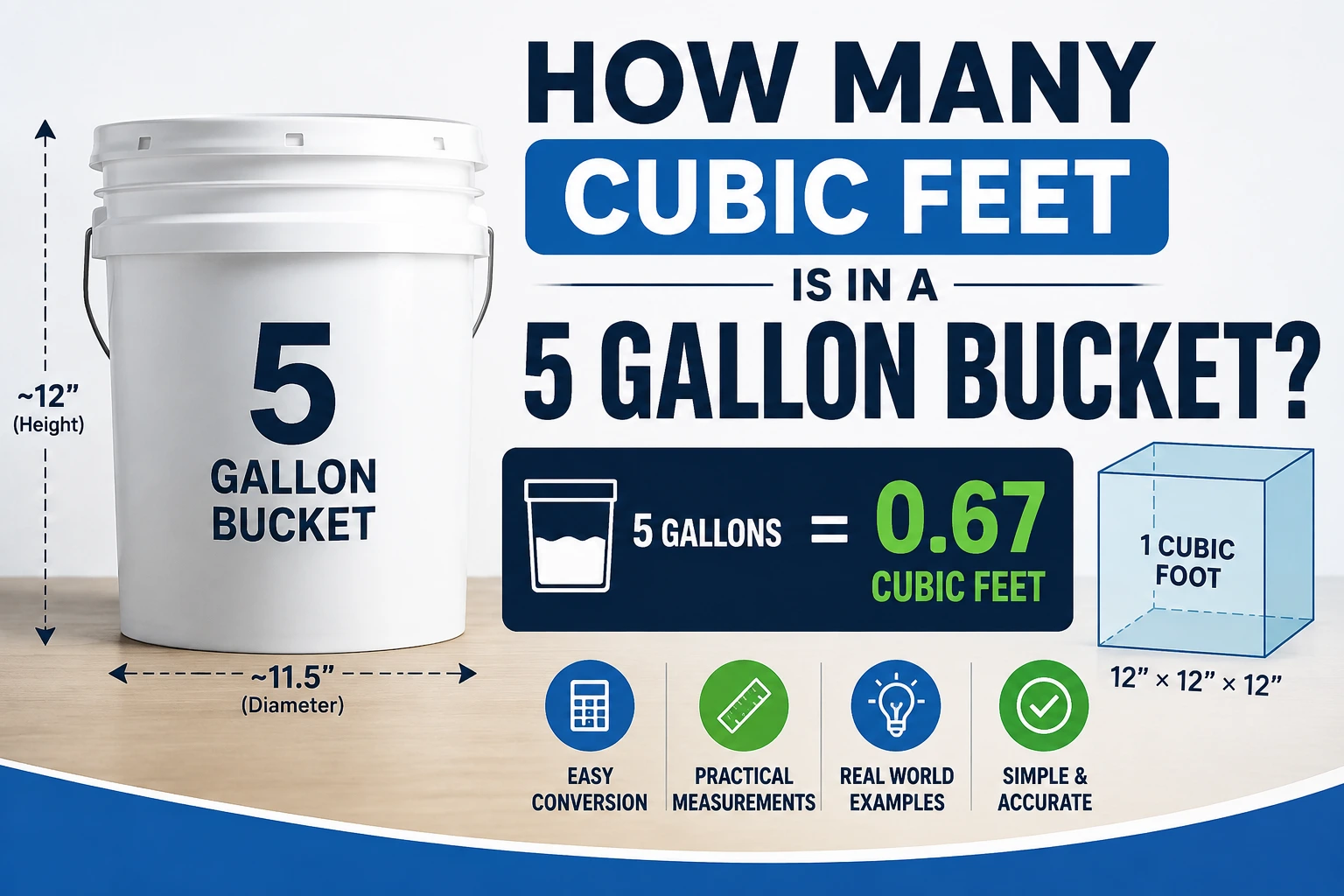
If you need to know how many cubic feet is in a 5 gallon bucket, the answer is approximately 0.668 cubic feet. In other words, five US gallons take up about two thirds of a cubic foot of space.
This conversion is useful when estimating storage space, calculating the amount of material needed for a project, comparing container sizes, or working with measurements that use cubic feet instead of gallons.
A five gallon bucket is a familiar container, but its capacity can be difficult to picture in cubic feet. Fortunately, the conversion is simple once you know the relationship between gallons and cubic feet.
The key figure to remember is that 1 US gallon equals approximately 0.1337 cubic feet. Therefore, five gallons equals approximately 0.6685 cubic feet.
Quick Answer
A standard five gallon capacity is approximately:
5 gallons = 0.668 cubic feet
For practical calculations, you can usually use 0.67 cubic feet.
This means one five gallon bucket occupies roughly two thirds of a cubic foot when filled to its stated capacity.
For example, if you have 10 gallons, you have about 1.34 cubic feet. If you have 20 gallons, you have about 2.67 cubic feet.
The calculation is:
5 × 0.1337 = 0.6685 cubic feet
So the simple answer is about 0.67 cubic feet.
How Many Cubic Feet Is in a 5 Gallon Bucket?
The volume of five gallons is approximately 0.668 cubic feet.
This measurement is based on the US liquid gallon. That point matters because the US gallon and the Imperial gallon used in some other countries are different sizes.
For normal household, construction, gardening, and storage calculations in the United States, five gallons generally refers to five US gallons.
A cubic foot is a three dimensional measurement. Imagine a box that is one foot long, one foot wide, and one foot high. The space inside that box is one cubic foot.
A five gallon bucket contains about 0.67 of that amount when filled to its rated capacity.
That gives you a useful mental picture. A full five gallon bucket is not quite one cubic foot. It holds about 67 percent of one cubic foot.
Understanding Gallons and Cubic Feet
Before converting the measurement, it helps to understand what the two units represent.
What Is a Gallon?
A gallon is a unit used to measure volume. In the United States, gallons are commonly used for liquids such as water, milk, fuel, paint, and cleaning products.
One US gallon contains approximately 231 cubic inches.
Five gallons therefore contain:
5 × 231 = 1,155 cubic inches
This gives us another way to understand the volume of a five gallon bucket.
What Is a Cubic Foot?
A cubic foot measures three dimensional space.
One cubic foot contains:
12 inches × 12 inches × 12 inches
That equals:
1,728 cubic inches
Because five gallons contain approximately 1,155 cubic inches, the conversion is:
1,155 ÷ 1,728 = 0.6684 cubic feet
This produces essentially the same answer as the gallon conversion.
How to Convert 5 Gallons to Cubic Feet
Converting gallons to cubic feet does not require a complicated calculator.
Step 1: Know the Conversion
One US gallon equals approximately:
0.133681 cubic feet
Step 2: Multiply by 5
Take the number of gallons and multiply it by 0.133681.
5 × 0.133681 = 0.668405
Step 3: Round the Result When Needed
For everyday work, you can round 0.668405 to:
0.67 cubic feet
For engineering, construction, or other work where greater accuracy matters, keep more decimal places.
The general formula is:
Cubic feet = gallons × 0.133681
Using five gallons:
Cubic feet = 5 × 0.133681
Cubic feet = 0.668405
Therefore, a five gallon volume is approximately 0.668 cubic feet.
5 Gallon Bucket Volume in Other Measurements
Knowing several equivalent measurements can make volume calculations easier.
| Measurement | Approximate volume |
|---|---|
| US gallons | 5 gallons |
| Cubic feet | 0.668 cubic feet |
| Cubic inches | 1,155 cubic inches |
| Liters | 18.93 liters |
| Milliliters | 18,927 milliliters |
| Cubic meters | 0.01893 cubic meters |
These values describe the volume of five US gallons.
The liter conversion is particularly useful if you are working with metric measurements. Five US gallons are approximately 18.93 liters.
The cubic meter value is useful for larger calculations because one cubic meter contains approximately 35.315 cubic feet.
5 Gallon Bucket Cubic Feet Compared With Other Volumes
Putting the number beside familiar measurements makes it easier to understand.
| Volume | Approximate cubic feet |
| 1 gallon | 0.134 cubic feet |
| 2 gallons | 0.267 cubic feet |
| 5 gallons | 0.668 cubic feet |
| 10 gallons | 1.337 cubic feet |
| 15 gallons | 2.005 cubic feet |
| 20 gallons | 2.674 cubic feet |
| 25 gallons | 3.342 cubic feet |
| 50 gallons | 6.684 cubic feet |
| 100 gallons | 13.368 cubic feet |
This comparison shows that approximately seven and a half gallons make one cubic foot.
More precisely, one cubic foot is about 7.48 US gallons.
That means a five gallon bucket holds less than one cubic foot, while two five gallon buckets hold about 1.34 cubic feet.
A Simple Real World Example
Suppose you have a storage area with one cubic foot of available space.
A single five gallon bucket represents about 0.67 cubic feet of volume. In theory, two full buckets would require about 1.34 cubic feet of volume.
However, physical storage is not the same as pure volume. Buckets have handles, walls, lids, and shapes that can prevent them from fitting together perfectly.
So the mathematical volume is useful for estimation, but physical dimensions are needed when planning an actual storage arrangement.
Does Every 5 Gallon Bucket Have Exactly the Same Volume?
Not necessarily.
The phrase five gallon bucket usually describes a bucket designed to hold around five gallons, but the actual physical dimensions can vary between manufacturers and models.
Some buckets may have slightly different shapes. Some may be taller and narrower, while others may be shorter and wider.
The bucket may also have a maximum capacity that differs from its practical fill level.
For example, a bucket marketed for five gallons may have extra space above the five gallon mark. This extra space is often useful because filling a container completely to its physical rim can cause spills.
Therefore, when calculating the amount of liquid or material inside a bucket, use the stated capacity rather than assuming every bucket has identical dimensions.
If exact physical storage space matters, measure the bucket or check its manufacturer specifications.
Practical Uses for Knowing 5 Gallon Bucket Volume
Knowing that five gallons equals approximately 0.67 cubic feet can help with many practical tasks.
Storage Planning
If you are storing buckets in a garage, warehouse, shed, or workshop, cubic feet can help estimate how much total space they represent.
For example, 12 buckets containing five gallons each represent approximately:
12 × 0.668 = 8.016 cubic feet
That is about 8 cubic feet of material or liquid volume.
Gardening
Gardeners often use five gallon buckets for soil, compost, mulch, fertilizer, and water.
If a gardening project calls for a certain volume in cubic feet, knowing the bucket conversion helps estimate how many buckets are required.
For example, if you need approximately 3.34 cubic feet of soil, that is roughly the same volume as five five gallon buckets.
Construction and DIY Projects
Five gallon buckets are common on construction sites and in home improvement projects.
They may be used for concrete ingredients, sand, gravel, paint, water, or other materials.
If a project specification gives material quantities in cubic feet, converting that number into five gallon buckets can make the amount easier to visualize.
Water Storage
Five gallon buckets are also commonly used for water storage.
Five US gallons equals approximately 18.93 liters and 0.668 cubic feet.
Remember that volume and weight are different measurements. Five gallons of water have a different weight from five gallons of another material because density changes from one substance to another.
How to Calculate the Volume of a Bucket Yourself
If you do not know the capacity of a bucket, you can estimate its volume using physical measurements.
Measuring a Round Bucket
For a roughly cylindrical bucket, the basic volume formula is:
Volume = pi × radius × radius × height
Measure the inside diameter of the bucket and divide it by two to get the radius.
Then measure the usable inside height.
Keep all measurements in the same unit before calculating.
If you use inches, the answer will be in cubic inches. You can then convert cubic inches to cubic feet by dividing by 1,728.
However, most buckets are tapered rather than perfect cylinders. The top is often wider than the bottom.
That means a simple cylinder calculation may not provide the exact capacity.
For the most accurate result, use the manufacturer’s stated capacity or measure the actual amount of water the container holds.
Using Gallons Instead of Physical Measurements
If the bucket is already labeled as five gallons, there is no need to calculate its dimensions.
Simply use the conversion:
Gallons × 0.133681 = cubic feet
For five gallons:
5 × 0.133681 = 0.668405 cubic feet
This is faster and generally more useful for everyday calculations.
Common Mistakes When Converting Bucket Volume
Several mistakes can lead to incorrect answers.
Confusing US Gallons With Imperial Gallons
A US gallon is smaller than an Imperial gallon.
If your source or project uses Imperial gallons, do not use the US gallon conversion without checking the units first.
Assuming Five Gallons Equals One Cubic Foot
This is a common shortcut, but it is not accurate.
One cubic foot is approximately 7.48 US gallons.
Five gallons is therefore only about 0.67 cubic feet.
Confusing Volume With Weight
A gallon measures volume, while pounds or kilograms measure weight.
A five gallon container can hold different weights depending on what is inside it.
Five gallons of water will not weigh the same as five gallons of soil, oil, or another material.
Ignoring Empty Space
A container labeled five gallons may not need to be filled all the way to the rim.
If you are planning safe storage, allow room for expansion and movement when appropriate.
Rounding Too Early
For simple household calculations, 0.67 cubic feet is usually enough.
For more precise work, use the full conversion before rounding the final answer.
Expert Tips for Accurate Volume Calculations
Start by identifying the exact gallon standard being used. This is especially important when working with international measurements.
Next, decide how much accuracy you actually need. A rounded value is useful for estimating storage, while a more precise value may be better for technical calculations.
When working with physical containers, remember that rated capacity and external dimensions are different things. A bucket can occupy more physical space than the volume of material inside it because the plastic walls and external features take up space.
For storage planning, measure the actual outside dimensions of the buckets and account for the arrangement between them.
For material calculations, use the actual internal capacity.
For liquid calculations, use the stated liquid capacity.
Most importantly, keep your units consistent. Converting gallons to cubic feet is easy when the starting measurement is clear.
Frequently Asked Questions
How many cubic feet is in a 5 gallon bucket?
A five gallon volume is approximately 0.668 cubic feet, which can normally be rounded to 0.67 cubic feet for everyday calculations.
Is 5 gallons the same as 1 cubic foot?
No. Five US gallons is approximately 0.668 cubic feet. One cubic foot contains approximately 7.48 US gallons. Therefore, a five gallon bucket contains less than one cubic foot.
How many 5 gallon buckets are in a cubic foot?
Approximately 1.5 five gallon bucket volumes equal one cubic foot. More precisely, one cubic foot divided by 0.668 cubic feet gives approximately 1.50.
This is a volume comparison rather than a statement that one and a half physical buckets will fit inside a cubic foot of space.
How many cubic inches are in a 5 gallon bucket?
Five US gallons equal approximately 1,155 cubic inches because one US gallon contains 231 cubic inches.
Dividing 1,155 cubic inches by 1,728 cubic inches per cubic foot gives approximately 0.668 cubic feet.
Does a 5 gallon bucket really hold exactly 5 gallons?
Not every bucket has identical physical dimensions or usable capacity. A bucket marketed as five gallons is designed around that capacity, but the actual container may have additional space above the intended fill level.
For precise work, check the manufacturer’s capacity or measure the container directly.
Conclusion
So, how many cubic feet is in a 5 gallon bucket? The answer is approximately 0.668 cubic feet, or about 0.67 cubic feet when rounded.
The basic conversion is simple:
5 US gallons × 0.133681 = 0.668405 cubic feet
You can also remember that one cubic foot contains approximately 7.48 US gallons. This makes it easy to estimate how many five gallon buckets are equivalent to a larger volume.
Whether you are planning storage, measuring gardening materials, estimating construction supplies, or simply trying to understand container capacity, the 0.67 cubic foot figure gives you a reliable everyday reference.
For exact calculations, always confirm whether the measurement uses US gallons or Imperial gallons and avoid confusing volume with weight. Once the units are clear, converting five gallons into cubic feet is quick and straightforward.
Discover more