

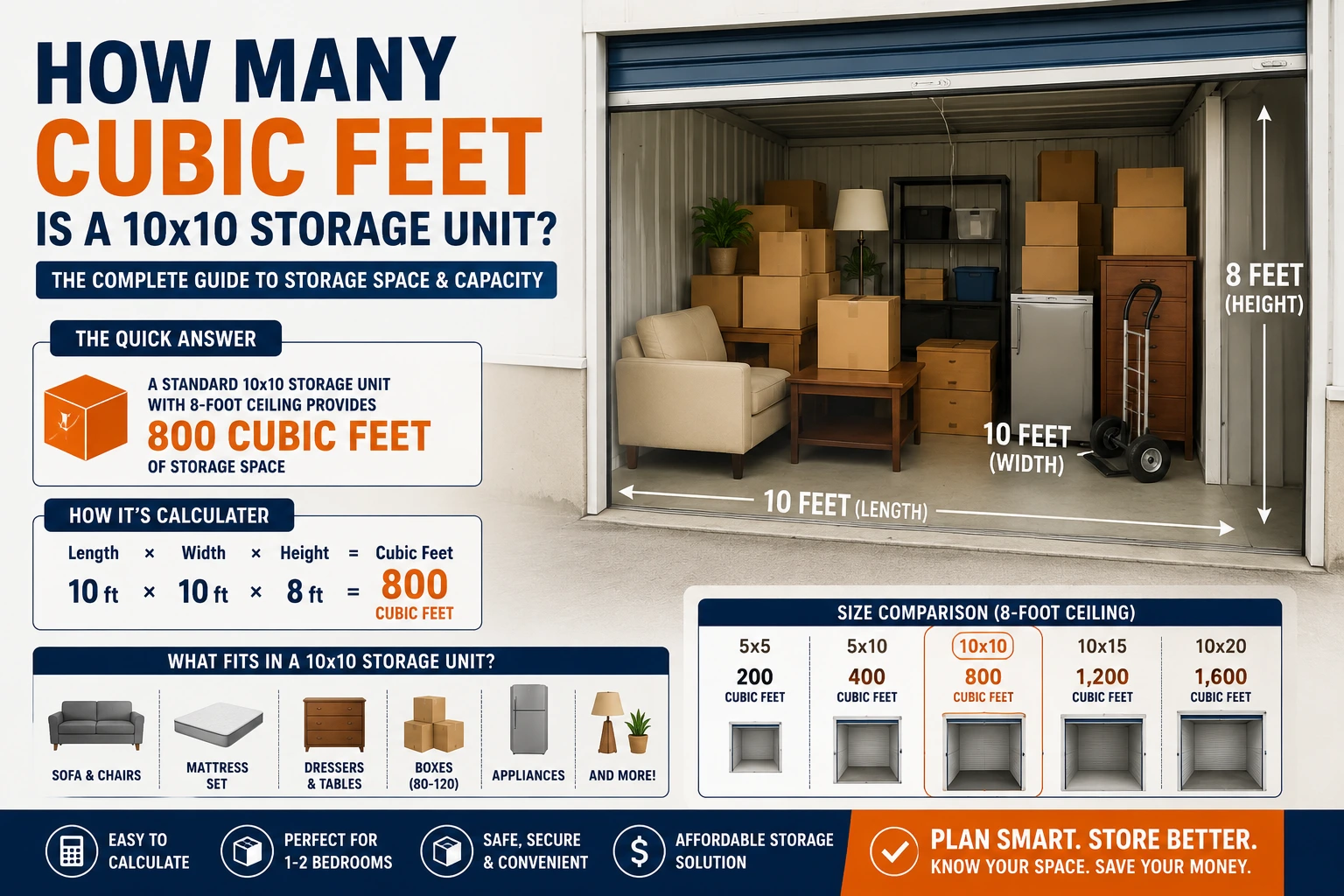
How Many Cubic Feet Is a 10×10 Storage Unit?
If you’re planning a move or looking for extra storage space, you may be wondering how many cubic feet is a 10×10 storage unit. Understanding the total storage volume helps you determine whether the unit is large enough for your belongings before you rent it.
A 10×10 storage unit is one of the most popular sizes offered by self-storage facilities because it provides enough room for the contents of a one- to two-bedroom home while remaining affordable. However, many people confuse square footage with cubic footage. While a 10×10 unit has 100 square feet of floor space, its actual storage capacity depends on the ceiling height.
In this guide, you’ll learn how to calculate cubic feet, what a typical 10×10 storage unit can hold, compare it with other storage sizes, and discover expert packing tips to maximize every inch of available space.
Quick Answer
The exact cubic footage depends on the ceiling height.
Most storage facilities offer units with ceilings approximately 8 feet high.
Calculation:
- Length = 10 feet
- Width = 10 feet
- Height = 8 feet
Formula:
Length × Width × Height
10 × 10 × 8 = 800 cubic feet
Final Answer
A standard 10×10 storage unit contains approximately 800 cubic feet of storage space.
Some facilities have higher ceilings, which increases the total cubic footage.
How Many Cubic Feet Is a 10×10 Storage Unit? Step-by-Step
Understanding the calculation is simple once you know the formula.
Step 1: Measure the Length
Length = 10 feet
Step 2: Measure the Width
Width = 10 feet
Step 3: Measure the Height
Most storage companies use ceilings around:
- 8 feet
- 8.5 feet
- 9 feet
- 10 feet
Always confirm the ceiling height with your storage provider because it directly affects storage capacity.
Step 4: Multiply All Three Measurements
Formula:
Length × Width × Height = Cubic Feet
For a standard unit:
10 × 10 × 8
= 800 cubic feet
What Does Cubic Feet Mean?
Many people confuse square feet with cubic feet, but they measure different things.
Square Feet
Square feet measure floor area only.
Formula:
Length × Width
For a 10×10 unit:
10 × 10 = 100 square feet
This tells you how much floor space is available.
Cubic Feet
Cubic feet measure the total three-dimensional storage space.
Formula:
Length × Width × Height
For an 8-foot ceiling:
10 × 10 × 8
= 800 cubic feet
This represents the total volume available for stacking boxes and furniture.
Why Ceiling Height Matters
The height of your storage unit significantly impacts its storage capacity.
Compare these examples:
| Ceiling Height | Cubic Feet |
|---|---|
| 8 feet | 800 cu ft |
| 8.5 feet | 850 cu ft |
| 9 feet | 900 cu ft |
| 10 feet | 1,000 cu ft |
Even though the floor dimensions remain the same, higher ceilings allow you to stack items safely and store more belongings.
Understanding Storage Volume
Think of a storage unit like a large box.
The floor gives you space to place items.
The height lets you stack them.
That’s why cubic feet provide a much better estimate of storage capacity than square feet alone.
For example:
Two storage units may each measure 100 square feet, but if one has a higher ceiling, it can store significantly more items.
What Fits Inside a 10×10 Storage Unit?
A standard 10×10 storage unit can usually hold the contents of a one- to two-bedroom apartment.
Depending on how efficiently you pack, you may fit:
- Queen-size mattress
- King-size mattress (standing upright)
- Sofa
- Loveseat
- Coffee table
- Dining table
- Chairs
- Dressers
- Nightstands
- Bookshelves
- Office desk
- Television
- Washing machine
- Dryer
- Refrigerator
- Filing cabinets
- Seasonal decorations
- Sports equipment
- Lawn equipment
- Approximately 80–120 medium moving boxes
Actual capacity depends on furniture size and packing methods.
Common Household Items That Fit
Here’s an example of what many families successfully store inside a 10×10 unit.
Bedroom Furniture
- Bed frame
- Mattress
- Box spring
- Dresser
- Nightstands
- Mirror
- Lamps
Living Room Furniture
- Sofa
- Coffee table
- TV stand
- Chairs
- Entertainment center
- Area rugs
Dining Room
- Dining table
- Four to six chairs
- Buffet cabinet
Kitchen
- Microwave
- Small appliances
- Kitchen boxes
- Pantry storage bins
Office Equipment
- Desk
- Office chair
- Printer
- Computer equipment
- File cabinets
Garage Storage
- Toolboxes
- Lawn mower
- Snow blower
- Garden tools
- Bicycle
How Many Boxes Fit in a 10×10 Storage Unit?
Although every move is different, here’s a general estimate.
| Box Size | Estimated Quantity |
|---|---|
| Small boxes | 140–180 |
| Medium boxes | 80–120 |
| Large boxes | 50–70 |
| Extra-large boxes | 30–40 |
Proper stacking makes a huge difference.
Leaving walking space reduces the number of boxes that fit.
10×10 Storage Unit Compared with Other Sizes
Understanding how a 10×10 unit compares to other storage sizes helps you choose the right option.
| Storage Size | Square Feet | Approximate Cubic Feet* | Typical Use |
|---|---|---|---|
| 5×5 | 25 | 200 | Closet contents |
| 5×10 | 50 | 400 | Studio apartment |
| 10×10 | 100 | 800 | 1–2 bedroom home |
| 10×15 | 150 | 1,200 | 2–3 bedroom home |
| 10×20 | 200 | 1,600 | 3–4 bedroom house |
| 10×30 | 300 | 2,400 | Large family home |
*Based on an 8-foot ceiling.
This comparison shows why the 10×10 unit is often considered the “sweet spot” for residential storage—offering a balance between space and cost.
Benefits of Renting a 10×10 Storage Unit
A 10×10 storage unit offers several advantages over smaller units.
Some key benefits include:
- Affordable monthly rental cost
- Large enough for most household moves
- Easy to organize with shelves
- Suitable for short-term and long-term storage
- Can store furniture and appliances together
- Ideal for home renovations
- Helpful during downsizing
- Excellent option for small business inventory
Because of its versatility, this size remains one of the most commonly rented storage units in the self-storage industry.
Tips for Maximizing Storage Space
Renting a 10×10 storage unit is only the first step. How you organize the unit determines how much you can actually fit inside. With proper planning, you can safely store more items while keeping everything accessible.
Disassemble Large Furniture
Take apart bulky furniture whenever possible.
Examples include:
- Bed frames
- Dining tables
- Shelving units
- Office desks
- Bunk beds
Store screws and hardware in labeled plastic bags and tape them securely to the matching furniture piece.
Use Uniform Moving Boxes
Boxes of similar sizes stack more securely than boxes of different dimensions.
Benefits include:
- Better weight distribution
- Easier stacking
- Improved stability
- More efficient use of vertical space
Heavy boxes should always go on the bottom, while lighter boxes belong on top.
Store Vertically
One of the biggest advantages of 800 cubic feet is the available height.
You can safely store many items upright, such as:
- Mattresses
- Box springs
- Sofas (when recommended by the manufacturer)
- Mirrors
- Headboards
- Folding tables
Using the vertical space allows you to maximize the unit’s full storage capacity.
Create Walkways
Avoid packing the unit wall to wall.
Leave a narrow aisle so you can:
- Reach important items
- Rotate seasonal belongings
- Retrieve boxes without unloading the entire unit
This small amount of planning can save hours of work later.
Label Every Box
Clear labels make finding items much easier.
Include details such as:
- Kitchen
- Bedroom
- Holiday decorations
- Important documents
- Fragile items
Consider numbering boxes and keeping a simple inventory list on your phone or computer.
Real-World Examples of a 10×10 Storage Unit
Example 1: Apartment Move
Sarah is moving from a one-bedroom apartment into a new home but has a one-month gap between move-out and move-in dates.
Her storage unit contains:
- Queen bed
- Sofa
- Coffee table
- Dining table
- Four chairs
- Television
- Dresser
- Bookshelves
- Washing machine
- Dryer
- Approximately 70 moving boxes
Everything fits comfortably inside a standard 10×10 storage unit with room to create a small access aisle.
Example 2: Home Renovation
A family renovating their living room and kitchen needs temporary storage for:
- Dining furniture
- Kitchen appliances
- Cabinets
- Decorative items
- Rugs
- Artwork
A 10×10 unit provides enough space to protect these belongings until the renovation is complete.
Example 3: Small Business Storage
A local online retailer rents a 10×10 storage unit for:
- Inventory
- Shipping supplies
- Office furniture
- Seasonal stock
Installing heavy-duty shelving allows the business owner to use the full height of the unit, making the most of the available cubic footage.
Storage Capacity Comparison by Household Size
The following guide shows which storage unit size is typically suitable for different living situations.
| Household Size | Recommended Storage Unit |
|---|---|
| Closet contents | 5×5 |
| Studio apartment | 5×10 |
| 1-bedroom apartment | 10×10 |
| 2-bedroom apartment | 10×10 |
| Small house | 10×15 |
| Medium house | 10×20 |
| Large family home | 10×30 |
While every move is unique, a 10×10 unit is often ideal for storing the contents of a one- or two-bedroom home.
Common Mistakes When Renting a Storage Unit
Avoiding these mistakes can help protect your belongings and save money.
Choosing a Unit That’s Too Small
Many renters underestimate how much space they need.
If you’re unsure, create a list of everything you plan to store and consult the storage facility’s size guide before renting.
Ignoring Ceiling Height
Some people assume all 10×10 units have the same capacity.
In reality, ceiling heights vary between facilities.
Always ask about the unit’s height, as it directly affects the total cubic footage.
Packing Without a Plan
Randomly placing furniture and boxes often wastes valuable space.
Plan the layout before loading the unit, placing heavier items at the back and frequently used items near the front.
Not Protecting Furniture
Use moving blankets, mattress covers, and plastic wrap to protect furniture from dust, scratches, and moisture.
Proper protection helps preserve your belongings during long-term storage.
Forgetting Climate-Controlled Storage
Certain items should be stored in climate-controlled units, including:
- Wooden furniture
- Electronics
- Musical instruments
- Artwork
- Important documents
- Leather goods
Climate control reduces the risk of damage caused by extreme temperatures and humidity.
Expert Tips for Using a 10×10 Storage Unit
Professionals recommend these best practices to maximize space and protect your belongings.
- Measure large furniture before moving day.
- Use shelving for small boxes and office supplies.
- Keep fragile items in clearly labeled boxes.
- Leave an access path through the center of the unit.
- Place heavy furniture against the walls.
- Stack lighter boxes on top of heavier ones.
- Store frequently used items near the entrance.
- Fill empty spaces inside furniture, such as drawers and cabinets, with smaller items.
- Avoid overloading boxes to prevent collapse.
- Keep an inventory list of everything inside the unit.
Following these tips helps you use the available 800 cubic feet efficiently and makes retrieving items much easier.
How to Estimate Your Storage Needs
Before renting a storage unit, ask yourself a few questions:
- How many rooms are you storing?
- Do you have large furniture or mostly boxes?
- Will you need access to your belongings regularly?
- Are you storing items for a few weeks or several months?
- Do you need climate-controlled storage?
Answering these questions can help you choose the right unit size and avoid paying for more space than you need.
FAQs
1. How many cubic feet is a 10×10 storage unit?
A standard 10×10 storage unit with an 8-foot ceiling contains approximately 800 cubic feet of storage space. If the ceiling is higher, the total cubic footage increases.
2. What fits inside a 10×10 storage unit?
A 10×10 unit typically holds the contents of a one- to two-bedroom apartment, including furniture, appliances, and around 80–120 medium-sized moving boxes.
3. Is a 10×10 storage unit enough for a two-bedroom apartment?
Yes, in many cases. If your furniture is packed efficiently and you make good use of vertical space, a 10×10 unit is often sufficient for a two-bedroom apartment.
4. What is the difference between square feet and cubic feet?
Square feet measure the floor area of the storage unit, while cubic feet measure the total storage volume, including the height. Cubic feet provide a more accurate estimate of how much you can actually store.
5. How can I maximize the space in a 10×10 storage unit?
Disassemble furniture, stack boxes safely, use shelving, store items vertically, label everything clearly, and leave a walkway for easy access. These strategies help you take full advantage of the available storage volume.
Conclusion
If you’re wondering how many cubic feet is a 10×10 storage unit, the answer depends on the ceiling height. A standard unit measuring 10 feet long, 10 feet wide, and 8 feet high provides approximately 800 cubic feet of storage space. This makes it an excellent choice for storing the contents of a one- to two-bedroom home, business inventory, or household items during a move or renovation.
By understanding the difference between square feet and cubic feet, planning your layout carefully, and using professional packing techniques, you can maximize every inch of available space. Before renting, always confirm the unit’s ceiling height with the storage facility to ensure it meets your storage needs. With the right preparation, a 10×10 storage unit offers a practical, cost-effective solution for both short-term and long-term storage.
Discover more