
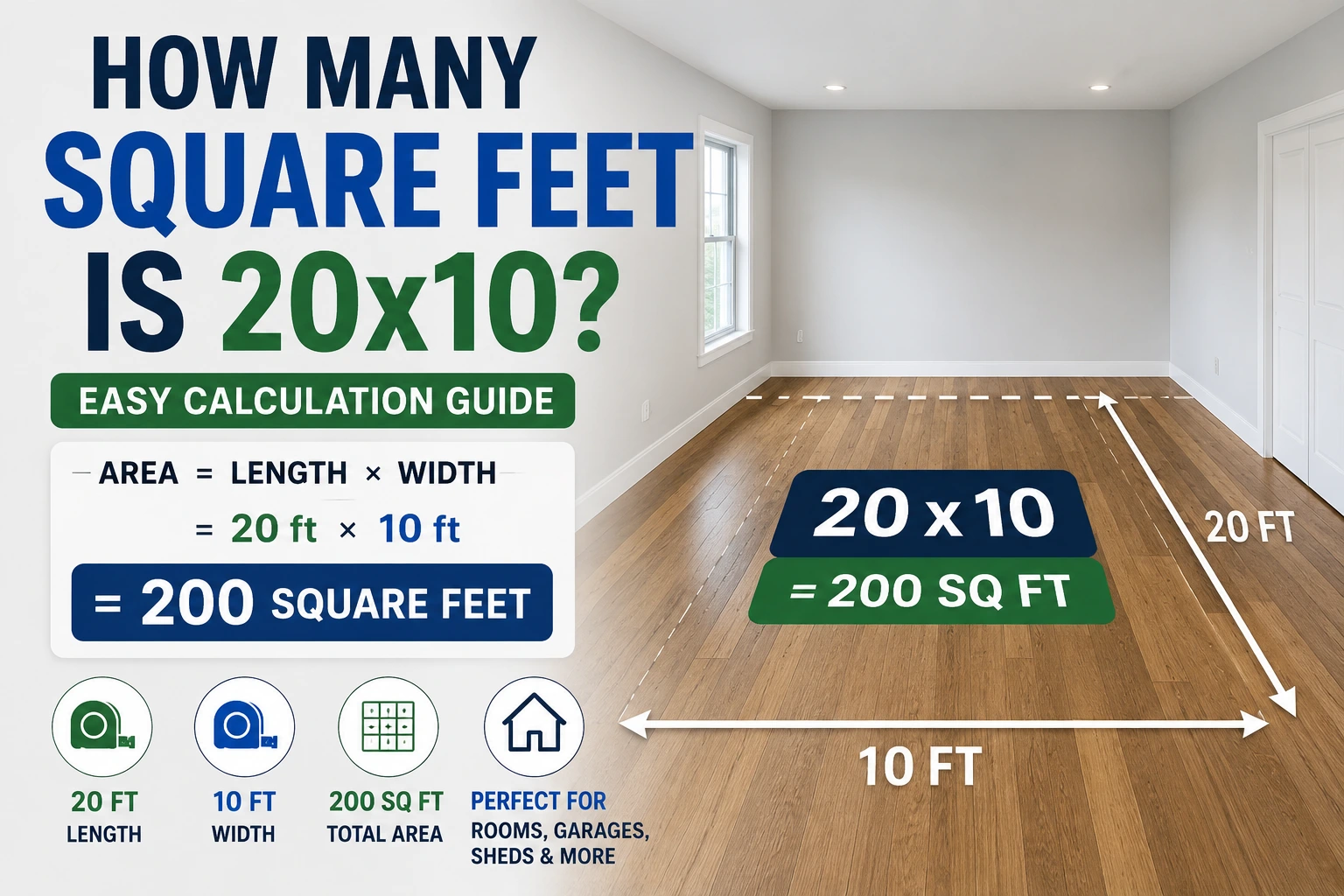
If you’re wondering how many square feet is 20×10, the answer is simple:
20×10=200 square feet
A space that measures 20 feet long and 10 feet wide contains 200 square feet of area.
This calculation is useful when planning flooring projects, estimating paint and carpet costs, designing rooms, purchasing materials, or evaluating property sizes. Whether you’re renovating a home, building a shed, or simply trying to understand room dimensions, knowing how to calculate square footage is an essential skill.
In this complete guide, you’ll learn:
- The exact square footage of a 20×10 area
- How square foot calculations work
- Real-world examples
- Common uses for a 20×10 space
- Comparison charts
- Practical planning tips
Let’s start with the basic calculation.
What Is the Square Footage of 20×10?
The area of a rectangle is calculated by multiplying length by width.
For a 20-foot by 10-foot space:
Area=Length×Width
Substituting the dimensions:
20 ft×10 ft=200 sq ft
Therefore:
20×10 = 200 square feet
This measurement applies whether the space is:
- A room
- A patio
- A garage section
- A garden plot
- A storage unit
- A workshop
As long as the dimensions are 20 feet by 10 feet, the area will always equal 200 square feet.
Understanding Square Feet
Before diving deeper, it’s important to understand what a square foot actually means.
A square foot is a unit of area.
Imagine a square that measures:
- 1 foot long
- 1 foot wide
That small square equals:
1 square foot
When calculating larger areas, you’re essentially counting how many of these one-foot squares fit inside a space.
For a 20×10 room:
- Length = 20 feet
- Width = 10 feet
- Total area = 200 one-foot squares
How to Calculate the Area of a 20×10 Space
The process is straightforward.
Formula
Use the standard area formula:
A=L×W
Where:
- A = Area
- L = Length
- W = Width
Example
For a 20×10 space:
- Length = 20 feet
- Width = 10 feet
Calculation:
20×10=200
Result:
- 200 square feet
This same formula works for any rectangular area.
Step-by-Step 20×10 Square Foot Calculation
Let’s break the calculation into easy steps.
Step 1: Measure Length
Measure the longest side.
Example:
- 20 feet
Step 2: Measure Width
Measure the shorter side.
Example:
- 10 feet
Step 3: Multiply the Measurements
20×10=200 sq ft
Step 4: Record the Result
Your final area is:
- 200 square feet
That’s all there is to it.
Real-World Examples of a 20×10 Area
Many people struggle to visualize square footage.
Here are some examples that help put 200 square feet into perspective.
Small Bedroom
Many guest bedrooms range between:
- 100–200 square feet
A 20×10 room would be considered a comfortable small bedroom.
Home Office
A 20×10 area provides enough room for:
- Desk
- Chair
- Shelving
- Filing cabinet
- Storage
Studio Workspace
Artists, crafters, and hobbyists often use spaces around 200 square feet.
Storage Area
A 20×10 storage unit offers substantial storage capacity for furniture and household items.
Common Uses for a 20×10 Space
A 200-square-foot area can serve many purposes.
Home Gym
A 20×10 room can fit:
- Treadmill
- Exercise bike
- Weight bench
- Free weights
Office Space
Perfect for:
- Remote work
- Small meetings
- Computer setup
Workshop
Many DIY enthusiasts use a 20×10 shed or workshop for:
- Tools
- Workbenches
- Equipment storage
Patio or Deck
A 20×10 outdoor space can comfortably accommodate:
- Dining furniture
- Grill
- Seating area
Comparing a 20×10 Area to Other Room Sizes
The following chart helps compare common room dimensions.
| Dimensions | Square Feet |
|---|---|
| 10×10 | 100 sq ft |
| 12×12 | 144 sq ft |
| 15×10 | 150 sq ft |
| 20×10 | 200 sq ft |
| 20×12 | 240 sq ft |
| 20×15 | 300 sq ft |
| 25×20 | 500 sq ft |
A 20×10 space falls into the medium-sized room category.
Why Square Foot Measurements Matter
Understanding square footage helps in many situations.
Flooring Projects
Flooring is usually sold by square foot.
For a 20×10 room, you’ll need approximately:
- 200 sq ft of flooring
- Plus 5–10% extra for waste
Carpet Installation
Carpet estimators use square footage to determine costs.
Paint Planning
Although paint coverage depends on wall area, room dimensions help estimate project size.
Real Estate Listings
Homebuyers often compare properties using square footage.
Construction Projects
Builders use area calculations when estimating:
- Materials
- Labor
- Costs
Practical Applications of a 20×10 Area
Example 1: Installing Hardwood Flooring
Suppose hardwood flooring costs $5 per square foot.
Calculation:
200×5=1000
Estimated flooring cost:
- $1,000 before waste and installation
Example 2: Adding Carpet
Carpet priced at $3 per square foot:
200×3=600
Estimated material cost:
- $600
Example 3: Building a Shed
A 20×10 shed provides:
- 200 square feet of usable space
Enough for tools, lawn equipment, and storage.
Common Mistakes When Calculating Square Footage
Many people make simple errors.
Confusing Perimeter With Area
Perimeter measures the distance around a shape.
Area measures the space inside.
For a 20×10 room:
Perimeter:
2(20+10)=60 feet
Area:
- 200 square feet
These are completely different measurements.
Using Incorrect Units
Always measure both dimensions in feet.
Forgetting Irregular Shapes
Complex rooms may need to be divided into rectangles before calculating total square footage.
Not Accounting for Waste
Flooring projects usually require extra material.
Square Footage Comparison Chart
Here’s a quick reference chart.
| Length × Width | Square Feet |
|---|---|
| 8 × 10 | 80 sq ft |
| 10 × 10 | 100 sq ft |
| 12 × 10 | 120 sq ft |
| 15 × 10 | 150 sq ft |
| 20 × 10 | 200 sq ft |
| 20 × 12 | 240 sq ft |
| 25 × 10 | 250 sq ft |
| 30 × 10 | 300 sq ft |
This chart helps compare common room sizes quickly.
Expert Tips for Measuring Areas Accurately
Use a Quality Tape Measure
Accurate measurements prevent costly mistakes.
Measure Twice
Double-check dimensions before purchasing materials.
Sketch the Room
A simple drawing makes calculations easier.
Include Closets Separately
Some projects require measuring closets and alcoves independently.
Round Carefully
Avoid excessive rounding when estimating materials.
Benefits of Understanding Square Footage
Learning basic area calculations provides several advantages.
Better Budgeting
You’ll know how much material to purchase.
Improved Planning
Room layouts become easier to design.
Smarter Shopping
You can compare products based on coverage rates.
Increased Confidence
Basic measurement skills help with countless DIY and home projects.
FAQs
1. How many square feet is a 20×10 room?
A 20×10 room contains exactly 200 square feet.
2. How do you calculate square feet for 20×10?
Multiply length by width:
20 × 10 = 200 square feet.
3. Is 200 square feet a large room?
It’s considered a medium-sized room and works well as a bedroom, office, gym, or workshop.
4. How much flooring do I need for a 20×10 room?
You’ll need about 200 square feet of flooring plus an additional 5–10% for cuts and waste.
5. What is the perimeter of a 20×10 room?
The perimeter is 60 feet, while the area is 200 square feet.
Conclusion
If you’ve been asking how many square feet is 20×10, the answer is simple:
20×10=200 square feet
A 20-foot by 10-foot area contains 200 square feet of usable space. This measurement is commonly used for rooms, patios, workshops, storage units, garages, and construction projects.
Understanding square footage helps you estimate materials, compare property sizes, budget renovation projects, and make smarter planning decisions. With a simple multiplication formula, you can quickly calculate the area of any rectangular space and confidently tackle your next project.
Discover more