
If you are working with flooring, lumber, carpet, countertops, fencing, trim, or another building material, you may ask how many linear feet are in a square foot.
The important answer is that there is no fixed number.
A linear foot measures length. A square foot measures area. Because they measure different things, you cannot directly convert square feet into linear feet unless you also know the width of the material or space.
For example, one square foot of material that is one foot wide equals one linear foot. But one square foot of material that is six inches wide requires two linear feet to cover the same area.
Understanding this difference can help you order the correct amount of material and avoid expensive measurement mistakes.
The Short Answer
There is not one universal conversion between linear feet and square feet.
The number of linear feet contained in a certain number of square feet depends on the width.
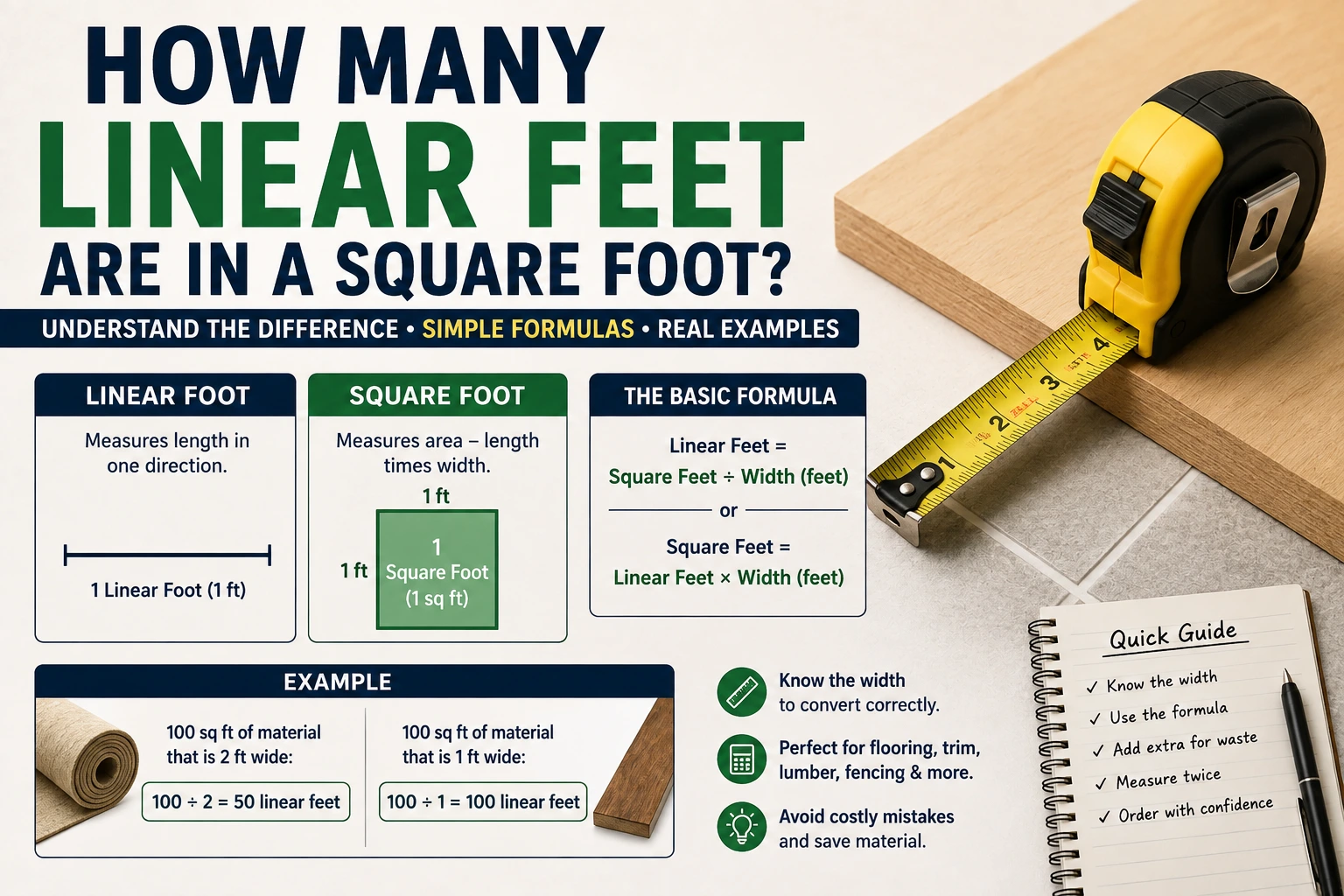
The basic relationship is:
Linear feet = square feet ÷ width in feet
For example, imagine you have 20 square feet of material that is two feet wide.
20 ÷ 2 = 10 linear feet
So, 20 square feet of material that is two feet wide equals 10 linear feet.
If the material is one foot wide, the same 20 square feet would equal 20 linear feet.
This is why the width must always be considered.
Why Linear Feet and Square Feet Are Different
The easiest way to understand the difference is to think about length compared with area.
A linear foot measures a straight distance of one foot.
A square foot measures a two dimensional area that is one foot long and one foot wide.
These are different types of measurements.
What Is a Linear Foot?
A linear foot is simply one foot of length.
If you have a board that is 8 feet long, it contains 8 linear feet.
The width of the board does not change its linear length.
For example, a board could be:
8 feet long and 4 inches wide
8 feet long and 8 inches wide
8 feet long and 12 inches wide
Each one is still 8 linear feet long.
However, the total surface area is different because the widths are different.
What Is a Square Foot?
A square foot measures area.
One square foot is an area that measures:
1 foot × 1 foot
Therefore:
1 square foot = 1 foot of length × 1 foot of width
If a rectangular area is 5 feet long and 4 feet wide, its area is:
5 × 4 = 20 square feet
The total area is therefore 20 square feet.
This distinction becomes especially important when buying materials.
How Many Linear Feet Are in a Square Foot?
So, how many linear feet are in a square foot?
The answer depends on width.
If the material is one foot wide, one square foot equals one linear foot.
If the material is six inches wide, one square foot equals two linear feet.
If the material is three inches wide, one square foot equals four linear feet.
The narrower the material, the more linear feet are required to cover a particular area.
The Width Determines the Answer
Consider a material that is 6 inches wide.
Six inches equals 0.5 feet.
To find the number of linear feet required to cover one square foot:
1 ÷ 0.5 = 2 linear feet
Therefore, two linear feet of material that is six inches wide covers one square foot.
Now consider material that is 3 inches wide.
Three inches equals 0.25 feet.
The calculation becomes:
1 ÷ 0.25 = 4 linear feet
Therefore, four linear feet of three inch wide material covers one square foot.
One Square Foot With a One Foot Wide Material
If a material is exactly one foot wide, the calculation is simple.
1 ÷ 1 = 1
Therefore:
1 square foot = 1 linear foot when the material is one foot wide
This is the only situation where the numbers are exactly the same.
One Square Foot With a Two Foot Wide Material
Now imagine material that is two feet wide.
To cover one square foot:
1 ÷ 2 = 0.5 linear feet
So, half a linear foot of material that is two feet wide covers one square foot.
This shows why the width is essential when converting between the two measurements.
How to Convert Square Feet to Linear Feet
The conversion is easy when you know the material width.
Use this formula:
Linear feet = square feet ÷ width in feet
Before using the formula, make sure the width is expressed in feet.
For example, if the material is 12 inches wide, convert 12 inches to 1 foot.
If the material is 6 inches wide, convert it to 0.5 feet.
If the material is 3 inches wide, convert it to 0.25 feet.
The Basic Formula
Suppose you have 100 square feet of material and it is 2 feet wide.
The calculation is:
100 ÷ 2 = 50 linear feet
Therefore, you need 50 linear feet of material that is two feet wide to cover 100 square feet.
Now suppose the same 100 square feet must be covered with material that is one foot wide.
100 ÷ 1 = 100 linear feet
You would need twice as much linear length because the material is only half as wide.
Step by Step Example
Imagine you need flooring for an area of 240 square feet.
The flooring material comes in rolls that are 6 feet wide.
First, identify the total area:
240 square feet
Next, identify the width:
6 feet
Then use the formula:
240 ÷ 6 = 40 linear feet
Therefore, 40 linear feet of six foot wide material would cover 240 square feet, assuming the material can be installed without additional waste.
In a real project, you may need to purchase additional material because of cutting, fitting, pattern matching, damaged pieces, or installation requirements.
Square Feet to Linear Feet Conversion Chart
The following chart shows how many linear feet are needed to cover different areas when the material has a specific width.
| Area | Material Width | Linear Feet |
|---|---|---|
| 10 square feet | 1 foot | 10 linear feet |
| 10 square feet | 2 feet | 5 linear feet |
| 10 square feet | 4 feet | 2.5 linear feet |
| 50 square feet | 1 foot | 50 linear feet |
| 50 square feet | 2 feet | 25 linear feet |
| 50 square feet | 5 feet | 10 linear feet |
| 100 square feet | 1 foot | 100 linear feet |
| 100 square feet | 2 feet | 50 linear feet |
| 100 square feet | 4 feet | 25 linear feet |
| 200 square feet | 2 feet | 100 linear feet |
| 500 square feet | 5 feet | 100 linear feet |
The chart demonstrates an important pattern.
As material width increases, the number of linear feet required to cover the same area decreases.
How to Convert Linear Feet to Square Feet
You can also work in the opposite direction.
To calculate square feet from linear feet, use:
Square feet = linear feet × width in feet
For example, suppose you have 30 linear feet of material that is 2 feet wide.
30 × 2 = 60 square feet
Therefore, 30 linear feet covers 60 square feet.
If the material is 6 inches wide, convert 6 inches into 0.5 feet.
Then:
30 × 0.5 = 15 square feet
So, 30 linear feet of six inch wide material covers 15 square feet.
This formula is useful when you know the length of material you have and want to determine how much surface area it can cover.
Real World Examples
The difference between linear feet and square feet becomes much easier to understand when you look at common projects.
Flooring
Flooring may be sold by square feet, linear feet, cartons, or another unit depending on the material.
If a flooring product is supplied in a fixed width, you can use that width to determine how much linear material is needed.
For example, a six foot wide flooring roll covering 300 square feet would require:
300 ÷ 6 = 50 linear feet
Always check the manufacturer’s actual product width before calculating the amount you need.
Carpet
Carpet is another common example.
Suppose a room requires 360 square feet of carpet and the carpet roll is 12 feet wide.
The calculation is:
360 ÷ 12 = 30 linear feet
You would need 30 linear feet of twelve foot wide carpet before accounting for cutting and installation waste.
Room shape also matters. A simple mathematical calculation does not always represent the exact amount required for installation.
Baseboards and Trim
Baseboards are normally purchased by linear feet because their main measurement is length.
If a room has walls totaling 180 feet, you may need around 180 linear feet of baseboard before accounting for doors, corners, waste, and cuts.
Square footage is not normally the best measurement for this type of material.
Countertops
Countertops can involve both measurements.
A countertop might be described by its linear length, while the actual surface area depends on its depth.
For example, 12 linear feet of countertop that is 2 feet deep covers:
12 × 2 = 24 square feet
If the depth changes, the surface area changes even though the linear length stays the same.
Fencing
Fencing is usually measured in linear feet because you are measuring the distance along the property boundary.
If you need a fence around a property with a total boundary length of 400 feet, you need approximately 400 linear feet of fencing before accounting for gates, overlaps, cuts, or installation requirements.
The total square footage of the property does not automatically tell you how much fencing you need.
Common Measurement Mistakes
One of the most common mistakes is assuming that one square foot equals one linear foot in every situation.
That is only true when the material is one foot wide.
Another mistake is forgetting to convert inches into feet.
For example, using 6 instead of 0.5 for a six inch wide material would produce a completely incorrect answer.
You should also avoid confusing the length of a material with its surface area.
A 10 foot board is 10 linear feet long. Its square footage depends on its width.
For example, if the board is 1 foot wide:
10 × 1 = 10 square feet
If the board is 0.5 feet wide:
10 × 0.5 = 5 square feet
The same linear length can therefore represent different amounts of surface area.
Another common mistake is ignoring waste.
Cutting, fitting, seams, corners, patterns, and installation conditions can all increase the amount of material required.
Expert Tips for Accurate Measurements
Always write down three things before starting a conversion:
- The total area
- The material width
- The unit used for the width
Then make sure all measurements use compatible units.
If the width is given in inches, convert it to feet before using the square feet to linear feet formula.
For example:
12 inches = 1 foot
6 inches = 0.5 feet
4 inches = approximately 0.333 feet
3 inches = 0.25 feet
For larger projects, measure the space more than once. Small measurement errors can become expensive when multiplied across a large project.
It is also wise to add a reasonable amount for waste when purchasing materials. The correct amount depends on the material and installation method.
For professional construction work, always follow the supplier’s measurement guidance because products can have different usable widths, installation requirements, and recommended waste allowances.
Frequently Asked Questions
Is one linear foot the same as one square foot?
No. A linear foot measures length, while a square foot measures area. They are only numerically equivalent when the material being measured is one foot wide.
Can you convert square feet to linear feet without knowing the width?
No. You need to know the width to convert square feet into linear feet. The formula is square feet divided by width in feet.
How many linear feet are in 100 square feet?
There is no single answer because the material width matters. If the material is one foot wide, 100 square feet equals 100 linear feet. If it is two feet wide, it equals 50 linear feet.
How many linear feet are in 500 square feet?
The answer depends on the width. For material that is five feet wide, 500 square feet requires 100 linear feet. For material that is one foot wide, it requires 500 linear feet.
Why do flooring suppliers use linear feet?
Some flooring products are manufactured in fixed widths. In those cases, measuring the material in linear feet can make ordering and installation easier. The material width must still be considered when determining how much area the product covers.
9. Conclusion
Understanding how many linear feet are in a square foot starts with recognizing that these are two different types of measurements.
A linear foot measures length. A square foot measures area.
There is no universal conversion because the material width determines how many linear feet are required to cover a particular number of square feet.
The key formulas are:
Linear feet = square feet ÷ width in feet
Square feet = linear feet × width in feet
For example, 100 square feet of material that is two feet wide equals 50 linear feet. The same 100 square feet of material that is one foot wide requires 100 linear feet.
Once you know the width, the calculation becomes simple.
Whether you are measuring flooring, carpet, countertops, lumber, trim, fencing, or another material, always check the width before converting between linear feet and square feet. This small step can help you order the right amount of material, reduce waste, and avoid costly measurement errors.
Discover more