

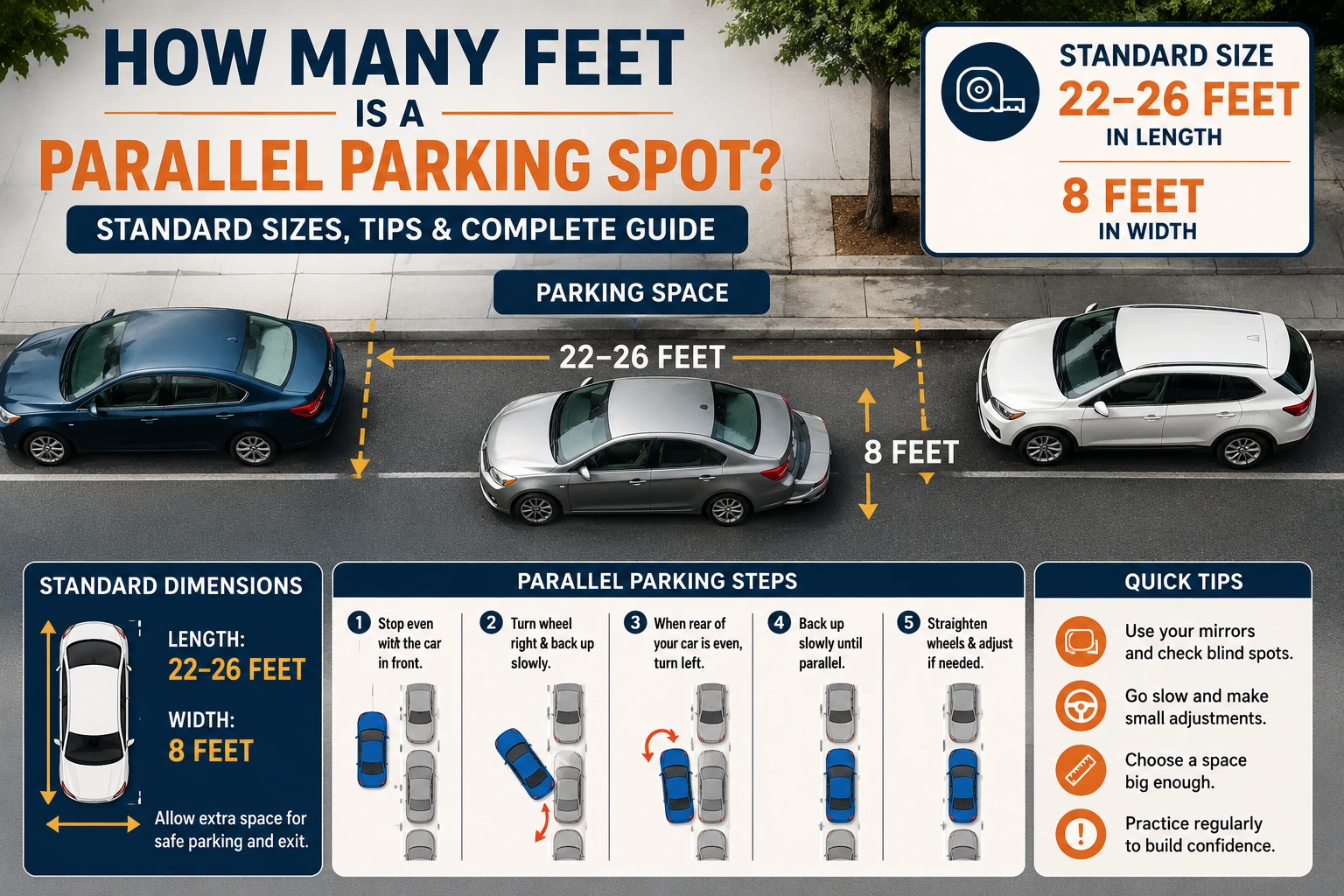
If you’re learning to drive or preparing for your driving test, you’ve probably wondered, how many feet is a parallel parking spot? Knowing the standard dimensions can make parking easier, improve your confidence behind the wheel, and help you avoid costly mistakes.
Parallel parking is one of the most important driving skills because it allows drivers to safely park along streets where space is limited. While the exact size of a parking space can vary depending on local regulations and vehicle types, there are common standards used across many cities and driving tests.
In this guide, you’ll learn the average length and width of a parallel parking spot, how those measurements compare for different vehicles, driving test requirements, practical examples, and expert tips that make parallel parking much less stressful.
What Is a Parallel Parking Spot?
A parallel parking spot is a designated space located alongside a curb where vehicles park parallel to the roadway instead of pulling into a parking lot space.
Unlike angled or perpendicular parking, parallel parking requires drivers to reverse into the space while keeping the vehicle aligned with the curb.
You’ll commonly find parallel parking spaces on:
- Residential streets
- Downtown business districts
- Shopping areas
- School zones
- City centers
- Urban neighborhoods
Because these spaces are often limited, learning how much room you need is essential.
Why Parallel Parking Matters
Parallel parking is more than just a driving test requirement.
It’s an everyday skill that helps drivers:
- Park safely in crowded cities
- Avoid blocking traffic
- Prevent vehicle damage
- Maximize available street parking
- Follow local parking regulations
Many driving exams include parallel parking because it demonstrates vehicle control, awareness, and precision.
How Many Feet Is a Parallel Parking Spot?
The average parallel parking spot measures between 22 and 26 feet long and approximately 8 feet wide.
Most cities design spaces that accommodate standard passenger vehicles while leaving enough room to enter and exit safely.
Here is a general guide.
| Parking Space | Typical Measurement |
|---|---|
| Length | 22–26 feet |
| Width | 8 feet |
| Minimum Recommended Length | 20 feet |
| Comfortable Length | 24–26 feet |
For larger SUVs, pickup trucks, and vans, parking spaces closer to 26 feet provide a more comfortable fit.
Standard Length
The length of a parallel parking spot depends on local parking standards and the surrounding road layout.
Typical measurements include:
| Vehicle Type | Recommended Space Length |
|---|---|
| Compact Cars | 20–22 feet |
| Sedans | 22–24 feet |
| SUVs | 24–26 feet |
| Pickup Trucks | 24–28 feet |
| Large Vans | 26–30 feet |
These dimensions allow enough clearance in front of and behind the vehicle for safe parking and exiting.
Standard Width
Although people often focus on length, width is equally important.
A standard parallel parking space is generally:
- 8 feet wide
- Occasionally 7.5 feet in older city streets
- Up to 9 feet in newer developments
The width provides enough room to:
- Open vehicle doors
- Exit comfortably
- Maintain safe distance from passing traffic
Parallel Parking Spot Size Chart
The following table summarizes typical dimensions.
| Parking Type | Length | Width |
|---|---|---|
| Compact Vehicle | 20–22 ft | 8 ft |
| Standard Passenger Car | 22–24 ft | 8 ft |
| Large SUV | 24–26 ft | 8–9 ft |
| Pickup Truck | 24–28 ft | 8–9 ft |
| Commercial Vehicle | 28–35 ft | 9–10 ft |
Keep in mind that municipalities may establish slightly different requirements depending on available street space.
Driving Test Parallel Parking Requirements
Many people search for how many feet is a parallel parking spot because they’re preparing for a driving test.
While every state or country has its own testing standards, most driving exams use dimensions similar to real world parking spaces.
United States
In many U.S. states:
- Parking spaces measure approximately 22–25 feet long.
- The curb is clearly marked.
- Traffic cones often simulate parked vehicles.
- Drivers are expected to park within 12–18 inches of the curb.
Some testing locations use slightly larger spaces to accommodate beginner drivers.
Canada
Canadian driving tests generally follow similar standards.
Applicants are usually required to:
- Reverse smoothly into the space.
- Finish within a reasonable time.
- Stay close to the curb.
- Avoid hitting cones or markers.
Most testing spaces range between 22 and 26 feet.
Other Countries
Parallel parking requirements vary around the world.
For example:
| Country | Typical Test Space |
|---|---|
| United Kingdom | Approximately one and a half car lengths |
| Australia | Around 23–26 feet |
| New Zealand | Similar to local street parking |
| European countries | Varies by city regulations |
Always review your local driver’s handbook before taking a road test.
Why Parking Spot Sizes Vary
Not every parallel parking space has identical dimensions.
Several factors influence parking spot length.
Vehicle Type
Cities must accommodate different kinds of vehicles.
For example:
- Compact cars require less space.
- SUVs need additional clearance.
- Pickup trucks have longer wheelbases.
- Commercial vans require significantly larger spaces.
Because of these differences, municipalities often design parking spaces that fit average passenger vehicles while leaving extra room for larger models.
Local Regulations
Every city or transportation department establishes its own parking guidelines.
Factors considered include:
- Street width
- Traffic volume
- Speed limits
- Emergency vehicle access
- Population density
- Public safety requirements
Older downtown districts may have shorter parking spaces because roads were designed decades ago.
Urban vs Rural Areas
Parking spaces also differ based on location.
Urban areas
- Limited street space
- Higher parking demand
- Smaller parking spots
- Closer vehicle spacing
Rural or suburban areas
- Wider roads
- More available land
- Larger parking spaces
- Easier parking access
Understanding these differences helps drivers adjust their parking technique depending on where they’re driving.
How Much Space Different Vehicles Need
Not every vehicle requires the same amount of room to park comfortably.
Here’s a comparison of common vehicle sizes.
| Vehicle | Vehicle Length | Recommended Parking Space |
|---|---|---|
| Compact Car | 13–15 ft | 20–22 ft |
| Mid Size Sedan | 15–17 ft | 22–24 ft |
| Full Size Sedan | 16–18 ft | 24 ft |
| SUV | 16–19 ft | 24–26 ft |
| Pickup Truck | 18–21 ft | 26–28 ft |
As a general rule, a parking space should be 4 to 8 feet longer than the vehicle itself. This extra clearance allows drivers to maneuver into the space safely without making excessive adjustments.
Practical Examples
Understanding real-world parking dimensions makes it easier to judge whether a parking space is suitable for your vehicle.
Example 1
Vehicle: Compact Car
Vehicle Length: 14 feet
Parking Space: 22 feet
Remaining clearance:
- Front: Approximately 4 feet
- Rear: Approximately 4 feet
This provides plenty of room to maneuver into the space with minimal adjustments.
Example 2
Vehicle: Mid Size Sedan
Vehicle Length: 16 feet
Parking Space: 24 feet
Remaining clearance:
- Around 4 feet at the front
- Around 4 feet at the rear
This is considered an ideal parking scenario for most drivers.
Example 3
Vehicle: Large SUV
Vehicle Length: 19 feet
Parking Space: 26 feet
Remaining clearance:
- Roughly 3.5 feet on each end
Although the space is tighter, experienced drivers can park comfortably with proper technique.
How to Parallel Park Step by Step
Knowing the dimensions is only part of successful parallel parking. Following a consistent method helps you park accurately and safely.
Step 1
Signal early to let other drivers know you intend to park.
Step 2
Pull alongside the parked vehicle in front of the empty space.
Leave about:
- 2 to 3 feet between vehicles
- Rear bumpers roughly aligned
Step 3
Shift into reverse.
Turn the steering wheel toward the curb while slowly backing up.
Step 4
When your front door reaches the rear bumper of the parked vehicle, begin turning the steering wheel in the opposite direction.
Step 5
Continue reversing until your vehicle is parallel with the curb.
Step 6
Straighten the wheels and adjust your position if necessary.
Ideally, your vehicle should finish:
- 6 to 18 inches from the curb
- Centered within the parking space
- Without touching the curb
Tips for Successful Parallel Parking
Even experienced drivers appreciate a few helpful reminders.
Practice With Cones
Traffic cones allow you to practice without worrying about damaging another vehicle.
Use Your Mirrors
Check:
- Rearview mirror
- Side mirrors
- Blind spots
before and during every maneuver.
Take Your Time
Rushing usually causes mistakes.
Move slowly and make small steering adjustments.
Learn Your Vehicle’s Dimensions
Knowing your car’s:
- Length
- Turning radius
- Width
makes parking much easier.
Avoid Over Steering
Many beginners turn the steering wheel too sharply.
Smooth steering movements create better positioning.
Look Behind You
Backup cameras help, but you should also physically turn your head to check for pedestrians, cyclists, and approaching vehicles.
Benefits of Understanding Parallel Parking Dimensions
Knowing the answer to how many feet is a parallel parking spot provides several practical advantages.
Greater Confidence
Understanding available space helps eliminate uncertainty when parking.
Easier Driving Tests
Many driving exam failures occur because applicants misjudge parking space dimensions.
Reduced Risk of Damage
Proper spacing lowers the chance of:
- Scraping bumpers
- Hitting curbs
- Contacting nearby vehicles
Faster Parking
Experienced drivers quickly recognize whether a space is suitable.
Better Urban Driving Skills
Cities often have limited parking.
Knowing standard dimensions helps you take advantage of available spaces safely.
Common Mistakes
Even after learning the correct parking dimensions, drivers often make avoidable errors.
Choosing a Space That’s Too Small
One of the biggest mistakes is attempting to fit into a space that’s shorter than recommended.
Remember:
Your parking space should generally be 4 to 8 feet longer than your vehicle.
Ignoring Mirrors
Failing to monitor surrounding traffic increases the risk of accidents.
Always check mirrors throughout the maneuver.
Parking Too Far From the Curb
Many states require vehicles to park within 12 to 18 inches of the curb.
Parking farther away can result in:
- Traffic obstruction
- Parking violations
- Reduced safety
Turning Too Early
Beginning your turn too soon often causes your vehicle to hit the curb.
Practice proper timing.
Forgetting About Front Clearance
Many drivers focus only on the rear of the vehicle.
Leave enough room in front so both you and other drivers can exit the parking space comfortably.
Expert Tips
Professional driving instructors recommend these habits.
- Practice in an empty parking lot before parking on busy streets.
- Learn reference points using your own vehicle instead of memorizing generic instructions.
- Adjust mirrors properly before driving.
- Stay calm during the maneuver.
- Do not feel pressured by vehicles waiting behind you.
- Use small steering corrections instead of large movements.
- Practice parking from both directions.
- Become familiar with local parking laws.
The more you practice, the easier parallel parking becomes.
FAQs
How many feet is a standard parallel parking spot?
Most standard parallel parking spots measure between 22 and 26 feet long and approximately 8 feet wide.
How much longer should a parking space be than my car?
A good rule is to choose a parking space that is 4 to 8 feet longer than your vehicle. This provides enough room to maneuver safely.
What size parallel parking space is used on driving tests?
Many driving tests use spaces measuring approximately 22 to 25 feet, although the exact dimensions vary by state or testing authority.
Can a pickup truck fit in a standard parallel parking space?
Yes, but larger pickup trucks usually require spaces closer to 26 to 28 feet for comfortable parking.
How close should I park to the curb?
In most areas, drivers should park within 6 to 18 inches of the curb, depending on local traffic regulations.
Conclusion
Knowing how many feet is a parallel parking spot can make everyday driving much easier and improve your confidence behind the wheel. While most standard parallel parking spaces measure 22 to 26 feet long and about 8 feet wide, the ideal size depends on your vehicle and local regulations. By understanding parking dimensions, practicing proper techniques, and allowing enough clearance, you’ll park more safely, avoid unnecessary damage, and perform better during driving tests. Whether you’re a new driver or simply looking to sharpen your skills, mastering parallel parking is a valuable ability that will serve you wherever you drive.
Discover more