

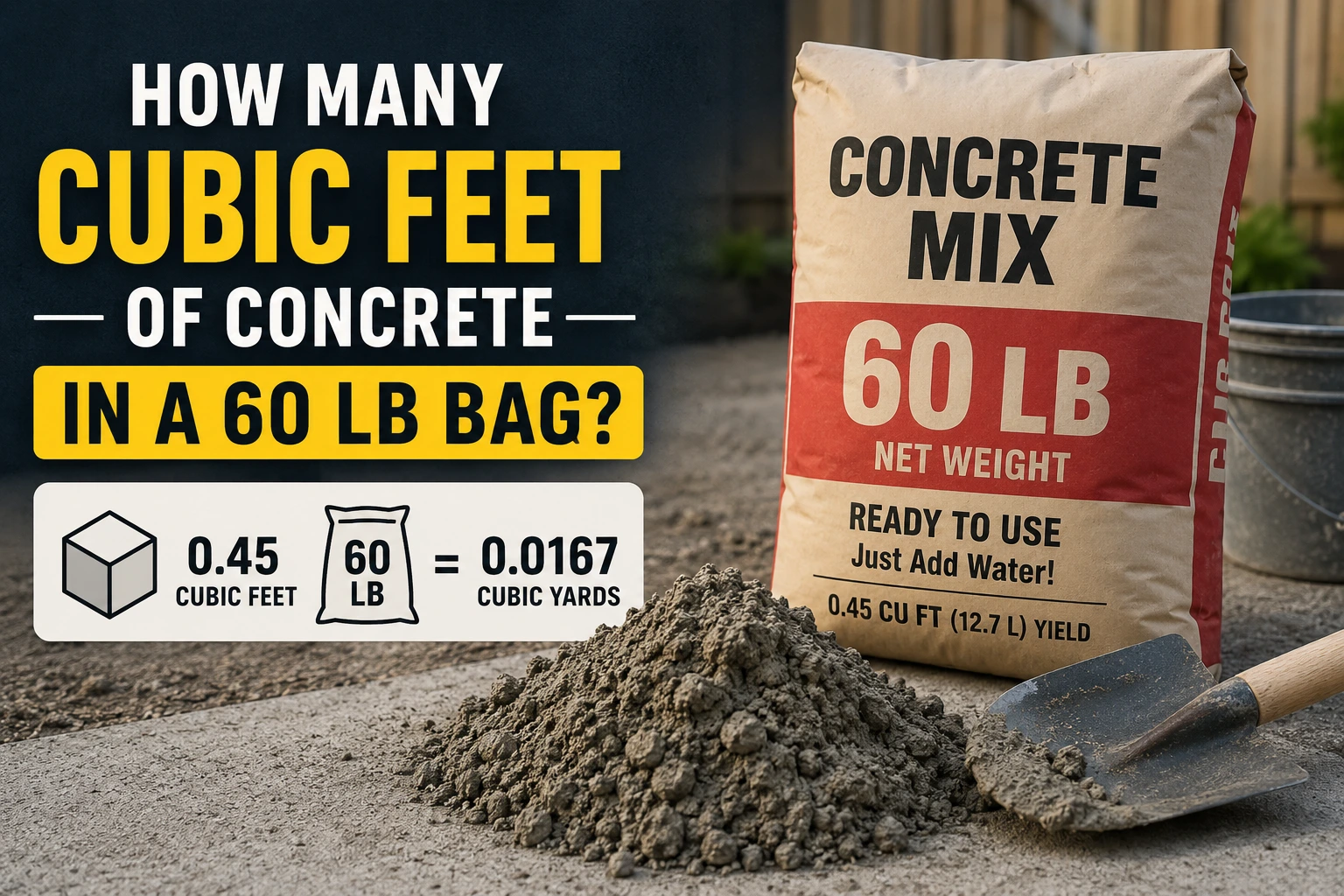
If you are planning a concrete project, one of the first questions you may ask is: how many cubic feet of concrete in a 60 lb bag? Knowing the answer helps you estimate materials correctly, avoid waste, and stay within budget.
A standard 60 lb bag of premixed concrete typically yields about 0.45 cubic feet of cured concrete. This measurement is important for projects like patios, fence posts, sidewalks, deck footings, and small slabs.
Many DIY homeowners buy too few bags and end up making extra trips to the hardware store. Others buy far too much and waste money. Understanding concrete yield can save time, effort, and frustration.
In this guide, you will learn exactly how much concrete a 60 lb bag produces, how to calculate coverage, how many bags you need for different projects, and practical tips for successful concrete work.
Understanding Concrete Bag Yield
Before calculating concrete needs, it helps to understand what “yield” means.
What Is Concrete Yield?
Concrete yield refers to the total volume of finished concrete produced after mixing the dry material with water. Manufacturers list this measurement in cubic feet.
For example, when a 60 lb concrete bag says it yields 0.45 cubic feet, that means the mixed and cured concrete will occupy that amount of space.
Concrete yield depends on:
- Bag weight
- Aggregate size
- Cement composition
- Water content
- Brand formulation
Although small variations exist, most standard 60 lb bags provide nearly the same output.
Standard Yield of a 60 lb Bag
A typical 60 lb bag of concrete produces:
0.45 cubic feet
This is the industry-standard estimate used by contractors and concrete calculators.
In cubic yards, that equals:
270.45≈0.0167 cubic yards
Since one cubic yard equals 27 cubic feet, you would need many bags for larger pours.
How Many Cubic Feet of Concrete in a 60 lb Bag Exactly?
The direct answer is simple.
A standard 60 lb bag of concrete yields approximately 0.45 cubic feet when mixed properly.
This number is widely accepted for common ready-mix products sold at home improvement stores.
Standard Measurement Explained
Here is a quick reference:
| Concrete Bag Size | Approximate Yield |
|---|---|
| 40 lb bag | 0.30 cubic feet |
| 50 lb bag | 0.37 cubic feet |
| 60 lb bag | 0.45 cubic feet |
| 80 lb bag | 0.60 cubic feet |
These values are averages and may vary slightly depending on the manufacturer.
Why Yield Can Slightly Vary
Several factors affect the final concrete volume:
- Too much water can weaken the mix
- Poor compaction creates air pockets
- Aggregate type changes density
- Brand formulations differ slightly
Always check the product label for exact yield information.
Coverage Chart for a 60 lb Concrete Bag
Many people struggle to visualize cubic feet. Coverage charts make estimating much easier.
The table below shows how much area one 60 lb bag covers at different slab thicknesses.
Coverage by Thickness
| Thickness | Approximate Coverage |
|---|---|
| 1 inch | 5.4 square feet |
| 2 inches | 2.7 square feet |
| 3 inches | 1.8 square feet |
| 4 inches | 1.35 square feet |
| 6 inches | 0.9 square feet |
Thicker slabs require more concrete volume.
Quick Reference Table
Here is another practical example:
| Project Type | Approximate Bags Needed |
|---|---|
| Fence post footing | 1–2 bags |
| Basketball pole base | 4–6 bags |
| Small sidewalk repair | 6–10 bags |
| 4×4 patio slab | 16–20 bags |
These estimates include minor waste allowance.
How to Calculate Concrete Needed for Your Project
Learning the basic formula helps you estimate accurately for almost any concrete project.
Concrete Volume Formula
The standard formula is:
Volume=Length×Width×Thickness
Always convert measurements into feet before calculating.
Step-by-Step Example
Suppose you are pouring a slab:
- Length = 10 feet
- Width = 8 feet
- Thickness = 4 inches
Convert thickness to feet:
4 inches=124=0.333 feet
Now calculate total volume:
10×8×0.333≈26.64 cubic feet
Now divide by the yield per bag:
0.4526.64≈59.2
You would need approximately 60 bags of 60 lb concrete mix.
Always round up slightly for waste and spillage.
Real World Examples of Concrete Usage
Concrete calculations become easier when you look at real applications.
Fence Post Installation
A standard fence post hole often measures:
- 12 inches diameter
- 24 inches deep
This usually requires about 1 to 2 bags of 60 lb concrete.
For stronger support in windy areas, contractors may increase the footing size.
Small Patio Slab
A 6×6 patio with 4-inch thickness requires:
6×6×0.333≈12 cubic feet
Divide by 0.45 cubic feet per bag:
0.4512≈27 bags
You would need about 27 bags.
Sidewalk Repair
A sidewalk section measuring:
- 3 feet wide
- 5 feet long
- 4 inches thick
Requires:
3×5×0.333≈5 cubic feet
That equals roughly 11 bags of 60 lb concrete mix.
60 lb vs 80 lb Concrete Bags
Many people wonder whether a 60 lb or 80 lb bag is better.
Yield Comparison
| Bag Size | Yield | Weight Handling |
|---|---|---|
| 60 lb | 0.45 cubic feet | Easier to carry |
| 80 lb | 0.60 cubic feet | Heavier but fewer bags |
An 80 lb bag gives more volume, but lifting it can be difficult for some users.
Which One Should You Choose?
Choose 60 lb bags if:
- You want easier handling
- You are working alone
- You have small projects
- You need precise mixing amounts
Choose 80 lb bags if:
- You are pouring large slabs
- You want fewer bags
- You have help lifting materials
- You need faster project completion
Many contractors prefer 80 lb bags for efficiency.
Common Mistakes When Estimating Concrete
Even experienced DIYers sometimes make estimation errors.
Ignoring Waste
Concrete projects usually involve:
- Spillage
- Uneven ground
- Overfilling forms
- Mixing loss
Add at least 5% to 10% extra material to your estimate.
Wrong Thickness Measurements
Many slab failures happen because concrete is too thin.
Driveways usually need:
- 4 inches minimum
- 5–6 inches for heavy vehicles
Patios may only need 4 inches.
Always measure carefully before buying concrete.
Mixing Too Much Water
Adding excess water weakens concrete strength and durability.
Too much water can cause:
- Cracking
- Shrinkage
- Surface dusting
- Reduced load capacity
Follow the manufacturer’s recommended water ratio.
Expert Tips for Working With Bagged Concrete
Concrete work becomes easier with proper preparation.
Mixing Tips
For best results:
- Use cold clean water
- Mix thoroughly
- Avoid dry pockets
- Use a wheelbarrow or mixer
- Pour quickly after mixing
Concrete begins setting faster in hot weather.
Weather Considerations
Temperature affects curing significantly.
Hot weather:
- Speeds curing
- Increases cracking risk
- Requires extra moisture
Cold weather:
- Slows curing
- May weaken concrete if frozen
Ideal pouring temperatures are between 50°F and 70°F.
Best Practices for Strong Concrete
Professional contractors recommend:
- Compacting concrete properly
- Removing air bubbles
- Finishing surfaces evenly
- Keeping concrete moist while curing
- Allowing full cure time before heavy loads
Concrete reaches most of its strength after about 28 days.
Benefits of Using Bagged Concrete
Bagged concrete remains popular for small projects because it offers several advantages.
Easy Availability
You can find premixed concrete at:
- Home improvement stores
- Hardware shops
- Building supply centers
This makes quick projects convenient.
Beginner Friendly
Premixed bags simplify the process because:
- Ingredients are pre-measured
- No advanced equipment is needed
- Instructions are straightforward
DIY homeowners often prefer bagged mixes for repairs and home upgrades.
Reduced Waste on Small Projects
Ready-mix truck deliveries are impractical for tiny pours. Bagged concrete allows smaller batch mixing.
This reduces unnecessary expense.
When You Should Not Use Bagged Concrete
Although convenient, bagged concrete is not ideal for every situation.
Large projects may require:
- Concrete trucks
- Power mixers
- Reinforcement planning
- Professional finishing crews
For driveways, foundations, or large patios, ready-mix delivery is often more cost effective.
Frequently Asked Questions
How many cubic feet of concrete in a 60 lb bag?
A standard 60 lb bag yields approximately 0.45 cubic feet of mixed concrete.
How many 60 lb bags make one cubic yard?
Since one cubic yard equals 27 cubic feet:
0.4527=60
You need about 60 bags.
How much area does a 60 lb concrete bag cover?
Coverage depends on thickness. At 4 inches thick, one bag covers about 1.35 square feet.
Is a 60 lb bag enough for a fence post?
Yes, many fence post installations use 1 to 2 bags depending on hole size and soil conditions.
Should I buy extra concrete bags?
Yes. It is smart to buy 5% to 10% extra to account for waste, spills, and uneven surfaces.
10. Conclusion
Understanding how many cubic feet of concrete in a 60 lb bag is essential for planning successful concrete projects. A typical 60 lb bag yields about 0.45 cubic feet of concrete, making it useful for small slabs, fence posts, sidewalks, and repair jobs.
Using proper calculations helps prevent material shortages and unnecessary costs. Always measure carefully, account for waste, and choose the right bag size for your project. Whether you are a beginner DIY homeowner or an experienced contractor, accurate concrete estimation saves time, money, and effort while producing stronger and longer-lasting results.
Discover more
how many cubic feet in a cubic yard of concrete