

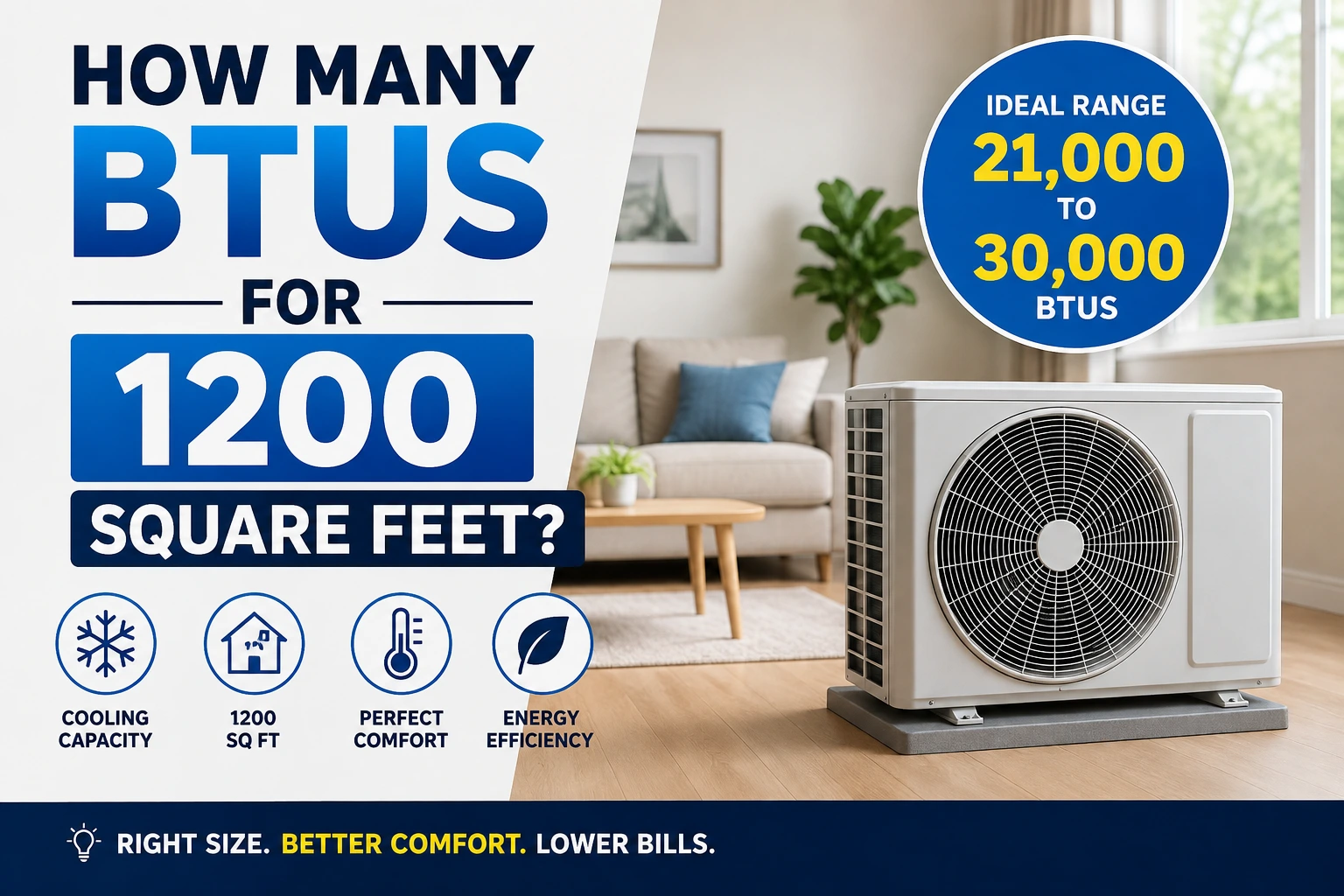
If you are asking how many BTUs for 1200 square feet, the answer depends on more than floor area alone. A 1200 square foot home may need around 21,000 to 30,000 BTUs per hour depending on the type of air conditioner, climate, insulation, ceiling height, sunlight, windows, and how the space is used.
For a basic room air conditioner, ENERGY STAR lists 21,000 BTUs per hour for an area from 1,000 to 1,200 square feet and 23,000 BTUs per hour for 1,200 to 1,400 square feet, assuming standard conditions and an 8 foot ceiling.
For a central air conditioning system, however, you should not simply multiply square footage by a fixed BTU number. The US Department of Energy explains that HVAC sizing should account for climate, insulation, building efficiency, and other factors, with a professional load calculation being the better approach.
How Many BTUs for 1200 Square Feet?
A useful starting point is 21,000 to 24,000 BTUs per hour for a typical 1200 square foot space under average conditions.
However, your actual requirement can be higher or lower.
| Space and Conditions | Approximate Cooling Capacity |
|---|---|
| Well insulated 1200 square feet | 21,000 to 24,000 BTUs |
| Average insulation | 23,000 to 27,000 BTUs |
| Hot climate | 27,000 to 30,000 BTUs |
| Very sunny space | 27,000 to 30,000 BTUs |
| Poor insulation or high heat gain | 30,000 BTUs or more |
These numbers are useful for understanding the range, but they should not replace a proper cooling load calculation for a central HVAC installation.
ENERGY STAR also warns that an oversized air conditioner is not automatically better. A unit that cools too quickly may not remove enough humidity, which can leave the room feeling damp even when the temperature is low.
What Does BTU Mean?
BTU stands for British thermal unit. In air conditioning, BTUs are used to describe how much heat an air conditioner can remove from a space over one hour.
For example, a 24,000 BTU air conditioner has a cooling capacity of 24,000 BTUs per hour.
BTU capacity is not the same as electricity consumption. A higher BTU rating means the system can remove more heat, but the amount of electricity it uses depends on factors such as efficiency, compressor technology, operating conditions, and the system design.
This distinction is important when comparing air conditioners.
A properly sized and efficient system can provide comfortable cooling without unnecessarily increasing energy use.
What Size AC Do I Need for 1200 Square Feet?
For many 1200 square foot homes, a system in the 24,000 BTU range can be a reasonable starting point. This is equal to 2 tons of cooling capacity, because one ton of cooling represents 12,000 BTUs per hour.
A 30,000 BTU system represents 2.5 tons of cooling capacity.
| AC Capacity | Equivalent Cooling Capacity |
| 18,000 BTUs | 1.5 tons |
| 21,000 BTUs | 1.75 tons |
| 24,000 BTUs | 2 tons |
| 30,000 BTUs | 2.5 tons |
| 36,000 BTUs | 3 tons |
The important point is that these numbers are not interchangeable recommendations for every 1200 square foot home.
A highly insulated home in a mild climate may need considerably less cooling than an older home with large sunny windows in a very hot climate.
The Department of Energy specifically notes that the old rule of using one ton for every 400 to 500 square feet does not account for climate or building efficiency.
How Climate Changes BTU Requirements
Climate is one of the biggest factors affecting air conditioner sizing.
A 1200 square foot home in a mild climate may have a lower cooling requirement than the same size home in an extremely hot region.
Hot weather increases the amount of heat entering the building through the roof, walls, windows, doors, and other surfaces. The air conditioner must remove that additional heat to maintain the desired indoor temperature.
If you live in a particularly hot climate, choosing a system near the upper end of the expected range may seem attractive. However, increasing capacity without calculating the actual cooling load can also result in an oversized system.
The right approach is to consider the local climate together with insulation, windows, ceiling height, occupancy, and other heat sources.
How Insulation Affects BTU Requirements
Insulation helps slow the movement of heat into and out of your home.
A well insulated 1200 square foot house can require less cooling capacity than a poorly insulated house of exactly the same size.
Consider two homes.
The first has:
- Good attic insulation
- Insulated walls
- Modern windows
- Properly sealed doors
- Limited direct sunlight
The second has:
- Poor attic insulation
- Older windows
- Air leaks around doors
- A hot roof
- Large areas exposed to direct sunlight
Both homes have 1200 square feet of floor space, but their cooling loads can be very different.
This is why square footage should be treated as a starting point rather than the complete sizing calculation.
How Sunlight and Windows Affect AC Size
Windows can have a major impact on the amount of heat entering a building.
A room with large south or west facing windows may receive substantial solar heat during the day. Older single pane windows can also allow more heat to enter than modern energy efficient windows.
ENERGY STAR recommends adjusting room air conditioner sizing based on sunlight. Its guidance suggests reducing capacity by 10 percent for heavily shaded spaces and increasing capacity by 10 percent for very sunny spaces.
Window coverings, exterior shading, trees, window orientation, and glass type can therefore affect the amount of cooling required.
For example, two 1200 square foot homes with identical floor plans can have different cooling needs if one has heavy shade and the other receives direct afternoon sunlight.
Does Ceiling Height Matter?
Yes.
Many basic room air conditioner sizing charts are based on an 8 foot ceiling. ENERGY STAR states that its room air conditioner capacity chart uses an 8 foot ceiling as the basis.
A home with 10 or 12 foot ceilings contains more air volume than a home with the same floor area and 8 foot ceilings.
However, air conditioner sizing is not based solely on air volume. Heat gain through the building envelope, insulation, windows, ventilation, and other factors also matter.
If your home has unusually high ceilings, mention this when speaking with an HVAC professional.
How Many BTUs for 1200 Square Feet in Different Conditions?
There is no single BTU number that works perfectly for every 1200 square foot home.
Here are practical examples.
Example 1: Well Insulated Home
Suppose your 1200 square foot home has good insulation, energy efficient windows, average ceiling height, and moderate sunlight.
A cooling capacity around 21,000 to 24,000 BTUs may be within a reasonable starting range.
A professional calculation should still confirm the final equipment size.
Example 2: Average Home in a Warm Climate
Suppose the home has average insulation, several windows, standard ceilings, and experiences warm summers.
A system around 24,000 to 30,000 BTUs may be considered depending on the actual cooling load.
Example 3: Older Home With High Heat Gain
An older home with poor insulation, air leaks, large windows, high ceilings, and strong sunlight may require more cooling capacity.
In this situation, simply purchasing a 24,000 BTU system because the home is 1200 square feet may not provide the expected comfort.
The better solution is to identify where the heat is entering the building and perform a proper load calculation.
Is 24000 BTU Enough for 1200 Square Feet?
In many situations, 24,000 BTUs can be enough for 1200 square feet, particularly when the building has average or good insulation and the climate is not extremely demanding.
It is also equal to 2 tons of cooling.
However, 24,000 BTUs should not automatically be treated as the correct size.
If the home has unusually high heat gain, poor insulation, large windows, or other demanding conditions, the actual requirement could be higher.
On the other hand, an efficient and well insulated home may require less capacity.
The most important question is not simply whether 24,000 BTUs sounds large enough. The question is whether the cooling load of the building actually requires that capacity.
Is 30000 BTU Enough for 1200 Square Feet?
A 30,000 BTU system can provide substantial cooling for a 1200 square foot property.
It may be appropriate in some hot climates or buildings with significant heat gain. However, installing a 30,000 BTU system simply because you want faster cooling can create a sizing problem.
An oversized system may reach the thermostat setting quickly and shut down before it has properly removed humidity from the air.
ENERGY STAR explains that oversized room air conditioners can reduce comfort because they may cool the space before adequately removing moisture.
Therefore, 30,000 BTUs may be right for one property and too large for another.
Room AC Versus Central AC Sizing
The type of air conditioner also matters.
A room air conditioner is normally selected according to the area it is intended to cool. ENERGY STAR provides a specific room AC sizing chart based on square footage.
A central air conditioning system is different because it is designed to cool the entire building through a distribution system.
Central AC sizing should consider:
- Building envelope
- Insulation
- Window area
- Window orientation
- Ceiling height
- Local climate
- Air leakage
- Occupancy
- Internal heat sources
- Ductwork
- Desired indoor temperature
For this reason, professional HVAC sizing is usually based on a detailed cooling load calculation rather than a simple square footage formula.
Common Mistakes When Choosing AC Size
Choosing an air conditioner for a 1200 square foot home can seem simple, but several common mistakes can lead to poor performance.
Choosing the Biggest Unit
A larger air conditioner is not always better.
Oversizing can cause short operating cycles and inadequate humidity removal. It can also increase equipment costs and energy use.
Using Only Square Footage
Square footage is useful, but it does not tell the entire story.
Two properties with the same floor area can have very different cooling loads.
Ignoring Insulation
Poor insulation allows more heat into the building. If insulation is ignored, the cooling requirement may be underestimated.
Ignoring Windows
Large or poorly insulated windows can contribute significant solar heat gain.
Forgetting Climate
A sizing method that works reasonably well in one climate may not work in another.
Assuming Every 1200 Square Foot Home Needs the Same BTU Rating
This is one of the biggest mistakes.
The correct capacity depends on the actual building conditions.
How to Calculate the Right AC Size
You can use the following process as a basic starting point.
Step 1: Confirm the Floor Area
Measure the length and width of each area being cooled.
For a simple rectangular area:
Length × Width = Square Feet
For multiple rooms, calculate each room and add the results.
ENERGY STAR recommends accurately measuring the space rather than estimating the floor area.
Step 2: Check Ceiling Height
Determine whether your ceilings are close to the standard 8 foot height used in basic sizing charts.
Higher ceilings can change the cooling requirements.
Step 3: Evaluate Insulation
Look at attic, wall, and floor insulation.
Poor insulation can increase heat gain.
Step 4: Check Windows and Sunlight
Count large windows and consider which direction they face.
Also consider whether the property receives heavy shade or direct sunlight.
Step 5: Consider Local Climate
Hot and humid conditions can increase cooling requirements.
Step 6: Consider Occupancy
People generate heat. ENERGY STAR recommends adding 600 BTUs for each person beyond two regular occupants when sizing certain room air conditioners.
Step 7: Get a Professional Load Calculation
For a central HVAC system, a professional load calculation is the most reliable approach.
The Department of Energy recommends using recognized sizing methods such as ACCA Manual J rather than relying only on rules of thumb.
Expert Tips for a 1200 Square Foot Home
If you are choosing an air conditioner, keep these points in mind.
- Do not automatically choose the highest BTU rating.
- Check the manufacturer’s efficiency rating before purchasing.
- Make sure the ductwork is suitable for the selected system.
- Improve insulation before increasing AC capacity when practical.
- Seal obvious air leaks around doors and windows.
- Use curtains or shades to reduce direct solar heat.
- Keep filters clean so the system can maintain proper airflow.
- Ask an HVAC professional for a load calculation before installing central AC.
- Consider humidity control if you live in a humid climate.
- Compare both cooling capacity and energy efficiency.
Correct sizing is important because the goal is not simply to make the room colder. The goal is to maintain comfortable temperature and humidity while using energy efficiently.
Quick BTU Reference for 1200 Square Feet
For a quick reference, consider this range:
| Property Condition | Starting Point |
| Efficient and well insulated | 21,000 to 24,000 BTUs |
| Average construction | 24,000 BTUs |
| Warm climate | 24,000 to 30,000 BTUs |
| Very hot or high heat gain | 30,000 BTUs or more |
| Professional central AC sizing | Based on cooling load |
These values should be treated as general guidance rather than a final equipment specification.
ENERGY STAR’s current room AC chart places 1200 square feet at 21,000 BTUs for the 1,000 to 1,200 square foot range and 23,000 BTUs for the 1,200 to 1,400 square foot range.
FAQs
How many BTUs do I need for a 1200 square foot house?
A 1200 square foot house may need roughly 21,000 to 30,000 BTUs depending on climate, insulation, windows, ceiling height, sunlight, and other factors. A professional load calculation provides a more accurate answer.
Is 24000 BTU enough for 1200 square feet?
A 24,000 BTU system can be suitable for many 1200 square foot properties. Whether it is correct depends on the home’s insulation, climate, windows, sunlight, ceiling height, and cooling load.
How many tons of AC do I need for 1200 square feet?
A 24,000 BTU system equals 2 tons of cooling. However, 2 tons should not automatically be selected for every 1200 square foot property because actual cooling requirements vary.
Can an AC be too big for 1200 square feet?
Yes. An oversized AC can cool the space quickly but may not run long enough to remove sufficient humidity. This can reduce comfort and may increase operating costs.
What is the best way to size AC for 1200 square feet?
The best method for a central HVAC system is a professional cooling load calculation. Factors such as climate, insulation, windows, building orientation, ceiling height, occupancy, and air leakage should be considered instead of relying only on square footage.
Conclusion
If you are wondering how many BTUs for 1200 square feet, a reasonable general starting range is about 21,000 to 30,000 BTUs per hour, with approximately 24,000 BTUs being a useful reference point for many average properties.
However, the correct AC size depends on much more than square footage. Climate, insulation, ceiling height, windows, sunlight, occupancy, humidity, and building efficiency can all change the cooling requirement.
For room air conditioners, ENERGY STAR provides specific square footage guidance and recommends adjustments for factors such as shade, sunlight, additional occupants, and kitchen use.
For central air conditioning, the safest approach is to have the property professionally sized using a recognized cooling load method. This helps prevent both undersizing and oversizing.
The right system should provide consistent comfort, control humidity, maintain airflow, and operate efficiently. Instead of choosing the biggest unit available, choose the capacity that matches the actual cooling needs of your 1200 square foot space.
Discover more