
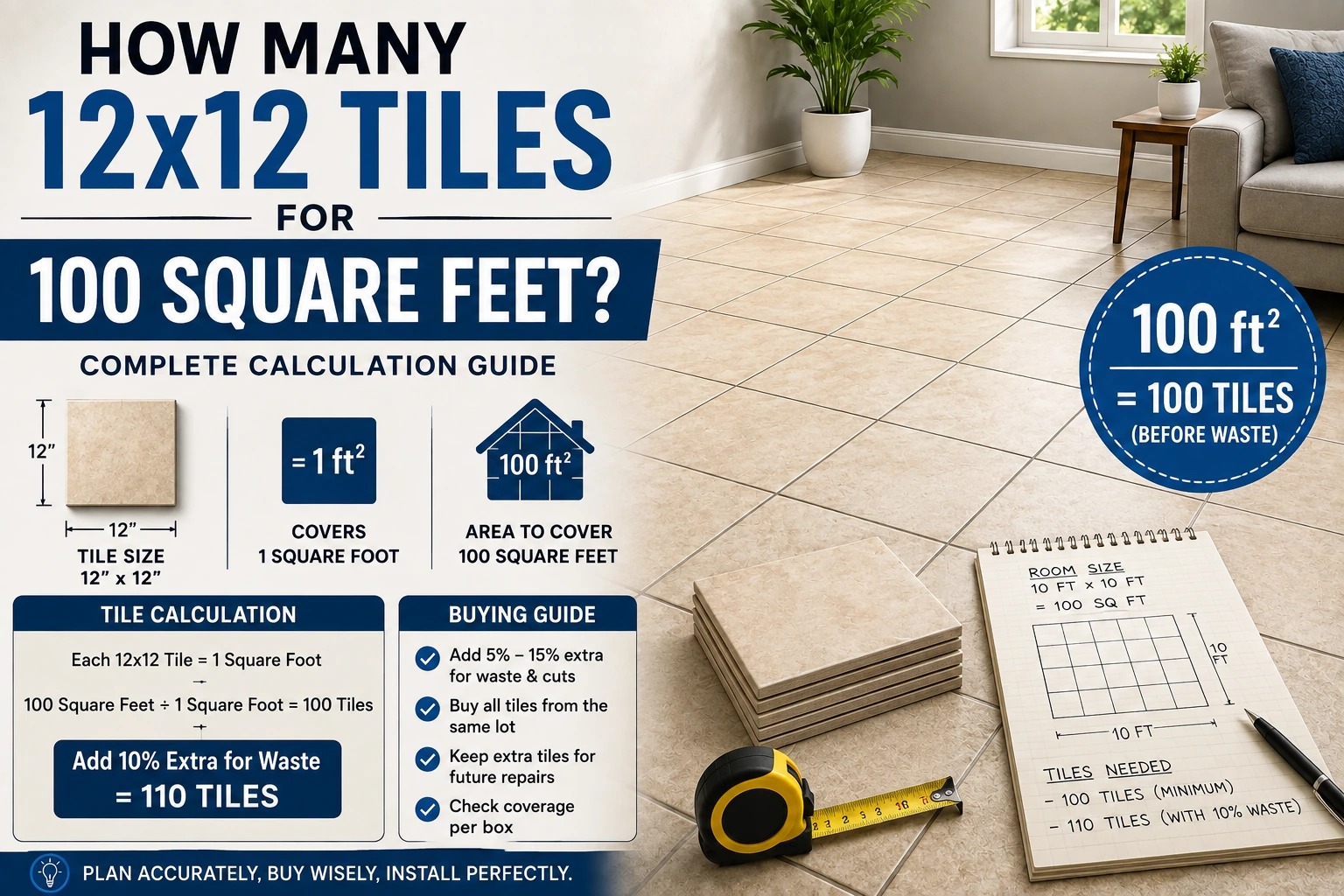
If you are wondering how many 12×12 tiles for 100 square feet, the basic answer is 100 tiles. A 12 inch by 12 inch tile covers exactly 1 square foot when the stated dimensions are the actual tile dimensions.
So, the basic calculation is simple:
100 square feet ÷ 1 square foot per tile = 100 tiles
However, buying exactly 100 tiles is not always the best idea. Real tile installations involve cuts around walls, corners, doors, cabinets, fixtures, and other obstacles. Tiles can also crack during transportation or installation.
For that reason, most flooring projects should include an additional amount for installation waste. Depending on the room shape and installation pattern, buying around 5 percent to 15 percent extra can be a sensible approach.
This guide explains the exact calculation, how much extra tile you may need, how to calculate boxes, and what to consider before purchasing.
How Many 12×12 Tiles for 100 Square Feet?
The answer is 100 tiles before accounting for waste.
A 12×12 tile measures 12 inches by 12 inches. Since 12 inches equals 1 foot, the tile measures 1 foot by 1 foot.
The area is calculated using:
Length × Width = Area
Therefore:
1 foot × 1 foot = 1 square foot
For 100 square feet:
100 ÷ 1 = 100 tiles
So, if your floor is exactly 100 square feet and there are no cuts, damaged tiles, or installation losses, 100 tiles would cover the entire area.
In real projects, however, you should usually purchase more than the exact calculated quantity.
How Much Area Does One 12×12 Tile Cover?
One standard 12×12 tile covers 1 square foot.
This makes 12×12 tiles particularly easy to calculate.
| Tile Size | Area Per Tile |
|---|---|
| 6 × 6 inches | 0.25 square feet |
| 8 × 8 inches | About 0.44 square feet |
| 10 × 10 inches | About 0.69 square feet |
| 12 × 12 inches | 1 square foot |
| 18 × 18 inches | 2.25 square feet |
| 24 × 24 inches | 4 square feet |
The important point is that tile dimensions are often given in inches while flooring areas are usually measured in square feet. Converting the tile dimensions correctly prevents calculation errors.
How to Calculate the Number of Tiles Needed
Calculating the number of 12×12 tiles required is straightforward.
Step 1: Convert Tile Dimensions to Feet
A 12 inch tile is equal to 1 foot.
Therefore, a 12 inch by 12 inch tile becomes:
1 foot × 1 foot
Step 2: Calculate One Tile’s Area
Multiply the length by the width:
1 × 1 = 1 square foot
Each tile therefore covers 1 square foot.
Step 3: Calculate the Total Number of Tiles
Divide the total floor area by the coverage of one tile.
For a 100 square foot floor:
100 ÷ 1 = 100 tiles
This is the exact theoretical quantity.
For another example, suppose your room measures 10 feet by 10 feet.
10 × 10 = 100 square feet
You would need 100 12×12 tiles before adding extra material for waste.
Should You Buy Extra Tiles?
Yes. For most tile projects, buying exactly the calculated number is risky.
Extra tiles are useful because some pieces may need to be cut. Others can break during installation. You may also discover that the room dimensions are not perfectly square.
A common approach is to purchase an additional percentage based on the complexity of the installation.
| Extra Tile Allowance | Tiles for 100 Square Feet |
| No extra | 100 tiles |
| 5 percent extra | 105 tiles |
| 10 percent extra | 110 tiles |
| 15 percent extra | 115 tiles |
| 20 percent extra | 120 tiles |
The final quantity may need to be rounded up because you cannot purchase a fraction of a whole tile.
Five Percent Extra
A 5 percent allowance may work for a simple room with a straightforward layout and relatively few cuts.
For 100 square feet:
100 × 0.05 = 5 extra tiles
Add those to the original 100 tiles:
100 + 5 = 105 tiles
So you would need approximately 105 tiles.
This approach can work well when the room is rectangular and the tile pattern is simple.
Ten Percent Extra
A 10 percent allowance is commonly used as a practical planning figure for many standard tile installations.
For 100 square feet:
100 × 0.10 = 10 extra tiles
Then:
100 + 10 = 110 tiles
Therefore, you would purchase approximately 110 12×12 tiles for a typical 100 square foot project.
This gives you a reasonable cushion for cuts, breakage, and minor measurement differences.
Fifteen Percent Extra
A 15 percent allowance may be appropriate when the room has many corners, unusual shapes, obstacles, or a more complicated installation pattern.
For 100 square feet:
100 × 0.15 = 15 extra tiles
Then:
100 + 15 = 115 tiles
You would therefore plan for approximately 115 tiles.
More complicated patterns can create more cutting waste because pieces may not be reusable elsewhere.
How Many 12×12 Tiles Do You Need With Waste?
The answer depends on the waste allowance you choose.
For a 100 square foot area:
Exact requirement: 100 tiles
With 5 percent waste: 105 tiles
With 10 percent waste: 110 tiles
With 15 percent waste: 115 tiles
For many straightforward installations, 10 percent extra provides a useful balance between having enough material and avoiding excessive leftovers.
However, the ideal allowance depends on the room and installation method.
A simple rectangular room with a straight tile pattern may require less extra material than a room with multiple angles and complicated cuts.
How Many Boxes of 12×12 Tile Do You Need?
Tile is often sold by the box rather than as individual pieces. The number of boxes you need depends on how many tiles each box contains.
For example, suppose one box contains 10 tiles.
Since each 12×12 tile covers 1 square foot, one box covers:
10 × 1 = 10 square feet
For a 100 square foot floor without waste:
100 ÷ 10 = 10 boxes
If you want 10 percent extra:
110 tiles ÷ 10 tiles per box = 11 boxes
So you would purchase 11 boxes.
Always check the manufacturer’s packaging because different products can contain different numbers of tiles per box.
Some boxes are labeled by total square foot coverage rather than tile count. If that is the case, use the stated coverage on the packaging.
Tile Quantity Examples for Different Room Sizes
Because each 12×12 tile covers 1 square foot, the calculation is especially simple.
| Floor Area | Exact Tiles | With 10 Percent Extra |
| 25 square feet | 25 | 28 tiles |
| 50 square feet | 50 | 55 tiles |
| 75 square feet | 75 | 83 tiles |
| 100 square feet | 100 | 110 tiles |
| 125 square feet | 125 | 138 tiles |
| 150 square feet | 150 | 165 tiles |
| 200 square feet | 200 | 220 tiles |
| 250 square feet | 250 | 275 tiles |
When using a percentage allowance, round up to a whole tile.
For example, 125 tiles with 10 percent extra equals 137.5 tiles mathematically. Since you cannot purchase half a tile as a complete unit, round up to 138 tiles.
Factors That Affect the Number of Tiles You Need
The simple calculation gives you the starting point, but several factors can change the final quantity.
Room Shape
A simple rectangle usually creates less waste than an irregular room.
Rooms with alcoves, curves, corners, or multiple sections can require more cuts.
Installation Pattern
A basic straight pattern usually creates less cutting waste.
Diagonal patterns, staggered arrangements, and other decorative layouts can require more cuts and therefore more spare material.
Doorways and Cabinets
Areas around door frames, cabinets, toilets, sinks, islands, and other fixed objects often require carefully measured cuts.
Some pieces may not be reusable after cutting.
Tile Quality
Tiles can sometimes crack or chip during transportation or installation. Having extra pieces available can prevent delays.
Future Repairs
Keeping a few spare tiles after installation can be extremely useful.
Tile colors and designs can change over time. A product that is available today may be discontinued later.
Saving leftover tiles can make future repairs much easier.
Common Tile Calculation Mistakes
Forgetting to Convert Inches
A 12 inch by 12 inch tile covers 1 square foot because each dimension equals 1 foot.
Do not treat 12 by 12 as 144 square feet. The 144 represents square inches.
Buying Exactly 100 Tiles
Although 100 tiles mathematically cover 100 square feet, real installations rarely have zero waste.
Buying additional tiles is safer.
Ignoring Box Coverage
Always check how much area each box covers.
A box may contain 10, 12, or another number of tiles depending on the manufacturer.
Forgetting Grout Joints
The grout space between tiles can slightly affect the layout and the number of full tiles needed across a room.
The effect is usually small for a basic calculation, but it becomes more relevant when planning exact layouts.
Not Measuring the Actual Room
Do not assume the room is exactly 100 square feet because the property listing or previous plan says so.
Measure the length and width yourself when possible.
Tips for Buying 12×12 Tiles
Before purchasing your tile, follow a few simple steps.
First, measure the room carefully. Measure the length and width at several points if the room may not be perfectly square.
Next, calculate the total area.
Then determine your waste allowance.
After that, check the tile packaging for coverage per box.
Also consider buying all the tile for the project at the same time. Tiles from different production batches can sometimes have slight variations in color or texture.
Keep your receipt and store several unused tiles in a safe, dry location after installation.
This gives you material for future repairs without needing to find an exact match years later.
Frequently Asked Questions
How many 12×12 tiles cover 100 square feet?
You need exactly 100 12×12 tiles to cover 100 square feet because each 12×12 tile covers 1 square foot. For actual installation, buying around 110 tiles provides a 10 percent allowance for waste.
How much area does one 12×12 tile cover?
One 12×12 tile covers exactly 1 square foot. A 12 inch length equals 1 foot, and a 12 inch width also equals 1 foot.
Should I buy extra tiles for a 100 square foot floor?
Yes. Extra tiles are recommended because cutting, breakage, measurement differences, and installation waste can reduce the number of usable full tiles. A 10 percent allowance is a practical starting point for many standard installations.
How many tiles should I buy for 100 square feet with ten percent waste?
You would need approximately 110 tiles. The calculation is 100 tiles plus 10 percent extra, which equals 110 tiles.
Can grout spacing change the number of tiles needed?
Grout spacing can affect the exact layout and positioning of tiles. However, for a basic coverage calculation, a 12×12 tile is treated as covering 1 square foot. Your final quantity should still include an appropriate allowance for cuts and waste.
Conclusion
The answer to how many 12×12 tiles for 100 square feet is 100 tiles when calculating the exact coverage.
Each 12 inch by 12 inch tile covers 1 square foot, so:
100 square feet ÷ 1 square foot = 100 tiles
For an actual installation, however, it is usually better to purchase extra tiles. With a 5 percent allowance, you would need about 105 tiles. With 10 percent extra, you would need about 110 tiles. With 15 percent extra, you would need about 115 tiles.
For a typical 100 square foot rectangular floor, 110 tiles is a practical starting point when allowing 10 percent for waste. More complicated rooms and installation patterns may require a larger allowance.
Before buying, measure the space carefully, check the coverage stated on the tile packaging, account for installation waste, and keep some spare tiles for future repairs. These simple steps can help prevent shortages and make your tiling project much easier to manage.
Discover more