
If you are planning to install new hardwood or engineered wood flooring, one of the first questions you may ask is how many square feet in a box of wood flooring. Knowing the answer helps you estimate project costs, avoid running short of materials, and prevent unnecessary overspending.
Unlike room measurements, there is no single standard coverage for every flooring box. The number of square feet in a box depends on the flooring manufacturer, plank dimensions, thickness, and product type.
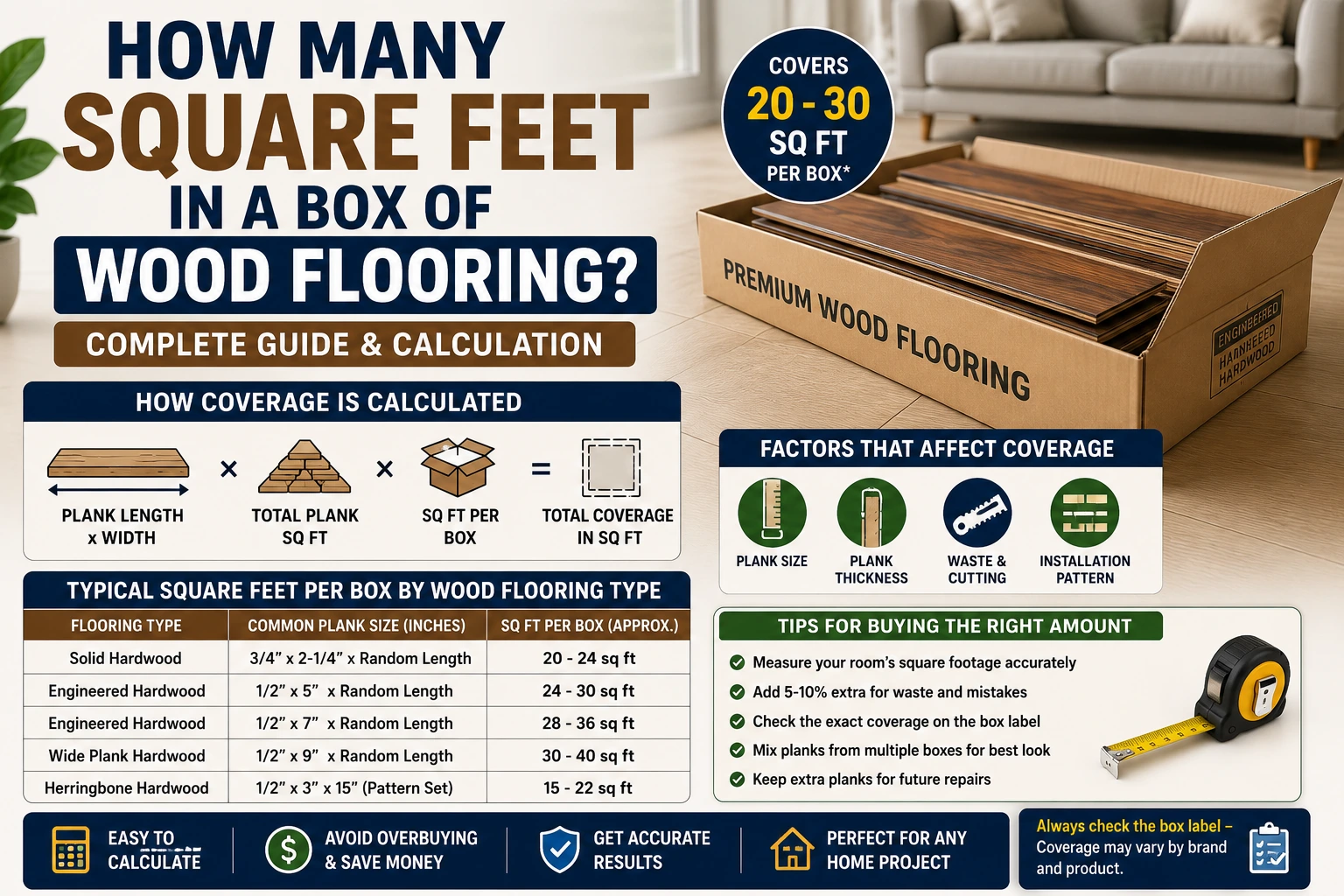
In general, most boxes of wood flooring cover between 20 and 30 square feet, although some premium or wide plank products may cover more or less.
This complete guide explains how flooring coverage works, how to calculate the number of boxes you need, comparison charts, real life examples, and expert tips to help you purchase the right amount of flooring.
Quick Answer
Most wood flooring products provide the following coverage.
| Flooring Type | Average Coverage Per Box |
|---|---|
| Solid Hardwood | 20 to 24 square feet |
| Engineered Hardwood | 24 to 30 square feet |
| Wide Plank Flooring | 30 to 40 square feet |
| Premium Hardwood | 18 to 25 square feet |
Answer:
Most boxes of wood flooring cover 20 to 30 square feet, but the exact coverage is printed on the product packaging.
What Is a Box of Wood Flooring?
Wood flooring is sold in boxes that contain several planks bundled together.
Each box contains enough planks to cover a specific floor area measured in square feet.
The number of planks inside each box varies depending on
- Plank width
- Plank length
- Plank thickness
- Flooring type
- Manufacturer
Rather than counting individual boards, manufacturers list the total coverage in square feet on the packaging.
How Many Square Feet in a Box of Wood Flooring?
The answer depends on the flooring product you purchase.
Most manufacturers package flooring to cover between 20 and 30 square feet per box.
For example
- Small plank hardwood may cover about 20 square feet.
- Engineered hardwood often covers 24 to 30 square feet.
- Wide plank flooring may cover 30 to 40 square feet.
Always check the product label because coverage differs from one brand to another.
Why Flooring Coverage Varies
Several factors affect the amount of flooring inside each box.
Plank Size
Longer and wider planks generally increase the total coverage per box.
Plank Thickness
Thicker flooring weighs more, so manufacturers may include fewer planks per package.
Flooring Type
Solid hardwood, engineered hardwood, bamboo, and laminate flooring are packaged differently.
Manufacturer
Each manufacturer chooses its own packaging size.
This is why two boxes may look similar but cover different areas.
Average Flooring Coverage Chart
The following table shows common flooring coverage ranges.
| Flooring Type | Approximate Coverage |
|---|---|
| Solid Hardwood | 20 to 24 sq ft |
| Engineered Hardwood | 24 to 30 sq ft |
| Wide Plank Hardwood | 30 to 40 sq ft |
| Bamboo Flooring | 22 to 28 sq ft |
| Luxury Vinyl Plank | 18 to 28 sq ft |
| Laminate Flooring | 18 to 30 sq ft |
These values are averages. Always verify the manufacturer’s specifications before purchasing.
How to Calculate the Number of Boxes Needed
Calculating flooring requirements is simple.
Step 1
Measure the room.
Multiply
Length × Width
Example
15 feet × 12 feet
= 180 square feet
Step 2
Determine box coverage.
Suppose one box covers
25 square feet
Step 3
Divide the room size by box coverage.
180 ÷ 25
= 7.2 boxes
Since you cannot buy a fraction of a box, round up.
Required boxes
8 boxes
Add Extra Flooring for Waste
Professional installers recommend buying additional flooring.
Waste occurs because of
- Cutting boards
- Room corners
- Doorways
- Closets
- Installation patterns
- Damaged planks
General recommendations
| Installation Type | Extra Flooring |
|---|---|
| Straight Pattern | 5 percent |
| Diagonal Pattern | 10 percent |
| Herringbone Pattern | 12 to 15 percent |
Example
Room size
180 square feet
Add 10 percent
180 × 1.10
= 198 square feet
If each box covers 25 square feet
198 ÷ 25
= 7.92
Round up
8 boxes
Real World Examples
Example One
Bedroom
12 × 12 feet
Room size
144 square feet
Box coverage
24 square feet
Calculation
144 ÷ 24
= 6 boxes
Example Two
Living Room
18 × 15 feet
Room size
270 square feet
Box coverage
27 square feet
Calculation
270 ÷ 27
= 10 boxes
Add extra for waste.
Example Three
Dining Room
20 × 14 feet
Room size
280 square feet
Box coverage
28 square feet
Calculation
280 ÷ 28
= 10 boxes
Add at least one additional box for installation waste.
Factors That Affect Flooring Coverage
Several factors influence the amount of flooring you need.
Room Shape
Rooms with many corners require more cutting.
Installation Pattern
Decorative patterns generate more waste than straight installations.
Closets
Do not forget to include closets if they will receive the same flooring.
Staircases
Stairs require additional material and careful planning.
Future Repairs
Keeping an extra box allows you to replace damaged boards years later if the same product is discontinued.
Benefits of Buying the Right Amount
Accurate estimates provide many advantages.
- Reduce project delays.
- Save money.
- Prevent material shortages.
- Improve installation quality.
- Ensure color consistency from the same production batch.
- Reduce unnecessary returns.
Common Mistakes to Avoid
Many homeowners make simple purchasing mistakes.
Buying Too Little
Running out of flooring can delay installation.
Replacement boxes may come from different production batches with slight color differences.
Ignoring Waste
Always purchase extra flooring.
Not Measuring Accurately
Double check every room before placing an order.
Forgetting Closets
Closets and hallways should be included in your calculations.
Assuming Every Box Covers the Same Area
Coverage varies between manufacturers.
Always read the packaging.
Expert Tips
Professional flooring installers recommend
- Measure every room carefully.
- Buy all flooring at the same time.
- Keep one unopened box for future repairs.
- Mix planks from several boxes during installation for a more natural appearance.
- Store flooring indoors before installation to allow it to adjust to room temperature.
- Check the exact square footage printed on every box before purchasing.
- Add extra flooring for complex layouts and decorative installation patterns.
Why Understanding Flooring Coverage Matters
Knowing how many square feet in a box of wood flooring helps you estimate costs more accurately and prevents unnecessary delays during installation.
It also makes it easier to compare different flooring brands because coverage per box directly affects the total number of boxes you need.
Whether you are remodeling a single bedroom or installing hardwood throughout an entire home, accurate measurements save time, money, and effort.
FAQs
How many square feet does a box of wood flooring usually cover?
Most boxes of wood flooring cover 20 to 30 square feet, although some products may cover more or less depending on the manufacturer.
How can I calculate how many flooring boxes I need?
Measure the total room area in square feet and divide it by the coverage listed on the flooring box. Always round up to the next whole box and add extra material for waste.
Should I buy extra wood flooring?
Yes. Most professionals recommend purchasing 5 to 10 percent extra for straight installations and more for complex patterns.
Does every manufacturer package the same amount of flooring?
No. Coverage varies based on plank size, thickness, flooring type, and manufacturer. Always check the product label before purchasing.
Why should I keep an extra box after installation?
Keeping one unopened box allows you to replace damaged planks in the future without worrying about discontinued products or color differences.
Conclusion
If you have been wondering how many square feet in a box of wood flooring, the answer depends on the product you choose. Most boxes cover 20 to 30 square feet, but coverage can vary based on plank size, flooring type, and manufacturer. The exact square footage is always listed on the packaging.
By measuring your room accurately, calculating the required coverage, and adding extra material for waste, you can purchase the correct number of flooring boxes with confidence. Following the tips in this guide will help you reduce costs, avoid installation delays, and achieve a professional looking floor that lasts for years.
Discover more