

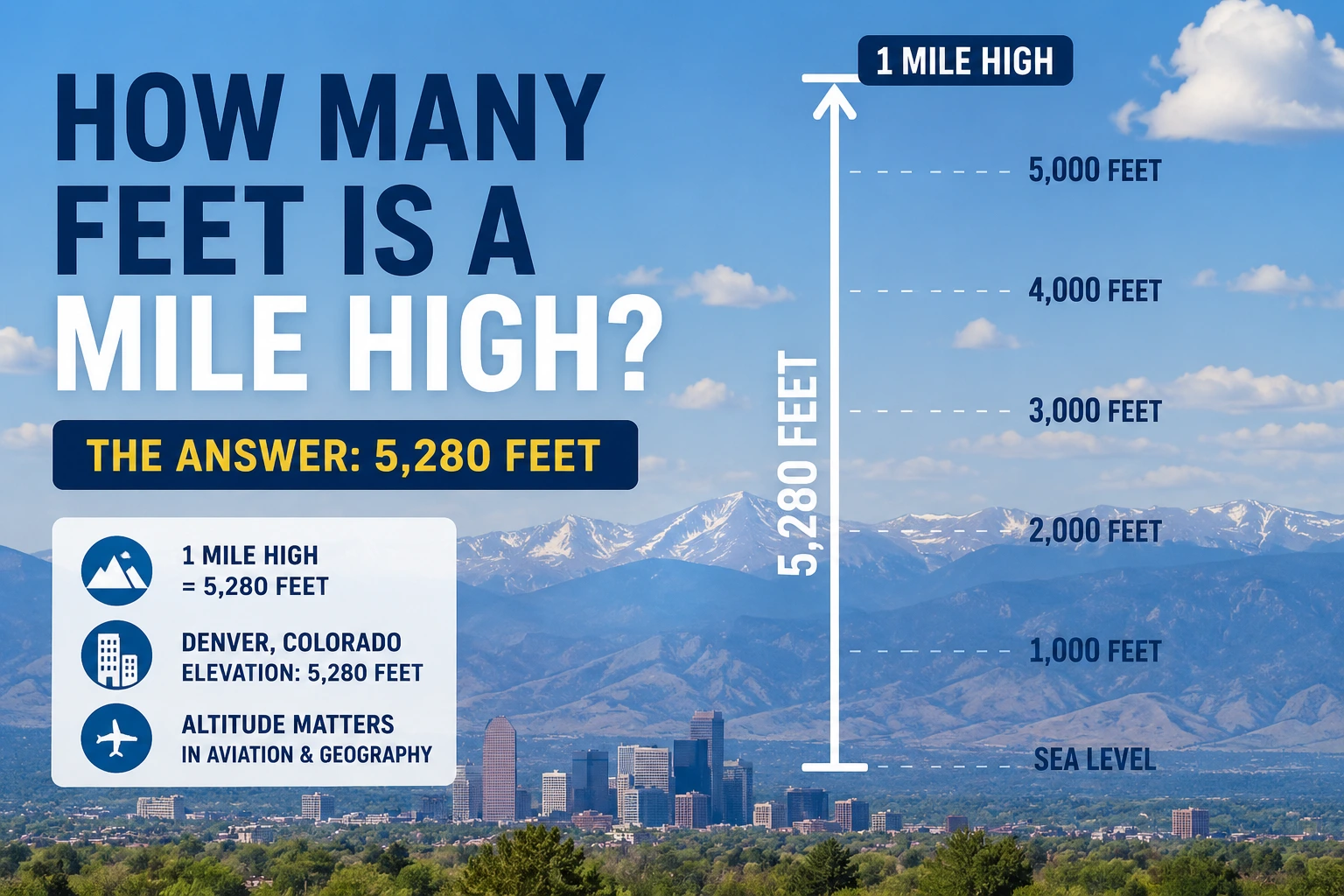
If you’ve ever heard the phrase “mile high”, you may have wondered exactly what it means in terms of feet. Whether you’re studying geography, planning a trip to Denver, learning unit conversions, or simply satisfying your curiosity, knowing how many feet is a mile high is useful information.
The answer is surprisingly straightforward, but understanding the concept behind it can make measurements and elevations much easier to visualize.
In this guide, you’ll learn the exact conversion, why certain places are called mile-high locations, practical comparisons, conversion formulas, and fascinating facts about mile-high elevations.
The Quick Answer
A mile high equals:
1 mile=5,280 feet
So, if something is one mile high, it is 5,280 feet above a reference point, typically sea level when discussing elevation.
This is the standard conversion used throughout the United States and other places that use the imperial measurement system.
Quick Fact
- 1 mile = 5,280 feet
- 1 mile = 1,760 yards
- 1 mile = approximately 1.609 kilometers
Therefore:
A mile-high elevation is exactly 5,280 feet.
Understanding What “Mile High” Means
The term mile high usually refers to elevation rather than physical height.
For example:
- A mountain may be one mile above sea level.
- A city may sit one mile above sea level.
- An aircraft may fly at many miles above the ground.
When people say a location is “mile high,” they generally mean its elevation reaches approximately 5,280 feet above sea level.
Elevation vs Height
Many people confuse elevation and height.
Elevation refers to how high something is relative to sea level.
Height refers to how tall something is from its base to its top.
For example:
- Denver’s elevation is about 5,280 feet above sea level.
- A skyscraper may be 1,500 feet tall but stand at sea level.
These measurements describe different things.
How Many Feet Are in One Mile?
To understand a mile-high elevation, it helps to know how a mile is measured.
A mile contains:
| Unit | Equivalent |
|---|---|
| 1 Mile | 5,280 Feet |
| 1 Mile | 1,760 Yards |
| 1 Mile | 63,360 Inches |
| 1 Mile | 1.609 Kilometers |
The mile has been used for centuries and remains one of the most recognized distance measurements in the United States.
The figure of 5,280 feet per mile comes from historical English measurement standards that were eventually adopted in America.
Why Is Denver Called the Mile High City?
One of the most famous uses of the phrase “mile high” is associated with the city of Denver.
Denver is famously known as the Mile High City because its official elevation is approximately 5,280 feet above sea level.
Interesting Denver Facts
- Denver’s nickname is “The Mile High City.”
- A special marker on the steps of the Colorado State Capitol indicates the mile-high elevation point.
- The city’s elevated location contributes to thinner air and unique weather patterns.
Visitors often notice the difference in altitude, especially when exercising or hiking.
How High Is a Mile Compared to Everyday Objects?
Visualizing 5,280 feet can be difficult. Comparing it to familiar objects makes it easier to understand.
Compared to Skyscrapers
Most modern skyscrapers range between 1,000 and 2,000 feet tall.
Examples:
| Structure | Approximate Height |
|---|---|
| 30-story building | 300 feet |
| 100-story skyscraper | 1,200 feet |
| Tall supertall skyscraper | 1,700–2,000 feet |
| One mile | 5,280 feet |
A mile is more than twice the height of the tallest skyscrapers on Earth.
Compared to Mountains
Many mountains exceed one mile in elevation.
For example:
- A hill of 1,000 feet is less than one-fifth of a mile.
- A mountain reaching 5,280 feet stands one mile above sea level.
- Many mountain towns sit at elevations greater than one mile.
This perspective helps hikers understand elevation gain during climbs.
Compared to Airplanes
Commercial airplanes typically cruise at:
- 30,000–40,000 feet
That means an airliner often flies:
- 6 to 8 miles above the Earth’s surface
A mile-high city sits much lower than typical flight altitudes.
Miles to Feet Conversion Chart
The following chart can help you quickly convert miles into feet.
| Miles | Feet |
|---|---|
| 0.25 | 1,320 |
| 0.5 | 2,640 |
| 0.75 | 3,960 |
| 1 | 5,280 |
| 2 | 10,560 |
| 3 | 15,840 |
| 5 | 26,400 |
| 10 | 52,800 |
This chart is useful for students, surveyors, hikers, and anyone working with distance measurements.
Real-World Uses of Mile-High Measurements
Understanding how many feet is a mile high has practical applications in many industries.
Aviation
Pilots routinely measure altitude in feet.
For example:
- 5,280 feet = one mile high
- 35,000 feet = approximately 6.6 miles high
Aircraft instruments display altitude in feet because it allows for greater precision.
Geography
Geographers use elevation measurements to:
- Map terrain
- Compare mountain heights
- Study landforms
- Assess environmental conditions
Knowing that one mile equals 5,280 feet helps interpret maps and elevation charts.
Construction
Engineers and architects often work with elevation measurements when designing:
- Roads
- Bridges
- Buildings
- Drainage systems
Elevation affects structural planning and environmental assessments.
Outdoor Recreation
Hikers, climbers, and cyclists regularly encounter elevation data.
Understanding mile-high elevations can help:
- Estimate physical exertion
- Plan routes
- Prepare for altitude changes
Higher elevations generally mean thinner air and lower oxygen levels.
How to Convert Miles to Feet
Converting miles into feet is simple.
Formula
Feet=Miles×5,280
Multiply the number of miles by 5,280.
Example 1
Convert 2 miles into feet.
Calculation:
2 × 5,280 = 10,560 feet
Answer:
2 miles = 10,560 feet
Example 2
Convert 3.5 miles into feet.
Calculation:
3.5 × 5,280 = 18,480 feet
Answer:
3.5 miles = 18,480 feet
Example 3
Convert 0.75 miles into feet.
Calculation:
0.75 × 5,280 = 3,960 feet
Answer:
0.75 miles = 3,960 feet
Common Mistakes When Converting Miles and Feet
Even simple conversions can lead to errors.
Forgetting the Exact Conversion
Some people mistakenly round a mile to 5,000 feet.
The correct value is:
5,280 feet
Using the wrong number can create significant inaccuracies.
Confusing Elevation and Distance
A mile traveled horizontally is not the same as a mile of elevation.
For example:
- Walking one mile on a flat road covers distance.
- Climbing one mile vertically involves elevation gain.
Mixing Metric and Imperial Units
Many countries use kilometers instead of miles.
Remember:
- 1 mile = 1.609 kilometers
- 1 kilometer = 3,280.84 feet
Always verify which measurement system is being used.
Interesting Facts About Mile-High Elevations
Here are some fascinating facts related to mile-high measurements.
A Mile Is Higher Than Many Cities
Most cities worldwide sit well below 5,280 feet.
Living at a mile-high elevation is relatively uncommon.
Altitude Can Affect the Human Body
At higher elevations:
- Air pressure decreases
- Oxygen levels become lower
- Physical activity may feel more challenging
Many visitors need time to adjust.
Some Mountain Towns Are Far Above One Mile
Several mountain communities exceed:
- 7,000 feet
- 8,000 feet
- 10,000 feet
These locations experience unique weather and environmental conditions.
Sports Can Be Affected by Elevation
Athletes often notice performance differences at higher elevations because thinner air changes how the body uses oxygen.
This is one reason why sporting events at elevated locations sometimes produce different results than those at sea level.
9. Frequently Asked Questions
1. How many feet is a mile high exactly?
A mile high is exactly 5,280 feet.
2. Why is a mile equal to 5,280 feet?
The measurement comes from historical English distance standards that became part of the imperial system.
3. Is Denver exactly one mile high?
Denver’s official elevation is approximately 5,280 feet above sea level, which earned it the nickname “The Mile High City.”
4. How many yards are in a mile-high elevation?
A mile contains 1,760 yards.
5. How many kilometers is one mile high?
One mile equals approximately 1.609 kilometers.
10. Conclusion
If you’ve been wondering how many feet is a mile high, the answer is simple: one mile equals exactly 5,280 feet. This measurement is commonly used when discussing elevation, altitude, and geographic features. Understanding this conversion makes it easier to interpret maps, compare elevations, plan outdoor adventures, and understand why places such as Denver are known as mile-high locations.
Whether you’re studying measurements, exploring geography, or simply satisfying your curiosity, remembering that a mile high equals 5,280 feet provides a useful reference point for countless real-world situations.
Discover more