

If you are new to baseball, one of the first questions you may ask is how many feet from home plate to pitcher’s mound. The answer is simple, but the story behind it is fascinating.
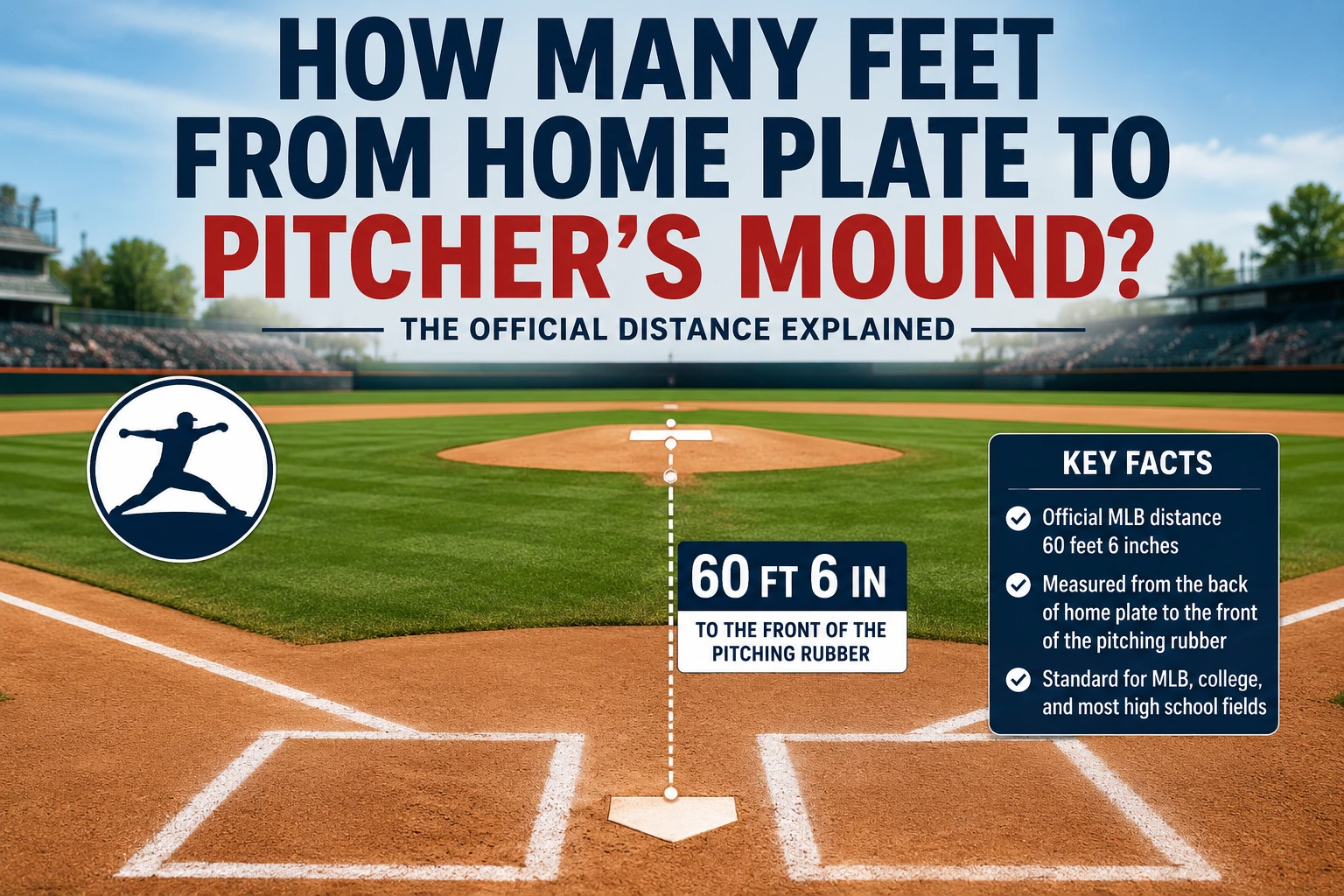
In Major League Baseball, the official distance from home plate to the pitching rubber is 60 feet 6 inches. This measurement has remained the standard for more than a century because it creates a fair balance between pitchers and hitters.
Understanding this distance helps players improve their game, coaches teach proper mechanics, and fans better appreciate the skill required to throw a pitch traveling over 90 miles per hour.
This guide explains the official pitching distance, how it is measured, why it matters, and how it changes in youth baseball and other leagues.
What Is the Official Distance From Home Plate to Pitcher’s Mound?
The official distance from home plate to the pitching rubber is:
60 feet 6 inches (18.44 meters)
Many people casually say the mound is 60 feet away, but that is not technically correct. The measurement is taken from the back point of home plate to the front edge of the pitching rubber, not to the center of the mound itself.
This distinction is important because the mound extends several feet around the pitching rubber.
Quick Answer
| Baseball Level | Distance |
|---|---|
| Major League Baseball | 60 feet 6 inches |
| College Baseball | 60 feet 6 inches |
| High School Baseball | 60 feet 6 inches |
| Little League Major Division | 46 feet |
| Intermediate Little League | 50 feet |
| Pony Baseball | 54 feet |
| Softball Fastpitch | 43 feet |
As players grow older and stronger, the pitching distance increases to match their skill level.
How the Distance Is Measured
A common misunderstanding is that officials measure to the middle of the mound.
Instead, the official measurement starts at:
- The rear point of home plate.
It ends at:
- The front edge of the pitching rubber.
Because the pitching rubber sits on top of the mound, people often refer to the entire mound when discussing the distance, even though the official rule measures to the rubber.
This method keeps every professional baseball field consistent.
Why Is the Pitcher’s Mound Exactly 60 Feet 6 Inches Away?
The answer comes from baseball history.
In the early years of baseball, pitchers threw from much closer distances. As pitching techniques improved, hitters struggled to make contact.
League officials wanted to restore balance between offense and defense.
In 1893, they moved the pitching distance to 60 feet 6 inches.
Surprisingly, they did not choose this number after scientific testing. Instead, field designers added 5 feet to the previous pitching distance while working within the dimensions of existing baseball parks.
The change proved successful and has remained the standard ever since.
History Behind the Rule
Before 1893:
- Pitchers stood much closer.
- Batters had less reaction time.
- Games became dominated by pitchers.
After increasing the distance:
- Batters could react better.
- Games featured more hits.
- Offense and defense became more balanced.
- Baseball became more exciting for fans.
More than 130 years later, professional baseball still uses the same distance.
How It Changed Baseball
The extra 5 feet 6 inches may not sound significant, but it dramatically changed the game.
Pitchers had to develop:
- Better accuracy
- Improved control
- Stronger mechanics
- More movement on pitches
Batters gained valuable milliseconds to recognize different pitch types.
This balance remains one of the reasons baseball continues to be competitive and entertaining.
Understanding the Pitcher’s Mound
The mound is much more than a raised pile of dirt.
It is carefully designed to help pitchers generate power while remaining safe and consistent throughout every game.
Pitching Rubber
The pitching rubber is the white rectangular slab where the pitcher begins every pitch.
Professional pitching rubbers measure:
- 24 inches wide
- 6 inches deep
Every pitch must begin with the pitcher making proper contact with the rubber according to the rules.
Mound Height
The official mound is:
10 inches above home plate
This elevated position allows pitchers to drive forward with greater momentum.
Ground crews carefully maintain this height because even small changes can affect performance.
Mound Shape
The mound has a gentle slope rather than a steep hill.
Professional rules specify how quickly the mound slopes downward from the pitching rubber toward home plate.
This design helps pitchers maintain balance while reducing injury risk.
Baseball Field Measurements at a Glance
Although many people focus on the pitching distance, every part of the baseball diamond follows official measurements.
Standard Baseball Dimensions
| Measurement | Official Distance |
|---|---|
| Home plate to pitching rubber | 60 feet 6 inches |
| Base paths | 90 feet |
| Home to second base | About 127 feet 3⅜ inches |
| Pitcher’s mound height | 10 inches |
| Pitching rubber width | 24 inches |
| Home plate width | 17 inches |
These standardized dimensions ensure every professional game is played under the same conditions.
How Many Feet From Home Plate to Pitcher’s Mound in Different Leagues?
Not every baseball field uses the same pitching distance.
Youth leagues adjust field dimensions based on players’ age, strength, and skill level.
Major League Baseball
Major League Baseball uses the official distance of 60 feet 6 inches.
This standard has remained unchanged since 1893 and is considered the highest level of competitive baseball.
Professional pitchers often throw between 90 and 100 miles per hour, making this distance essential for maintaining a fair challenge between pitchers and batters.
High School Baseball
Most high school baseball programs also use the professional pitching distance of 60 feet 6 inches.
This prepares players for college baseball and higher levels of competition while helping them develop proper pitching mechanics.
Little League Baseball
Little League players use shorter pitching distances to match their physical development.
For example:
- Tee Ball uses much shorter distances.
- Minor divisions often pitch from around 46 feet.
- Intermediate divisions may use 50 feet.
- Older youth leagues gradually increase the distance until players reach the full regulation measurement.
These adjustments help young athletes build confidence while reducing unnecessary strain on their arms.
Softball Comparison
Although softball and baseball share many similarities, the pitching distance is much shorter.
In women’s fastpitch softball, the pitching distance is typically 43 feet.
Softball pitchers use an underhand motion instead of the overhand delivery used in baseball, making the shorter distance appropriate for the speed and style of play.
Why Does the Distance From Home Plate to Pitcher’s Mound Matter?
The distance between the pitcher and the batter is one of the most important measurements in baseball. It directly affects pitch speed, reaction time, player safety, and the overall balance of the game.
If the mound were even a few feet closer, pitchers would have a significant advantage because hitters would have less time to react. If it were farther away, hitters would have more time to recognize pitches, making it harder for pitchers to record outs.
Reaction Time
A fastball thrown at 95 miles per hour reaches home plate in less than half a second.
During that short time, a batter must:
- Recognize the pitch type.
- Judge the speed.
- Decide whether to swing.
- Make solid contact.
The official pitching distance creates a fair challenge for both players.
Pitching Strategy
Pitchers do much more than throw hard.
They use different pitches such as:
- Fastballs
- Curveballs
- Sliders
- Changeups
- Cutters
- Sinkers
The 60 feet 6 inches distance allows each pitch to move naturally before crossing home plate.
Player Safety
The official measurement also helps reduce injuries.
If pitchers threw from a shorter distance, batters would have less time to protect themselves from fast line drives or wild pitches.
Likewise, pitchers have enough space to react to balls hit back toward the mound.
How to Measure the Distance Correctly
Whether you are building a backyard baseball field or preparing a practice area, measuring correctly is essential.
Follow these simple steps.
Step 1
Locate the back point of home plate.
This is the sharp rear corner of the five sided plate.
Step 2
Measure a straight line toward second base.
Use a measuring tape to ensure accuracy.
Step 3
Mark the front edge of the pitching rubber.
The distance should be exactly 60 feet 6 inches for a regulation baseball field.
Step 4
Build the mound around the pitching rubber.
Remember that the official measurement is to the pitching rubber, not the center of the mound.
Accurate measurements help players practice under game like conditions.
Common Myths About the Pitcher’s Mound Distance
Many baseball fans have heard incorrect information about field measurements. Here are some of the most common myths.
| Myth | Fact |
|---|---|
| The mound is exactly 60 feet away. | The official distance is 60 feet 6 inches. |
| The distance is measured to the center of the mound. | It is measured to the front of the pitching rubber. |
| Every baseball league uses the same distance. | Youth leagues use shorter distances. |
| Softball uses the same pitching distance as baseball. | Fastpitch softball typically uses 43 feet. |
| The mound is simply a pile of dirt. | It follows strict size, height, and slope regulations. |
Knowing these facts helps players better understand the game.
Expert Tips for Coaches and Players
Whether you are coaching beginners or preparing for competitive baseball, these tips can improve practice sessions.
Use Regulation Measurements
Practicing on a properly measured field helps players develop consistent mechanics and timing.
Teach Young Players Gradually
Avoid moving younger players to longer pitching distances too early. Allow them to build strength and confidence first.
Maintain the Mound
An uneven mound can affect balance, pitching accuracy, and increase the risk of injuries.
Practice Game Situations
Use regulation distances during scrimmages so players become comfortable under realistic conditions.
Verify Measurements Regularly
Weather and heavy use can change field dimensions over time. Regular inspections keep the field safe and fair.
Interesting Facts About the Pitcher’s Mound
Baseball has a rich history, and the pitching mound has played an important role in shaping the game.
Some interesting facts include:
- The current pitching distance has been used since 1893.
- The pitching rubber measures 24 inches wide.
- The mound is 10 inches higher than home plate.
- Professional pitchers can throw over 100 miles per hour.
- A baseball reaches home plate in less than half a second during many professional games.
- Grounds crews carefully maintain mound height and slope before every game.
- Even small changes to the mound can affect pitching performance.
These details show why field dimensions are carefully regulated at every level of baseball.
Why Beginners Should Learn Baseball Field Measurements
Learning the dimensions of a baseball field helps new players understand the game more quickly.
Knowing where each position is located improves:
- Field awareness
- Defensive positioning
- Throwing accuracy
- Pitching confidence
- Overall baseball knowledge
Parents and coaches can also use these measurements when setting up practice fields at schools, parks, or in the backyard.
Understanding the correct distance from home plate to the pitching mound helps create better practice habits from the start.
What is the official distance from home plate to the pitcher’s mound?
The official distance in Major League Baseball, college baseball, and most high school baseball is 60 feet 6 inches. The measurement is taken from the back point of home plate to the front edge of the pitching rubber.
Is the pitching mound exactly 60 feet away?
No. This is a common misconception. The correct distance is 60 feet 6 inches, not exactly 60 feet.
Why is the pitching distance 60 feet 6 inches?
The distance was adopted in 1893 to create a better balance between pitchers and hitters. It has remained the official standard for professional baseball ever since.
Do Little League baseball fields use the same pitching distance?
No. Little League uses shorter pitching distances based on the players’ age. Common distances include 46 feet and 50 feet before advancing to the full regulation distance of 60 feet 6 inches.
Is the distance measured to the mound or the pitching rubber?
The official measurement is taken to the front edge of the pitching rubber, not the center or front of the mound.
Conclusion
If you have ever wondered how many feet from home plate to pitcher’s mound, the official answer is 60 feet 6 inches for Major League Baseball and most adult leagues. This carefully chosen distance creates the right balance between pitching and hitting while maintaining player safety and competitive fairness.
Understanding this measurement is valuable whether you are a player, coach, parent, or baseball fan. It also helps when building a practice field, teaching young athletes, or simply learning more about the game. While youth leagues adjust the pitching distance to suit different age groups, the professional standard of 60 feet 6 inches remains one of the most recognizable and important measurements in baseball, shaping every pitch and every at bat.
Discover More