

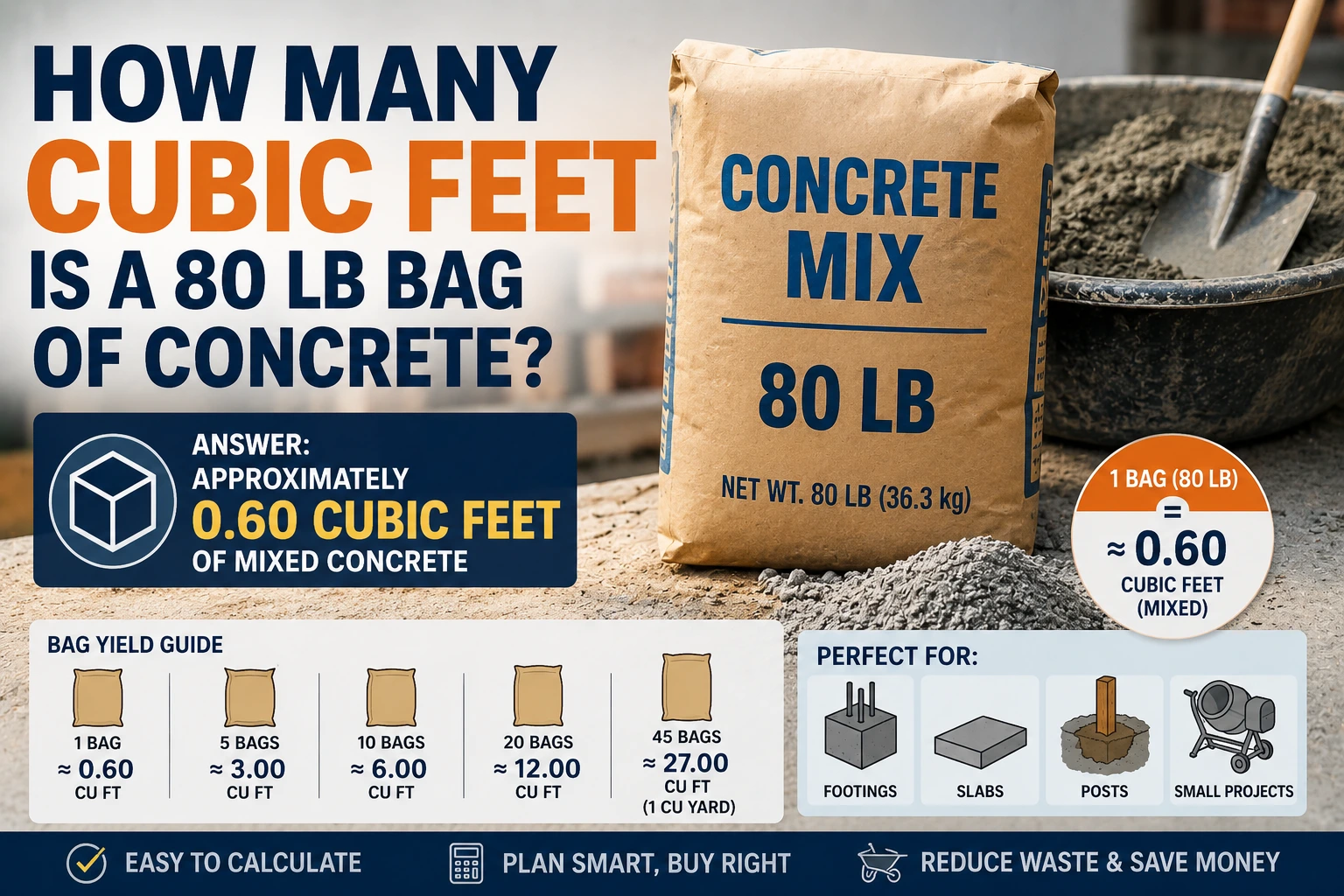
If you are planning a concrete project, you may be wondering how many cubic feet is a 80 lb bag of concrete. For most standard 80 lb bags of concrete mix, the expected yield is about 0.60 cubic feet of mixed concrete.
This number is important because concrete projects are usually measured by volume rather than weight. A slab, footing, walkway, step, or post hole needs a certain number of cubic feet of concrete. Once you know that one 80 lb bag produces about 0.60 cubic feet, you can estimate how many bags your project will require.
However, the exact yield can vary slightly between products. Always check the yield printed on the specific bag you purchase.
In this guide, you will learn how to calculate concrete volume, estimate the number of 80 lb bags required, convert bags into cubic yards, understand coverage, and avoid common ordering mistakes.
How Many Cubic Feet Is a 80 lb Bag of Concrete?
An 80 lb bag of standard concrete mix generally yields about 0.60 cubic feet of concrete when properly mixed.
That means:
1 bag = approximately 0.60 cubic feet
Using this figure, you can estimate larger quantities.
| Number of 80 lb Bags | Approximate Concrete Volume |
|---|---|
| 1 bag | 0.60 cubic feet |
| 2 bags | 1.20 cubic feet |
| 3 bags | 1.80 cubic feet |
| 5 bags | 3.00 cubic feet |
| 10 bags | 6.00 cubic feet |
| 15 bags | 9.00 cubic feet |
| 20 bags | 12.00 cubic feet |
| 25 bags | 15.00 cubic feet |
| 30 bags | 18.00 cubic feet |
| 40 bags | 24.00 cubic feet |
| 50 bags | 30.00 cubic feet |
For example, if your project requires 6 cubic feet of concrete, you can divide 6 by 0.60.
6 ÷ 0.60 = 10 bags
So you would need approximately 10 bags of 80 lb concrete mix before allowing for waste or variations in the actual yield.
What Does Concrete Yield Mean?
Concrete yield refers to the amount of usable mixed concrete produced by a bag of dry concrete mix.
An 80 lb bag contains a carefully proportioned combination of cement, sand, and aggregate. Water is added according to the manufacturer’s instructions. After mixing, the material becomes fresh concrete that can be placed into a form or excavation.
The important distinction is that the 80 lb weight does not mean the finished concrete will occupy 80 lb worth of space.
Weight and volume are different measurements.
For estimating a project, you normally need the volume of mixed concrete, which is expressed in cubic feet or cubic yards.
Dry Concrete Mix Versus Mixed Concrete
A bag of concrete mix looks like a certain volume while it is dry. However, you should not use the loose dry volume as your project yield.
Manufacturers provide a specific yield for the finished mix after water has been added and the ingredients are properly combined.
For this reason, the yield printed on the product packaging is the best figure to use.
If your particular product states a yield of 0.60 cubic feet, use 0.60 in your calculations.
How Much Concrete Does an 80 lb Bag Make?
A typical 80 lb bag of standard concrete mix produces approximately 0.60 cubic feet of mixed concrete.
To understand this in another unit, one cubic yard contains 27 cubic feet.
Therefore, one 80 lb bag produces approximately:
0.60 ÷ 27 = 0.0222 cubic yards
This means a single bag represents only a small fraction of a cubic yard.
That is why larger concrete projects can require many bags. A full cubic yard can require approximately 45 bags when each 80 lb bag yields 0.60 cubic feet.
The actual number should always be based on the stated yield of your specific product.
80 lb Concrete Bag Yield Chart
The following chart provides a quick reference for estimating the volume produced by multiple 80 lb bags when using a 0.60 cubic foot yield.
| Bags | Cubic Feet | Approximate Cubic Yards |
| 1 | 0.60 | 0.022 |
| 5 | 3.00 | 0.111 |
| 10 | 6.00 | 0.222 |
| 15 | 9.00 | 0.333 |
| 20 | 12.00 | 0.444 |
| 25 | 15.00 | 0.556 |
| 30 | 18.00 | 0.667 |
| 40 | 24.00 | 0.889 |
| 45 | 27.00 | 1.000 |
| 50 | 30.00 | 1.111 |
This table assumes each bag produces exactly 0.60 cubic feet. Your product may have a different stated yield, so check the packaging before purchasing.
How to Calculate How Many Bags You Need
Calculating the number of concrete bags for a project is easier than it may seem.
You first calculate the volume of the space that needs to be filled. Then you divide that volume by the yield of one bag.
The basic formula is:
Length × Width × Depth = Cubic Feet
Then:
Cubic Feet Needed ÷ Cubic Feet Per Bag = Number of Bags
Here is the process step by step.
Step 1 Measure the Length
Measure the length of the area in feet.
For example, imagine a small slab that is 10 feet long.
Step 2 Measure the Width
Measure the width in feet.
Suppose the slab is 8 feet wide.
Step 3 Measure the Depth
Measure the planned concrete thickness.
For example, a 4 inch slab has a depth of 4 inches.
Because the other measurements are in feet, convert 4 inches into feet.
4 ÷ 12 = 0.333 feet
Step 4 Calculate Cubic Feet
Now multiply the three measurements:
10 × 8 × 0.333 = approximately 26.64 cubic feet
The project therefore requires approximately 26.64 cubic feet of concrete before allowing for waste.
Step 5 Divide by the Bag Yield
If one 80 lb bag produces 0.60 cubic feet:
26.64 ÷ 0.60 = 44.4 bags
Since you cannot purchase 0.4 of a bag, you would need at least 45 bags based on this calculation.
It is also sensible to allow some extra material for spillage, uneven ground, measurement differences, and other practical factors.
How Many 80 lb Bags Do Common Projects Need?
The number of bags depends heavily on the dimensions of the project.
A small post hole may require only one or two bags. A larger patio can require dozens of bags.
Here are some examples.
| Project Volume | Approximate 80 lb Bags |
| 1 cubic foot | 2 bags |
| 2 cubic feet | 4 bags |
| 3 cubic feet | 5 bags |
| 5 cubic feet | 9 bags |
| 6 cubic feet | 10 bags |
| 10 cubic feet | 17 bags |
| 12 cubic feet | 20 bags |
| 15 cubic feet | 25 bags |
| 20 cubic feet | 34 bags |
| 25 cubic feet | 42 bags |
The values are rounded up because you need enough concrete to fill the entire volume.
For example, a project requiring 10 cubic feet would need:
10 ÷ 0.60 = 16.67
Therefore, you would need at least 17 bags based on a 0.60 cubic foot yield.
How Many 80 lb Bags Make a Cubic Yard?
A cubic yard contains 27 cubic feet.
If each 80 lb bag yields 0.60 cubic feet:
27 ÷ 0.60 = 45 bags
Therefore, approximately 45 bags of 80 lb concrete mix are required to produce one cubic yard when each bag yields 0.60 cubic feet.
However, buying and mixing 45 individual bags is a significant amount of work. For larger projects, ready mix concrete delivered by truck may be more practical.
For smaller projects, bagged concrete can be convenient because you can mix only what you need.
What Factors Affect Concrete Yield?
The stated yield is the best starting point, but several factors can affect the final amount of usable concrete.
Mix Type
Not every concrete product has exactly the same formulation.
Standard concrete mix, high strength concrete, fast setting concrete, and other specialty products can have different aggregate sizes and recommended uses.
Always check the instructions for the specific product.
Water Amount
The amount of water affects the consistency and performance of concrete.
Adding too much water can make the mix easier to handle, but it can reduce strength and may affect the finished material.
Always follow the manufacturer’s recommended water amount.
Compaction
Concrete should be properly placed and consolidated so that large air pockets are removed.
Poor placement can leave voids, while excessive manipulation can affect the final result.
Uneven Ground
When pouring a slab or walkway over uneven ground, the actual depth may vary.
If you calculate the volume using only the minimum depth, you may underestimate how much concrete is needed.
Spillage and Waste
Some material can be lost during mixing, transportation, placement, or cleanup.
For this reason, ordering exactly the calculated amount can leave you short.
Common Mistakes When Estimating Concrete
Concrete is not something you want to run out of halfway through a pour. Avoid these common errors.
Using the Bag Weight as the Volume
An 80 lb label tells you the weight of the dry mix. It does not tell you the cubic feet of finished concrete.
Use the stated yield instead.
Forgetting to Convert Inches to Feet
If your length and width are measured in feet but your depth is measured in inches, convert the depth before calculating volume.
For example:
4 inches = 0.333 feet
6 inches = 0.5 feet
8 inches = 0.667 feet
Ignoring the Concrete Thickness
A small change in thickness can create a large change in total concrete volume.
Measure the depth carefully.
Forgetting Waste
A mathematical calculation may produce a precise number, but real construction conditions are not always perfect.
Allowing a reasonable amount for waste can prevent an extra trip to the store.
Assuming Every Bag Has the Same Yield
Different products can have different yields.
The safest approach is to read the manufacturer’s coverage and yield information on the bag you are using.
Tips for Buying and Mixing Bagged Concrete
Before purchasing concrete, measure the project carefully and write down the dimensions.
Then calculate the total volume in cubic feet.
After that, check the yield listed on your chosen product.
Divide the project volume by the bag yield and round up to the next whole bag.
For example:
Project volume = 8 cubic feet
Bag yield = 0.60 cubic feet
8 ÷ 0.60 = 13.33
You would need at least 14 bags before considering additional material for waste.
For better planning:
• Measure the area more than once.
• Convert all measurements to the same unit.
• Check the product instructions before mixing.
• Follow the recommended water quantity.
• Prepare the work area before opening bags.
• Have enough tools and mixing capacity available.
• Consider how the fresh concrete will be transported to the final location.
• For large structural projects, follow applicable building requirements and professional recommendations.
Why Bagged Concrete Can Be Useful
Bagged concrete is convenient for small and medium projects because it can be purchased in manageable quantities.
You do not need a concrete truck for a small repair, post installation, garden project, or similar task.
Another benefit is that unused unopened bags can generally be stored for later use if they are kept dry and according to the manufacturer’s storage recommendations.
However, bagged concrete also has drawbacks.
Mixing many bags manually can take significant time and effort. Large projects may be more efficient with ready mix concrete delivered directly to the site.
The best option depends on the size of the project, available equipment, labor, access, and required concrete volume.
A Simple Example for a Concrete Slab
Suppose you want to create a concrete area that measures 12 feet by 10 feet with a thickness of 4 inches.
First convert the thickness:
4 ÷ 12 = 0.333 feet
Now calculate the volume:
12 × 10 × 0.333 = approximately 40 cubic feet
If one 80 lb bag produces 0.60 cubic feet:
40 ÷ 0.60 = approximately 66.67 bags
You would therefore need at least 67 bags based on the calculated volume.
This example shows why larger slabs can quickly require a large number of bags.
For a project of this size, it may be worth comparing the cost and labor of bagged concrete with delivered ready mix.
Expert Tips for More Accurate Concrete Estimates
For simple projects, the basic cubic feet formula is usually enough. For more complicated projects, take additional measurements.
If a slab has different depths, divide it into sections and calculate each section separately.
If a project has an irregular shape, break it into rectangles or other simple shapes and calculate each area individually.
For foundations, structural slabs, retaining walls, or other important construction work, use professional plans and specifications rather than relying only on a general online calculation.
The yield printed by the manufacturer should always take priority over a generic estimate.
Most importantly, do not assume that an 80 lb bag from one manufacturer will have exactly the same yield as every other 80 lb product.
Quick Reference
If you need the answer quickly, remember this:
One 80 lb bag of standard concrete mix generally yields about 0.60 cubic feet of mixed concrete.
Using that figure:
2 bags = 1.20 cubic feet
5 bags = 3.00 cubic feet
10 bags = 6.00 cubic feet
20 bags = 12.00 cubic feet
30 bags = 18.00 cubic feet
45 bags = 27.00 cubic feet
Since 27 cubic feet equals one cubic yard, approximately 45 bags can produce one cubic yard when each bag yields 0.60 cubic feet.
Always verify the yield printed on your particular concrete product before making a final purchase.
FAQs
How many cubic feet does an 80 lb bag of concrete make?
A standard 80 lb bag of concrete mix generally yields about 0.60 cubic feet of mixed concrete. The exact yield can vary by product, so check the manufacturer’s stated yield.
How many 80 lb bags of concrete do I need for 1 cubic yard?
One cubic yard contains 27 cubic feet. If each 80 lb bag yields 0.60 cubic feet, you need approximately 45 bags to produce one cubic yard.
How much area does an 80 lb bag of concrete cover?
Coverage depends on the thickness of the concrete. Since an 80 lb bag generally yields about 0.60 cubic feet, the coverage must be calculated using the planned thickness and area.
How do I calculate how many bags of concrete I need?
Calculate the project volume by multiplying length, width, and depth in feet. Then divide the cubic feet required by the yield of one bag. Round the result up to a whole bag and consider allowing additional material for waste.
Is the yield of every 80 lb bag of concrete the same?
No. Different products and manufacturers can have different stated yields. The product packaging and manufacturer’s instructions should be used for the most accurate calculation.
Conclusion
If you are asking how many cubic feet is a 80 lb bag of concrete, the general answer is approximately 0.60 cubic feet of mixed concrete for a standard 80 lb bag.
This number makes concrete planning much easier. To estimate the number of bags you need, first calculate the total volume of your project in cubic feet. Then divide that number by the stated yield of your concrete mix.
For example, a project requiring 10 cubic feet would need approximately 17 bags when using a 0.60 cubic foot yield.
Remember that the actual yield can vary between products. Always check the bag before making your final calculation, and allow for reasonable waste when purchasing materials.
The key formula to remember is:
Project cubic feet ÷ 0.60 = Approximate number of 80 lb bags
For accurate work, use the manufacturer’s stated yield rather than relying only on a general estimate. This simple step can help you buy the right amount of concrete, reduce waste, and avoid running short during your project.
Discover more