
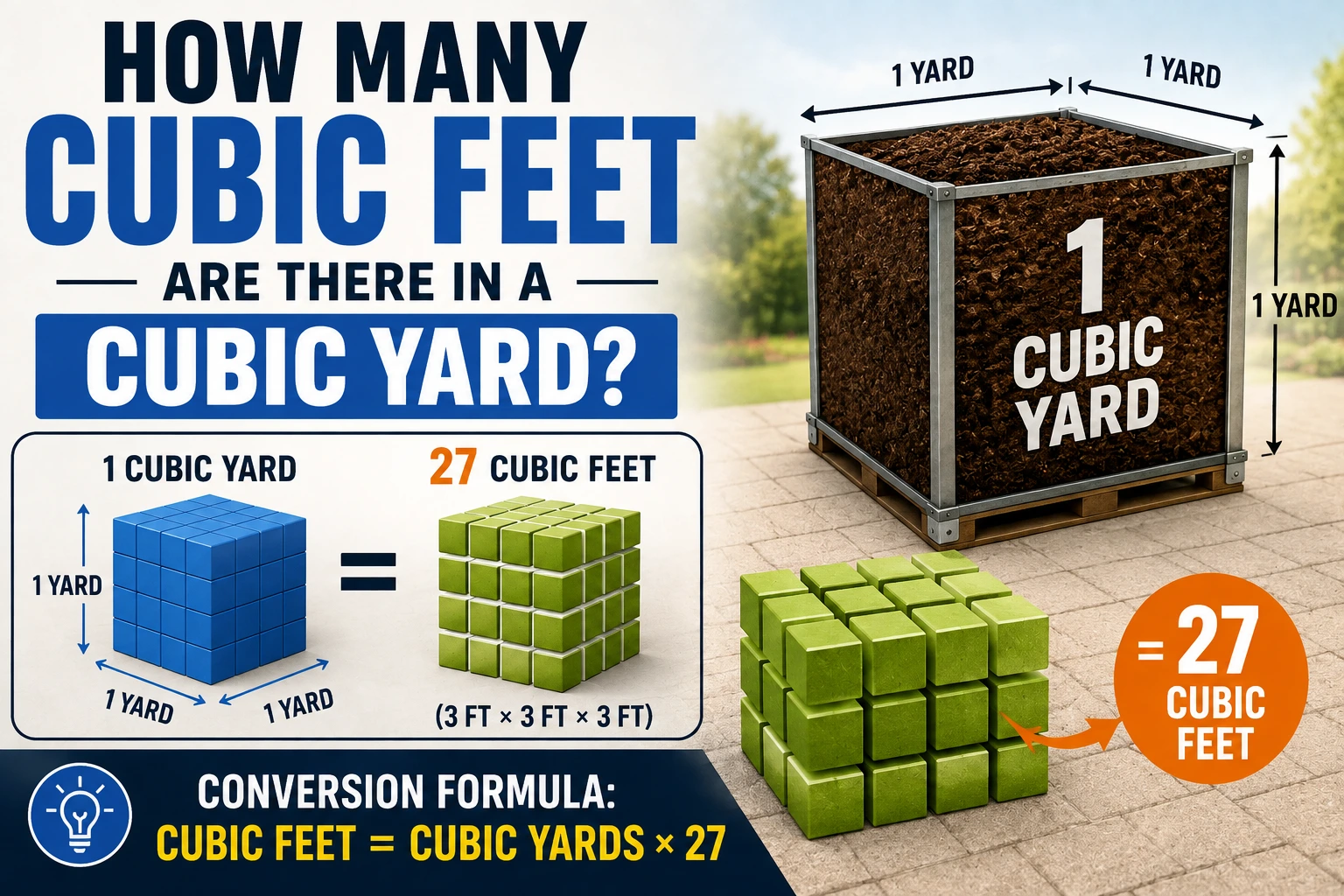
If you are wondering how many cubic feet are there in a cubic yard, the answer is 27 cubic feet.
One cubic yard contains exactly 27 cubic feet.
The conversion comes from the fact that one yard equals three feet. Because we are dealing with volume, the conversion must be applied in three dimensions.
Three feet in length multiplied by three feet in width multiplied by three feet in height gives:
3 × 3 × 3 = 27
Therefore:
1 cubic yard = 27 cubic feet
This measurement is especially important when buying or calculating materials such as soil, mulch, gravel, sand, concrete, compost, and other bulk materials.
Understanding this simple conversion can help you avoid ordering too much or too little material for a project.
The Quick Answer
The direct answer is:
1 cubic yard = 27 cubic feet
The conversion formula is:
Cubic feet = Cubic yards × 27
For example:
1 cubic yard × 27 = 27 cubic feet
2 cubic yards × 27 = 54 cubic feet
3 cubic yards × 27 = 81 cubic feet
5 cubic yards × 27 = 135 cubic feet
10 cubic yards × 27 = 270 cubic feet
The number 27 is the key conversion factor when changing cubic yards into cubic feet.
How Many Cubic Feet Are There in a Cubic Yard?
There are exactly 27 cubic feet in one cubic yard.
This answer is different from a simple length conversion because cubic measurements describe volume.
A regular yard measures length.
A cubic yard measures length, width, and height.
Since:
1 yard = 3 feet
you need to convert all three dimensions from yards to feet.
The calculation is:
3 feet × 3 feet × 3 feet = 27 cubic feet
That is why one cubic yard contains 27 cubic feet rather than only 3 cubic feet.
This distinction is important when working with materials that occupy space.
Understanding Cubic Feet and Cubic Yards
Before converting between the two units, it helps to understand what they measure.
What Is a Cubic Foot?
A cubic foot is a unit of volume.
Imagine a box that measures:
1 foot long
1 foot wide
1 foot high
The amount of space inside that box is one cubic foot.
It can be represented as:
1 × 1 × 1 = 1 cubic foot
Cubic feet are commonly used to measure the volume of rooms, boxes, storage areas, appliances, soil, gravel, and other materials.
What Is a Cubic Yard?
A cubic yard is also a unit of volume, but it is larger than a cubic foot.
Imagine a cube that measures:
1 yard long
1 yard wide
1 yard high
Because one yard equals three feet, each side of the cube is three feet long.
Therefore:
3 × 3 × 3 = 27 cubic feet
So the volume of that cube is one cubic yard.
This is why bulk materials are often sold by the cubic yard. A cubic yard represents a fairly large amount of material and is convenient for landscaping and construction projects.
How to Convert Cubic Yards to Cubic Feet
The conversion is straightforward once you know the basic relationship.
The Basic Conversion Formula
Use this formula:
Cubic feet = Cubic yards × 27
The number 27 comes from multiplying three feet by three feet by three feet.
For example, if you have 4 cubic yards:
4 × 27 = 108 cubic feet
Therefore:
4 cubic yards = 108 cubic feet
Step by Step Example
Suppose you need to convert 6 cubic yards into cubic feet.
Start with the amount:
6 cubic yards
Use the conversion factor:
1 cubic yard = 27 cubic feet
Multiply:
6 × 27 = 162
Therefore:
6 cubic yards = 162 cubic feet
The same method works for any whole number or decimal amount of cubic yards.
Converting Multiple Cubic Yards
Here are some common conversions:
2 cubic yards = 54 cubic feet
3 cubic yards = 81 cubic feet
4 cubic yards = 108 cubic feet
5 cubic yards = 135 cubic feet
6 cubic yards = 162 cubic feet
8 cubic yards = 216 cubic feet
10 cubic yards = 270 cubic feet
If you know the number of cubic yards, simply multiply it by 27.
Why One Cubic Yard Equals 27 Cubic Feet
The reason is based on three dimensional measurement.
One yard equals three feet.
For a volume measurement, you have three dimensions:
Length
Width
Height
A cube that measures one yard on every side has dimensions of three feet by three feet by three feet.
Therefore:
3 × 3 × 3 = 27
So:
1 cubic yard = 27 cubic feet
This is an important difference between linear measurements and cubic measurements.
For example, one yard equals three feet.
But one square yard equals nine square feet because area has two dimensions:
3 × 3 = 9
A cubic yard equals 27 cubic feet because volume has three dimensions:
3 × 3 × 3 = 27
Remembering the number of dimensions makes these conversions much easier.
Cubic Yards to Cubic Feet Conversion Chart
The following chart provides quick conversions for common amounts.
| Cubic Yards | Cubic Feet |
|---|---|
| 1 | 27 |
| 2 | 54 |
| 3 | 81 |
| 4 | 108 |
| 5 | 135 |
| 6 | 162 |
| 7 | 189 |
| 8 | 216 |
| 9 | 243 |
| 10 | 270 |
| 15 | 405 |
| 20 | 540 |
| 25 | 675 |
| 30 | 810 |
This chart can be useful when estimating the amount of material needed for larger projects.
For example, if a supplier says you need 8 cubic yards of soil, you can quickly determine that this equals 216 cubic feet.
Real World Uses for Cubic Yard Measurements
Cubic yards are widely used because many materials are purchased and delivered in bulk.
Soil and Garden Projects
Garden soil is often sold by the cubic yard.
Suppose you need 3 cubic yards of soil for a large garden project.
You can convert the amount to cubic feet:
3 × 27 = 81 cubic feet
So you would need 81 cubic feet of soil.
Knowing this can help when comparing supplier quantities or checking whether a material delivery matches your project requirements.
Mulch and Landscaping
Mulch is another material commonly measured in cubic yards.
If a landscaping company recommends 5 cubic yards of mulch, that represents:
5 × 27 = 135 cubic feet
Therefore, 5 cubic yards is equal to 135 cubic feet.
The actual coverage will depend on the area and depth of the mulch.
Gravel and Sand
Gravel and sand are also commonly sold by volume.
For example, if a project requires 2 cubic yards of gravel:
2 × 27 = 54 cubic feet
That means the required volume is 54 cubic feet.
However, remember that volume does not directly tell you the weight. Different materials have different densities, so the weight of one cubic yard of gravel can differ from the weight of one cubic yard of another material.
Concrete Projects
Concrete may also be calculated using cubic measurements.
If a project requires a certain number of cubic yards of concrete, converting the amount into cubic feet can make the volume easier to compare with the dimensions of the project.
For example:
2 cubic yards = 54 cubic feet
The correct calculation should always account for the full length, width, and depth of the area being filled.
How to Calculate Cubic Yards From Measurements
You can calculate the volume of a space yourself if you know its dimensions.
Measure Length
First measure the length of the area in feet.
For example:
12 feet
Measure Width
Next measure the width.
For example:
10 feet
Measure Depth
Finally measure the depth.
For example:
0.5 feet
Apply the Formula
Multiply the three measurements:
12 × 10 × 0.5 = 60 cubic feet
You now have 60 cubic feet.
To convert cubic feet into cubic yards, divide by 27:
60 ÷ 27 = approximately 2.22 cubic yards
Therefore, the area requires approximately 2.22 cubic yards of material based on those dimensions.
When ordering materials, it is often wise to consider the actual project conditions and allow an appropriate amount for settling, uneven surfaces, or measurement variation.
Common Mistakes When Converting Cubic Yards
Cubic measurements can be confusing if the dimensions are not handled correctly.
Using 3 Instead of 27
A common mistake is assuming that one cubic yard equals 3 cubic feet.
That is incorrect.
Three feet are in one linear yard, but a cubic yard has three dimensions.
The correct calculation is:
3 × 3 × 3 = 27
Therefore:
1 cubic yard = 27 cubic feet
Using 9 Instead of 27
Another mistake is using 9.
Nine is the conversion between square yards and square feet.
A square measurement has two dimensions.
A cubic measurement has three dimensions.
Therefore:
1 square yard = 9 square feet
1 cubic yard = 27 cubic feet
Confusing Area With Volume
Square feet measure area.
Cubic feet measure volume.
For example, a floor might have an area of 500 square feet.
That does not mean it has a volume of 500 cubic feet.
To calculate volume, you also need a third measurement, such as depth or height.
Forgetting Depth
When calculating materials for landscaping, depth is extremely important.
A garden bed that is 100 square feet can require very different amounts of soil depending on whether the soil depth is 2 inches, 6 inches, or 12 inches.
Always account for length, width, and depth when calculating volume.
Cubic Feet Compared With Cubic Yards
Both units measure volume, but they are different in size.
| Measurement | Equivalent |
| 1 cubic foot | 1 cubic foot |
| 1 cubic yard | 27 cubic feet |
| 2 cubic yards | 54 cubic feet |
| 3 cubic yards | 81 cubic feet |
| 5 cubic yards | 135 cubic feet |
| 10 cubic yards | 270 cubic feet |
Cubic feet may be more convenient for smaller spaces.
Cubic yards are often more practical when ordering large quantities of landscaping or construction materials.
For example, a small garden project might be easier to calculate in cubic feet, while a truck delivery of mulch might be quoted in cubic yards.
Tips for Buying Materials by Volume
If you are buying soil, mulch, gravel, sand, or another bulk material, accurate volume calculations can save money.
Keep these tips in mind:
- Measure the area carefully.
- Use the same measurement unit for length, width, and depth.
- Calculate volume before converting units.
- Remember that one cubic yard equals 27 cubic feet.
- Check whether the supplier sells material by cubic yard or cubic foot.
- Consider the required depth when ordering landscaping materials.
- Confirm the quantity with the supplier if the project is large.
- Avoid assuming that volume and weight are the same.
It is also helpful to calculate your requirement before placing an order. This gives you a better idea of whether the quoted quantity makes sense.
Frequently Asked Questions
How many cubic feet are there in a cubic yard?
There are exactly 27 cubic feet in one cubic yard. The calculation comes from three feet multiplied by three feet multiplied by three feet.
Is one cubic yard the same as 27 cubic feet?
Yes. One cubic yard and 27 cubic feet represent exactly the same volume. They simply use different units of measurement.
How many cubic feet are in 2 cubic yards?
There are 54 cubic feet in 2 cubic yards. Multiply 2 by 27 to get 54 cubic feet.
How many cubic yards are in 27 cubic feet?
There is exactly 1 cubic yard in 27 cubic feet. To convert cubic feet to cubic yards, divide the number of cubic feet by 27.
Can I use cubic feet to calculate landscaping materials?
Yes. Cubic feet can be used to calculate the volume of soil, mulch, gravel, sand, and other landscaping materials. If the supplier sells the material by cubic yard, divide your cubic feet measurement by 27 to find the equivalent cubic yards.
Conclusion
If you are asking how many cubic feet are there in a cubic yard, the answer is 27 cubic feet.
The conversion works because one yard equals three feet, and a cubic measurement has three dimensions.
3 × 3 × 3 = 27
Therefore:
1 cubic yard = 27 cubic feet
This conversion is especially useful when calculating soil, mulch, gravel, sand, concrete, and other bulk materials. To convert cubic yards into cubic feet, multiply by 27. To convert cubic feet back into cubic yards, divide by 27.
The key fact to remember is simple:
One cubic yard contains 27 cubic feet.
Once you understand this relationship, converting between cubic yards and cubic feet becomes quick and straightforward for landscaping, construction, home improvement, and everyday volume calculations.
Discover more