

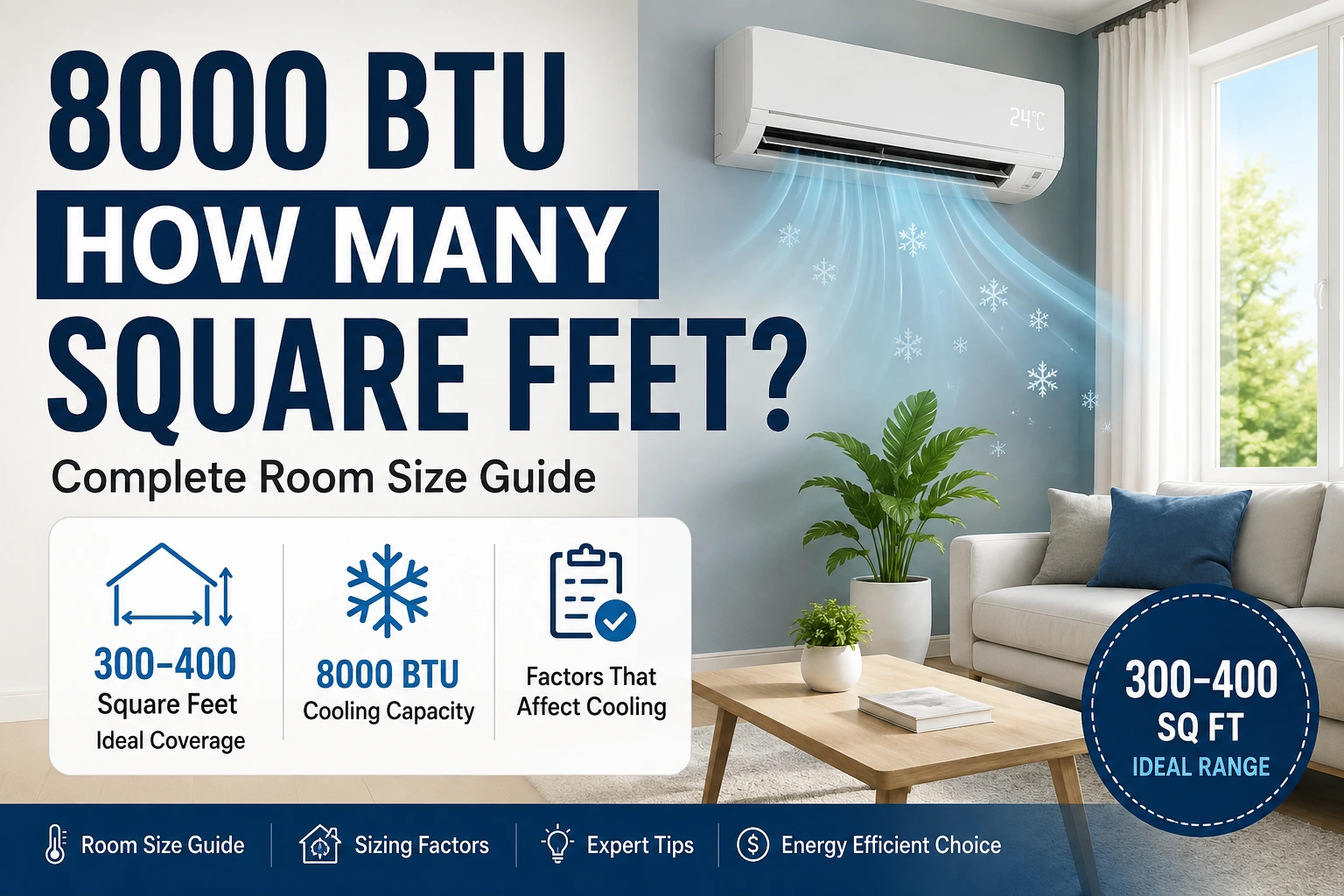
If you are wondering 8000 BTU how many square feet an air conditioner can cool, the general answer is around 300 to 400 square feet. However, room size is only one part of choosing the right air conditioner. Climate, sunlight, ceiling height, insulation, windows, room use, and the number of people inside can all affect cooling performance.
An 8000 BTU air conditioner is often a good choice for a medium sized bedroom, living room, home office, studio, or small apartment area. In a well insulated room with average ceiling height and limited direct sunlight, it can provide effective cooling without needing a much larger unit.
This guide explains exactly how much space an 8000 BTU air conditioner can handle, how to calculate your room size, when 8000 BTU may be too small or too large, and what factors should be considered before buying.
8000 BTU How Many Square Feet Can It Cool?
An 8000 BTU air conditioner can generally cool about 300 to 400 square feet under typical conditions.
For many standard rooms, approximately 350 square feet is a practical target.
Here is a simple reference table:
| Air Conditioner Capacity | Approximate Room Size |
|---|---|
| 5,000 BTU | 150 to 250 square feet |
| 6,000 BTU | 200 to 300 square feet |
| 8,000 BTU | 300 to 400 square feet |
| 10,000 BTU | 400 to 500 square feet |
| 12,000 BTU | 500 to 600 square feet |
| 14,000 BTU | 600 to 700 square feet |
These figures are general guidelines rather than fixed rules. A room with strong afternoon sunlight may require more cooling capacity than a shaded room of exactly the same size.
What Does 8000 BTU Mean?
BTU stands for British Thermal Unit. It is a measurement used to describe the amount of heat an air conditioner can remove from a space over a specific period.
An air conditioner rated at 8000 BTU has a cooling capacity designed to remove approximately 8000 BTUs of heat per hour under its rated testing conditions.
The higher the BTU rating, the more heat the unit can remove. However, choosing the highest BTU rating is not always the best solution.
An air conditioner that is too small may run continuously without reaching the desired temperature. A unit that is too large can cool the room quickly but may cycle on and off frequently, which can affect humidity control and comfort.
The goal is to match the cooling capacity with the room and its conditions.
How Many Square Feet Does an 8000 BTU AC Cool?
For a typical room, an 8000 BTU air conditioner is commonly suitable for approximately 300 to 400 square feet.
A few examples can make this easier to understand.
250 Square Feet
An 8000 BTU unit is likely to have more than enough capacity for a 250 square foot room under normal conditions. Depending on the climate and room characteristics, a smaller unit may be sufficient.
300 Square Feet
A 300 square foot bedroom, office, or living area can be a good match for an 8000 BTU air conditioner.
350 Square Feet
A 350 square foot room is close to the middle of the typical range. An 8000 BTU unit can work well if the room has average insulation, standard ceilings, and moderate sunlight.
400 Square Feet
An 8000 BTU unit may cool a 400 square foot space, but the conditions matter more at this size. A heavily sunlit room, poorly insulated space, or room with high ceilings may need greater cooling capacity.
More Than 400 Square Feet
Once the room becomes significantly larger than 400 square feet, an 8000 BTU air conditioner may struggle, especially in a hot climate. A larger capacity may be more appropriate.
How to Calculate Your Room Size
Before deciding whether an 8000 BTU air conditioner is suitable, calculate the actual square footage of the room.
The basic formula is:
Room Area = Length × Width
For example, suppose your room is 20 feet long and 17 feet wide.
20 × 17 = 340 square feet
That gives you a 340 square foot room, which falls comfortably within the typical range for an 8000 BTU air conditioner.
For an irregularly shaped room, divide the space into smaller rectangles, calculate each area separately, and then add them together.
Example of an Irregular Room
Suppose one section measures 15 feet by 12 feet.
15 × 12 = 180 square feet
A second section measures 10 feet by 12 feet.
10 × 12 = 120 square feet
The total area is:
180 + 120 = 300 square feet
An 8000 BTU air conditioner could be suitable for this space under normal conditions.
8000 BTU Room Size Chart
The following chart provides a quick way to compare room sizes with an 8000 BTU air conditioner.
| Room Area | 8000 BTU Suitability |
|---|---|
| 150 square feet | More capacity than usually needed |
| 200 square feet | More than enough in many situations |
| 250 square feet | Generally suitable |
| 300 square feet | Very suitable |
| 350 square feet | Very suitable |
| 400 square feet | Suitable in favorable conditions |
| 450 square feet | May be undersized |
| 500 square feet | Usually too small |
Remember that this is a practical guide, not a substitute for a professional cooling load calculation.
Factors That Change How Much Space 8000 BTU Can Cool
Two rooms with the same square footage can have very different cooling requirements.
Climate
Outdoor temperature has a major effect on air conditioner performance.
A room in a mild climate may require less cooling than a similarly sized room in an area that experiences extremely hot summers.
If temperatures regularly become very high, an 8000 BTU unit may have more difficulty cooling the upper end of its recommended room size.
Direct Sunlight
Rooms with large windows facing strong afternoon sunlight can become much hotter.
If your room receives intense sunlight for several hours each day, you may need additional cooling capacity or better window protection.
Blackout curtains, reflective shades, and quality window coverings can reduce heat entering the room.
Insulation
Good insulation helps keep cooled air inside and outdoor heat outside.
A well insulated 350 square foot room can be easier to cool than a poorly insulated 300 square foot room.
Check the walls, windows, doors, attic areas, and other locations where heat may enter.
Ceiling Height
Most room size recommendations assume a standard ceiling height.
If your ceiling is significantly higher than average, the room contains more air volume. This can increase the cooling requirement.
A room with a 12 foot ceiling may need more cooling than a room with the same floor area and an 8 foot ceiling.
Number of People
People produce heat.
A room occupied by one or two people may have a different cooling requirement from a room regularly occupied by five or six people.
This becomes particularly important in bedrooms, offices, meeting rooms, classrooms, and entertainment spaces.
Appliances
Televisions, computers, refrigerators, ovens, lighting, and other electrical equipment generate heat.
A home office containing several computers may require more cooling than an otherwise identical room with very few appliances.
Is 8000 BTU Enough for a Bedroom?
Yes, an 8000 BTU air conditioner can be suitable for many medium sized bedrooms.
For example, a 15 foot by 20 foot bedroom has an area of 300 square feet.
15 × 20 = 300 square feet
That falls within the common range for an 8000 BTU unit.
However, consider the bedroom’s location and exposure. A top floor bedroom with large west facing windows and poor insulation may need more cooling than a shaded bedroom on a lower floor.
For a smaller bedroom, such as 150 to 250 square feet, an 8000 BTU unit may provide more capacity than necessary.
Is 8000 BTU Enough for a Living Room?
An 8000 BTU air conditioner can work well for a living room around 300 to 400 square feet when conditions are favorable.
Living rooms often have more windows and people than bedrooms, though, so the cooling requirement can be higher.
If the living room has large glass doors, high ceilings, several occupants, or strong direct sunlight, consider those factors before selecting the unit.
An open plan area also requires special attention because the air conditioner may need to cool connected spaces rather than a single enclosed room.
Is an 8000 BTU AC Good for 500 Square Feet?
In most situations, 8000 BTU is not the ideal capacity for 500 square feet.
A 500 square foot space is above the common recommended range for an 8000 BTU air conditioner. The unit may run for long periods and still struggle to maintain the desired temperature, particularly during very hot weather.
A larger unit may be more appropriate, but the correct capacity depends on the room’s conditions.
If the 500 square foot area is divided into separate rooms, another solution may be more effective. Individual rooms can sometimes benefit from separate cooling units rather than trying to cool the entire area from one location.
8000 BTU Versus Other AC Sizes
Understanding the difference between capacities can make choosing an air conditioner easier.
| Capacity | Typical Application |
|---|---|
| 5000 BTU | Small bedroom or office |
| 6000 BTU | Small to medium room |
| 8000 BTU | Medium room or living area |
| 10000 BTU | Larger room |
| 12000 BTU | Large room or open area |
| 14000 BTU | Very large area |
These ranges overlap because room conditions vary.
An 8000 BTU unit is often attractive because it sits between smaller units intended for compact spaces and larger units designed for bigger rooms.
Window AC, Portable AC, and Other Differences
Not every air conditioner rated at 8000 BTU should be compared in exactly the same way.
Window air conditioners generally place the heat rejection system outside the room through the window installation.
Portable air conditioners operate differently. Some models use a single hose while others use two hoses, and their real world cooling performance can vary.
When comparing portable air conditioners, look at the manufacturer’s stated cooling capacity and testing standard rather than relying only on the number printed on the product.
For a buying decision, check the product label, room size recommendation, energy efficiency information, and installation requirements.
Common Mistakes When Choosing an 8000 BTU Air Conditioner
Choosing Based Only on Square Footage
Square footage is important, but it is not the entire calculation.
Ignoring sunlight, insulation, ceiling height, climate, and occupancy can lead to poor results.
Buying the Biggest Unit Available
A larger air conditioner is not automatically better.
Oversizing can lead to short cooling cycles and less effective moisture removal. Comfort depends on both temperature and humidity.
Ignoring Windows
Large windows can introduce substantial heat into a room. Window coverings can help, but the underlying cooling requirement still needs to be considered.
Forgetting Open Doorways
If the room is connected to a hallway, kitchen, stairway, or another open area, the air conditioner may effectively be cooling more space than the measured room.
Ignoring Energy Efficiency
Two units with similar cooling capacity can have different operating costs.
Look at the energy efficiency rating and estimated annual energy use when comparing models.
How to Make an 8000 BTU AC Work More Efficiently
If your room is close to the upper end of the recommended range, several practical steps can improve comfort.
- Keep doors and windows closed while the AC is operating.
- Use curtains or blinds to reduce direct sunlight.
- Seal noticeable gaps around windows and doors.
- Clean or replace filters according to the manufacturer’s instructions.
- Keep the outdoor or exhaust area clear where applicable.
- Avoid unnecessary heat producing appliances during the hottest part of the day.
- Improve insulation where practical.
- Set the thermostat to a comfortable temperature instead of an extremely low setting.
These steps do not increase the actual BTU capacity of the air conditioner, but they can reduce the amount of heat entering the room and help the unit perform more effectively.
A Simple Way to Decide If 8000 BTU Is Right for You
Use this quick process.
Step 1: Measure the Room
Measure the length and width.
Step 2: Calculate Square Footage
Multiply the length by the width.
Step 3: Check the Basic Range
If the room is around 300 to 400 square feet, an 8000 BTU air conditioner may be a suitable starting point.
Step 4: Check Room Conditions
Consider sunlight, insulation, ceiling height, climate, windows, occupants, and appliances.
Step 5: Check the Manufacturer’s Recommendation
Always compare your room with the manufacturer’s stated room size guidance before buying.
Step 6: Consider a Professional Load Calculation
For a large, expensive, unusually shaped, or permanently cooled space, a professional cooling load assessment provides a more accurate answer.
Expert Tips for Choosing the Right BTU
If you are close to the boundary between two capacities, do not automatically choose the larger unit.
Instead, examine the conditions of the room.
A shaded and well insulated 400 square foot room may perform differently from a poorly insulated 400 square foot room exposed to intense sunlight.
Also consider how the room will be used. A bedroom occupied by one or two people has different heat loads from a home office containing multiple computers or a living room frequently occupied by several people.
Finally, follow the manufacturer’s installation instructions. Even a correctly sized air conditioner can perform poorly if it is installed incorrectly or if airflow is restricted.
Frequently Asked Questions
How many square feet will an 8000 BTU air conditioner cool?
An 8000 BTU air conditioner will generally cool about 300 to 400 square feet under typical conditions. Actual performance depends on climate, insulation, sunlight, ceiling height, windows, and occupancy.
Is 8000 BTU enough for 400 square feet?
It can be enough for 400 square feet when the room has average or favorable conditions. Strong sunlight, poor insulation, high ceilings, or very hot weather can increase the cooling requirement.
Can an 8000 BTU AC cool 500 square feet?
An 8000 BTU air conditioner is generally not the best choice for 500 square feet. A larger capacity may be needed, particularly in a hot climate or poorly insulated space.
Is 8000 BTU too much for a 200 square foot room?
It may be more capacity than necessary for a 200 square foot room under normal conditions. A smaller air conditioner could potentially provide adequate cooling while using less energy.
How do I calculate the BTU needed for my room?
Start by calculating the room’s square footage using length multiplied by width. Then consider climate, sunlight, insulation, ceiling height, windows, occupants, and heat producing appliances. Manufacturer sizing guidance or a professional cooling load calculation can provide a more precise result.
Conclusion
So, 8000 BTU how many square feet can it cool? In general, an 8000 BTU air conditioner is suitable for approximately 300 to 400 square feet, with around 350 square feet being a useful middle point for many standard rooms.
However, square footage should not be the only factor in your decision. A room with strong sunlight, poor insulation, high ceilings, many occupants, or several heat producing appliances may require more cooling capacity.
For the best result, measure your room, calculate its square footage, consider the room conditions, and compare the result with the manufacturer’s recommendations. Choosing the right size helps maintain comfort, control humidity, and avoid unnecessary energy use.
Discover more